INITIATION CEREMONIES AND CUSTOMS
CHAPTER VII
I. THE NAOJOTE [Navjote]. THE INITIATION OF A ZOROASTRIAN CHILD INTO THE FOLD.
Two kinds of initiation.
By initiation, we mean an introduction into a certain religious
organization. by the performance of certain
rites and ceremonies. Of this kind of initiation,
the Parsees have two: (i) The Naôjote [navjote),
which is the initiation of a Parsee child into the fold of the
Zoroastrian religion. (ii) The Nâvar [nawar] and the Martab, the two
grades of initiation into Priesthood. We will at first speak
of the Naôjote or the initiation of a child into the religion
through investiture with a sacred shirt and thread [sudre and kusti].
2. Op. cit., Vol. I., Part I., page 53.
Naojote [navjote]. Meaning of the word.
The ceremony of investing a child with sacred shirt and thread [sudre and kusti]
is called Naojote.3 A Zoroastrian may put
on any dress he likes. He may dress as an European, Hindu, Mahomedan or as a
person of any nationality, but he must put on the sudre
and kusti, i.e., the sacred shirt and thread as visible symbols
of Zoroastrianism. The word Naôjote is made up of two words,
Pahlavi naô [...] (Avesta nava, [...] Sans. [...] P. [...]
Lat. novus, Germ. neu, Fr. neuf) 'new' and zôt ([...] Av. [...]
nom. [...] sans. [...]) i.e. one who offers prayers, from zu
[...] (Sans. hu [...]) to offer prayers. The initiation is so named,
[179]
because, it is after its performance, that a Zoroastrian child is
said to be responsible for the duty of offering prayers and
observing religious customs and rules as a Zoroastrian.4 The
ceremony of Naojote among the Parsees corresponds to that of
Confirmation5 among the Christians.
4. Some take the word Naôjote to be another form of Naôzâd, i.e. a new birth. meaning thereby, a spiritual birth. After going through the ceremony, the child undertakes some moral or spiritual responsibility. Hence the word (West S.B.E. XXIV. chap. V, n. 1. p. 262). The Shayest Ne-Shayest speaks of it as navid zâdih (Dr. M. B. Davar's ed., p. 72, l. 1. Chap. XIII, 2) i.e. new birth.
5. "The word 'confirm' is found frequently in both the Old and the New Testaments in various shades of meaning, but with the general sense of strengthening and establishing" (Hasting's Dictionary of the Bible). It is worth noting in connection with this meaning, that one meaning of zu, the Avesta root of the word zaotar is "to be strong" (Sans. P.).
The age for this investiture.
Seven is the age at which it is enjoined to initiate a child.
According to Herodotus (I, 136) and Strabo
(Bk. XV, chap. III. 18). the ancient Iranians
commenced the education of their children
at the age of five. It seems that a part of that education was
religious education which prepared them for this ceremony of
investiture. Plato (First Alcibiades 37) gives the age of education
as seven. This then must be the age of the regular
commencement of secular education after the religious investiture
with the sacred shirt and thread [sudre and kusti]. The Vendidad
(XV. 45) and the Dinkard (Vol. IV, chap. 170)6 support
Plato's statement. In case a child is not sufficiently intelligent
to understand the ceremony and to know its responsibilities,
it is permitted that the ceremony can be postponed
to any age upto fifteen, at which age the investiture must
take place. If the ceremony is not performed and if the
child is not invested with the sacred shirt and thread [sudre and kusti] at or
before the age of 15, the child is said to be claimed by the
[180]
Druj as7 her own. The Vendidad (18:31, 54) represents
the evil Druj as claiming four kinds of men as her own.
Among these, the fourth kind is that of persons who,
having passed the age of 15, go about without the sacred shirt and
thread [sudre and kusti]. The Druj says: "He assuredly is the fourth of my
those (i.e. above class of) men, he, an ill-behaved man, who,
after (the age of ) fifteen years, moves about without the sacred thread
and shirt."8 The Sad-Ddar {Chap. 10:1) says that "it is
incumbent on all Behedins,9 (whether) males or females, who
attain the age of 15 years, to bear the sacred thread, because the
sacred thread is the waist-belt of humility and the symbol for
preserving obedience to God, may He be honoured and
respected."10 If one moves about without the sacred shirt
and thread after the age of fifteen, he is said to commit the
sin of vashâd dobârishnih or kushâd davârashni11
(i.e. running about uncovered or naked.)
7. Av. druj, one who does harm, deceives, speaks lies. This is personified as a female evil power.
8. Vd. 18:54.
9. i.e. Zoroatrians. Lit. members of the good religion.
10. Sad-Dar Nasar (Chap. 10:1). Edition of Mr. B. N. Dhabhar, p. 9. According to the 46th Chapter of this book, the period of 15 years includes the nine months of the child being in the womb of the mother. Thus, the latest permissible age for the initiation is 14 years 3 months. Vide also the Shayest Ne-Shayest, Chap. 10:13. It also gives the age as 14 years and 3 months (Dr. M. B. Davar's ed., p. 51). S.B.E. Vol. V. (1880) p. 321.
11. Menog-i Khrad 2:35. Vide Ervad Tehmuras's Edition with my Introduction, p. 12, l. 9 (S.B.E, Vol. XXIV, p. 11); Viraf-nameh 25:6; Patet 10.
With the age of the child, at which it is to be invested with the
sacred shirt and thread, begins the responsibility of the parents
to give a good religious and moral education to their children.
It is enjoined, that good religious and moral education should be
given to a child at an early age. According to the Pahlavi Ganj-i Shayagan
and the Shayest Ne-Shayest, the parents are held
[181]
responsible, if they fail in this duty and if the child in consequence
commits a bad action. On the other hand, the parents
are believed to take a share in the meritoriousness, if the child,
by virtue of the religious and moral education given to it,
does a religious act.12
Sudre, i.e., the Sacred Shirt. Meaning of the word. Its Structure and Symbolism.
The ceremony of Naojote consists of the investiture of the
child with sacred shirt and thread. Before
speaking of the investiture itself, I will
first speak of this shirt and thread and of
their symbolism.
The shirt is called Sadreh, Sudre, or Sudreh. Anquetil Du Perron
says, that the word "sadreh" comes from Zend "setehr paéschenghé,
which means "useful clothing."13 Dastur Edalji Darabji Sanjana
also derives the word similarly,14 and says that
the word sud-reh means "an advantageous path." Dr. West15
takes the word to be Persian "sud-reh" meaning an advantageous
path. Some derive the word from Avesta "vastra," meaning
'clothing' and say that the word "sadreh" is formed by
dropping the first letter "v."16 Mr. K. E. Kanga thinks that
the word is Arabic sutrah, i.e. anything which covers or
protects (the body).17 The Dadestan-i Denig18 speaks of it as
pirâhan (Pers. shirt). The Pahlavi Vendidad19
[182]
speaks of it as shapik. It also speaks of it as
tashkuk.20 A Persian gloss of the word is given as
sudreh.21
14. Mojejâti Zarthoshti, p. 10.
15. S.B.E. Vol. V, p. 286.
16. The Zend Avesta par Darmesteter II, p. 243 n. 13. As an instance of a similar dropping of "v" "we have the case of Vîrs Sans. vir Lat. vir, which has given us the Pers. yal i.e., hero."
17. He wrote of this in a letter to me.
18. Question 39:1. Ervad Tehmuras's Text, p. 125, l. 2.
19. Chap. 18:7. Dastur Hoshang's Text, p. 566. Dastur Dr. Hoshang says, that it is the same as Pers. [...] a night shirt (ibid. Vol. II Glossarial Index, p. 209.) Anquetil Du Perron (Tome II, p. 529) takes the Pahlavi word to be Chev. In that case, it is the same as Pers. [...] below, i.e., the garment below the kusti.
20. Pahl. Vend. 17:1. Dastur Dr. Hoshang's Text, p. 561, l. 12.
21. Ibid, note 17.
The sacred shirt and thread are symbolic in their structure.
The symbolism is explained not in the Avesta, but in later Pahlavi
and Persian books. Some of the symbolism is explained in the
Dadestan-i Denig (Ques. 39, Chap. 40). The Persian Sar-nâmeh-i-râz i Yazdâni
also refers to it. The shirt is made up of white
cambric, the white colour being symbolic of innocence, and as
such, the symbol of the Mazdayasni religion.22 The Dadestan-i Denig
enjoins that the shirt should be pure white23
and of only one fold,24 not double. The reason for the shirt
to be of only one fold is said to be that Vohuman (Bahman)
is "one creation" which is the first (ayôk dâm i fartûm).25 The
word Vohû-mana being variously used, the signification is not
clear, but what is meant seems to be this, that the whiteness of
the shirt is supposed to influence for good one's mind. Again,
the shirt must not be made up of one continuous piece of cloth
but of two pieces sewn together on the sides, so that one piece
may be on the right hand side, and the other on the left hand
side, thus dividing the shirt into two parts, the front and the
back part. These two parts — the front and the back — are said
to be symbolic of the past and the future, both being related
with each other through the present. It has an opening for
the head and reaches down to the knees.
23. "Darûst sapit" (Ervad Tehmuras's Text, p. 125, ll. 5-6). Ques. 39 S.B.E. XVIII, Chap. 40, p. 133.
24. Ayôtâk, ayôkardeh. Ibid.
25. Ibid.
The most important part of the shirt is the gireh-bân (lit.
that which preserves the knot), which signifies loyalty to, or faith
[183]
in, the religion. The Gireh-bân is known as the "kisseh-i-kerfeh,"
i.e., "the purse or the bag of righteousness." It is made in the
form of a bag or purse, which rests a little below the throat. It
indicates symbolically that a man has to be industrious, and
has not only to fill his purse or bag with money, but also with
kerfeh (righteousness). The Shayest Ne-Shayest enjoins,26 that
the sacred shirt should be put next to skin, i.e., there should
be no other garment under it.27 Thus, the sudre is a symbol
that reminds one of purity of life and righteousness.
27. Cf. Jeremiah 13:11, where the waist-cloth or the girdle or linen is enjoined always to "cleave to the loins", i.e., to be "worn next the skin," which process of wearing signified "righteousness and faithfulness." (Isaiah 11:5). The sudre, to a certain extent, corresponds to "the linen ephod" of the priest (1 Samuel 2:18.)
Kusti or the sacred thread. Meaning of the word. Its structure and symbolism.
The Avesta word for the sacred thread is "aiwyaonghana,"
lit. to gird round the body. Kûsti is
its Pahlavi rendering. The word Kusti
is variously derived. (a) It may be
derived from Pahlavi kust [...]
meaning "direction or side." Thus, the word kusti may mean
"that which points out the proper direction or path." Sudre
(the sacred shirt) indicates the advantageous path, and kusti
(the sacred thread) indicates the proper direction to proceed
on that path. Talting the same derivation, kusti may mean,
"a badge distinguishing those who are on the side (kust) of
(i.e., who believe in) Zoroastrianism." (b) Some derive the
word from kosht waist, and say that it is so called
because it is put on the waist.28 (c) Again kosht also means
"limit or boundary," so kusti may mean "that which keeps
us, or reminds us to keep ourselves, within proper limits or bounds."
The Sudre being, as said above, "the advantageous
[184]
path of righteousness," the kusti, which is put
over it, is "that which confines us or keeps us within the
limits of that path of righteousness." The Avesta word for
kusti, viz., aiwyaonghana, which literally means "to sit round
or to limit," renders this derivation probable. (d) Again,
some take this word kusti to be kishti, i.e., a ship, and say
that it signifies that, like a ship, it carries us to the safe haven
of righteousness. Whatever derivation we take, the kusti
symbolizes and indicates a direction in the path of righteousness.
The kusti is made up of lamb's wool. The wool is at first
combed and then spun into fine thread on a hand-spindle called
châtri. Two such long threads are prepared on two spindles or
châtris, and are then twisted into one. This thread is then
woven into the kusti on a hand-loom called jantar,
the ends of which are movable, so that it can be
adjusted to the length required. The twisted thread is passed
round the loom 72 times; so, the kusti consists of 72 threads,
divided into six strands, each of twelve threads. A continuous
thread is made to pass, in the process of weaving, through
each of the six strands. When the weaving is almost finished,
and when about a foot of the threads remain to be woven, the
whole thread is removed from the loom and handed to a priest
to be cut and consecrated. It is the privilege of the women
of the priestly class to weave and prepare a sacred thread,
and it is the privilege of a priest to cut and consecrate it.
To consecrate the thread, the priest first performs the
padyab kusti. He then recites the Srosh baj29 as far as the
word Ashahê. He next recites the nirang (the liturgical formula)
for cutting and consecrating the thread. followed by
the Ashem Vohu and
Yatha aha vairyo [Ahunwar].30
While reciting the latter, he cuts the kusti into two parts as he utters the word
[185]
shyaothnanam. On finishing the Yatha ahu vairyo, he utters in
baj (i.e. in a suppressed tone) the brief Pazand formula of
sraosh ashô tagi tan farman,31 and then finishes the baj. The women
who prepare the kusti, generally get it cut and consecrated
by the male priest members of their own families. When
they have no such members and have therefore to get it consecrated
by other priests, they have to pay a small fee for it.
After this consecration, the kusti is returned by the priest to
the owner, who now completes its weaving. First, by means of a
needle, she turns the kusti, which is hollow, inside out, and then
knits by hand the remaining part of the thread. Three tassels
(lari),32 each of 14 threads, are formed at each end of the
woven thread. The kusti is then finally washed before being
used.
30. Yasna 27:14 and 13 respectively.
31. Srosh yasht, Yt. 11, (Darmesteter. Le Zend Avesta II, p. 482. "Vienne Srôsh ... Ormazd.")
32. Pers. lar. ("thin").
The kusti, being prepared from the wool of a lamb, which is
considered to be an emblem of innocence and purity, is held to
remind a Zoroastrian of the purity of life which he has always
to observe. The 72 threads composing the kusti, symbolize
the 72 has or chapters of the Yasna. The 24 threads, which make
up each of the three tassels at each end of the kusti, symbolize
the 24 Kardahs or sections of the Visparad, a part of the
liturgical prayer; the six strands, each of twelve threads, into
which the 72 threads of the kusti are divided at the time of
weaving, are said to symbolize the six religious duties33 of a
[186]
Zoroastrian; the twelve threads in each of the six strands
symbolize the twelve months of the year; the six tassels symbolize
the six season festivals (Gahambars) of a Zoroastrian
year; the hollow of the thread symbolizes the space between
this world and the next; the doubling of the thread in the beginning
symbolizes the connection between the present corporeal world and
the future spiritual world; the turning of the kusti inside out
symbolizes the passage of the soul from the corporeal to the spiritual world;
the final uniting of all the threads into one symbolizes universal brotherhood
or union. Though we have not the authority of Avesta books for an explanation
of the symbolism of all the parts of the kusti, there is no doubt, that its
structure had some symbolic signification from very ancient times. It symbolizes
some moral precepts or ideas, just as the Janôi or the sacred thread
of the Brahmins and the cord worn by the Franciscan fathers round their
waists do. The Sudre and Kusti of the Parsees may remind one of
the white garment and girdle of the Essenes, a Jewish sect.34
The Sad-Dar (Mr. B. N. Dhabhar's ed. p. 6 , Chap. 6:2; S.B.E. XXIV, p. 264), and the Menog-i Khrad (Chap. IV, 8. B. E. XXIV. p. 26, Ervad Tehmuras's Text, p. 36 Ques. 3) give a slightly different list. The Sarnâmeh-i-râz-i Yazdâni, a much later Persian book, gives a slightly different enumeration. (Vide the Persian-Gujarati edition of 1255 Yazdazardi, by Mr. Pallonji Jivanji L. Hâtariâ, Persian text, pp. 38-40).
34. Josephus.— The Antiquity of the Jews, translated by W. Whiston (1811), Vol. III, p. 444. Bk. II, Ch. 8:7.
Just as the cross is said to have existed as a symbol from
times anterior to Christ, though Christ's crucifixion added to
its signification, so the kusti is said to have existed as a symbol
before Zoroaster. It was Jamshed of the Peshdadian dynasty
who is said to have introduced it.35 Zoroaster is said to have
confirmed this previous custom of putting on the kusti,
[187]
am also directed that it may be put on over a saored shirt
(vohumanich vastarg) and with a recital of religious formulae
(dînîk niranghâ).36 He held it to be a symbol of the necessity
of (a) obedience to God, (b) closing up the door against sin and
(c) breaking up the power of destruction.
36. Dadestan-i Denig, Chap. 39:19, Tehmuras's Text, p. 120, Ques. 38:22.
It is enjoined, that, excepting the time of bathing, a Zoroastrian
must always bear the sacred shirt and thread. The thread
is to be untied and retied during the day on the following
occaaions:— (1) immediately after leaving bed in the morning;37
(2) every time after answering a call of nature; (3) before saying
prayers; (4) at the time of bathing; (5) before meals. A
modern Parsee sometimes neglects to do so on the first and fifth
occasions, but he generally does so on the second, third, and
fourth occasions. The Dadestan-i Denig says,38 that, from times
immemorial, men turn towards light at the time of performing
the kusti ceremony as it is connected with a form of prayer.
38. Chap. 39.
The first thing that one has to do on these occasions (except
the first) is to perform what is called pâdyâb [padyab]39 or ablution. It
consists of washing the face and other uncovered parts of the
body like hands and feet with pure water and after reciting a
short prayer-formula.40 Then he has to face the sun. If he is
within the house and if the sun is not visible, he has to stand
facing the east in the murning up to 12 o'clock noon, and facing
the west from 12 o'clock to night-fall. At night, he has to face
a lamp or the moon. If there is no moon or lamp, he may face
[188]
the stars. We will, later on, while speaking of the investiture by
the priest, describe in detail the process of putting on the kusti.
40. Khshnaôthra Ahurahê Mazdâo Ashem Vohu, i.e., May God be pleased. Piety is the best good and happiness. Happiness to him who is pious for the best piety.
As to its symbolism the kusti is a kind of belt. "Kamar-bastan" i.e.,
"to tie the waist" or "to put on the belt" is a
phrase which has come to mean "to be ready to serve, to be
prepared for a work." So the Dadestan says, that the putting
on of the kusti on the waist,4l symbolizes one's readiness to serve God.
The knots of a kusti.
While putting on the kusti, one has to fasten it with two
knots, one in the front and another on the
back. Knots, which signify firmness and
resolution, symbolize here resolutions about
certain, religious and moral thoughts. While forming the first
half of the first knot in the front on the second round of the
thread, a Zoroastrian has to think that Ahura Mazda exists,
that He is one, is holy and is matchless. While forming the
second half of this first knot, he has to remember that the
Mazdayasnian religion is the word of God and that he must
have full faith in it. In the third round of the thread, while
forming the first half of the second knot at the back, one has
to remember that Zoroaster is the Prophet of God, and that he
is our guide to show us the proper path of worship. While
forming the second half of the second knot, he is to bear in
mind that he has always to attend to "good thoughts, good words, and good deeds."42
Symbolic signification of the kusti, as given in the Pahlavi Datestan-i Denig.
The Dadestan-i Denig (Chap. 39, Pursishna 38)
dwells at some length on the symbolic signification
of the kusti. The purport of what
it says is this:— Firstly, God wishes that
man should serve Him and should follow
[189]
His path. Now, there are certain conventional ways in which
a man shows his service or obedience to God. For example,
he falls on his knees in his prayers; he lowers his head and
bows; he raises his hands towards Heaven. All these ways or
rites, which symbolize service or obedience or homage to God,
are done occasionally. But the kusti is a standing symbol
to signify permanently a man's readiness to serve God.
As a kind of kamar-band or belt, put on in a solemn way
with religious meditation and prayer, it reminds a person
of his perpetual obligation to stand in the service of God.
Whenever a Zoroastrian sees this kusti, this band or belt
on his waist, he has to consider it as a badge of service and
to say to himself "I am the servant (bandah) of God."
Secondly, a person puts on a badge or belt of service and
stands before his superior to receive his orders. Thus, the
sacred belt or kusti reminds a man of humiliation before God,
and of his readiness to receive His orders. Thirdly, the
kusti is a kind of a band, i.e., a kind of a shutter. A shutter
shuts up a thing, so that neither outside influence may affect
that thing nor that thing's influence affect an outside thing.
So, by putting the band of a kusti, a Zoroastrian, while reciting
the words manashni, gavashni, and kunashni, i.e., thoughts, words, and deeds,
and putting on the knots on the thread,
resolves to let no outside evil influence enter into his mind and
affect the purity of his thoughts, words, and deeds, and not to
let that purity of thoughts, words, and deeds leave his mind.
Fourthly, we learn from the Dadestan-i Denig, that the kusti
reminds one to have a high ideal of character before his mind.
The waist over which the kusti is fastened, divides our physical
body into three parts, the higher, the middle, and the lower.
The upper or the higher part of our body is the seat of heart and brain
which typify higher characteristics. The lower part, which contains
organs like the stomach which always require
something to feed it, typifies lower characteristics of appetite,
thirst, lust, etc. So, the kusti being tied on the middle portion
of the body, viz., the waist, and acting as a band or stopper, must
[190]
remind us not to let the lower passions rise above and suppress our higher
characteristics.43
The ceremony of Naojote.
Having described the preparation and the consecration of
the shirt and thread, and having explained
their symbolism, we will now describe the
Naojote ceremony itself, wherein a priest
puts over the child the sacred shirt and thread.
Preparation before the Investiture proper. Sacred bath. Ceremonial requisites.
As a qualification of fitness to go through this ceremony,
the child is expected to know a few short
prayers. Of these, the knowledge by heart
of the Nirang-i kusti (i.e., the prayer for
the sacred thread) is indispensably necessary,
because it is required to be recited whenever the sacred thread
is to be untied and fastened again, on certain occasions
during the day, of which we have spoken above, This Nirang-i kusti
is made up of the following three prayers:— (1) Kem-na-Mazda;44
(2) Nirang-i-kusti or Ahura Mazda Khodae;45 (3) Jasa me avanghe Mazda,
Mazdayasno ahmi.46
[191]
Besides this prayer of Nirang-i-kusti, the prayers known as
Nirang-i-ab-i Zar or Nirang-i Gaomez, Srosh-baj, and Patet,
were, at one time, expected from a Zoroastrian child, to be
known by heart for the Naojote ceremony. But now-a-days
they are not deemed absolutely necessary.
45. This is a prayer in the Pazand language. For the text of this prayer in the Avesta character, vide Khurdeh Avesta in Zend Characters by Ervad Tehmuras Dinshaw Anklesaria (1887). pp 23-26, and Khurdeh Avesta by Mr. Framjee Minocherji Dastur (1881) pp. 5-7 For its translation, vide S.B.E., Vol. XVIII, p. 384; Le Zend Avesta, par Darmesteter, Tome II, p. 685; and Spiegel, Bleeck's Translation, Vol. of Khordeh Avesta, p. 4.
46. This short prayer, which forms, as it were, a short statement of the Zoroastrian Articles of Faith or Confession of Faith, is taken from Yasna 12:9. The first four words meaning "Oh God, come to my help " are added as an invocation, from Ohrmazd Yasht, Yt. 1:27.
On the day fixed for the investiture, a little before the time
of the ceremony, the child is made to go through a sacred bath
or a kind of purification known as nahn.47 Upto a few years ago,
it was customary that the child should abstain from any kind
of food in the morning until after the investiture. This was
considered as a little sacrifice on the part of the child to testify
its faith in the importance and value of the ceremony.
Upto a few years ago, the ceremony was always performed
in the morning, but now it is performed in the evening also
according to the convenience of the parties. The very fact, that
it was enjoined that during the course of the ceremony the
officiating priest must recite the dawn (Hoshbami48) prayer,49
shows, that it was thought necessary that the ceremony should be performed in the morning.
48. Pahl. [...] Av. usha, Sans. [...], Lat. aurora, and Av. bâmya Pers. bâm brilliant.
49. For the prayer vide Spiegel (Bleeck's Translation), Khordeh Avesta, pp 5; Darmesteter, Le Zend Avesta, Vol. II. p. 688.
After the sacred bath, the child is taken to a room where the
parents and their relations and friends, and the officiating priest
with one or more other priests have assembled. The upper part
of its body, which is to be covered with the sacred shirt at the
hands of the officiating priest, is covered over with a sheet of
white cloth that can be easily removed. The child is made to
sit on a low wooden stool covered over with a sheet of white
cloth, in front of the officiating priest, who sits on a carpet on the
floor. The child is made to sit facing the East. The following
requisite things are placed on the carpet:— (1) a tray
[192]
containing a new set of clothes for the child, including a new
sacred shirt and thread; (2) a tray of rice known as akhiâna
which, at the end of the ceremony, is presented to the family
priest; it is a remnant of the old system, when there was a
payment in kind as well; (3) a tray of flowers which are
presented at the end to the assembled priests, friends, and
relations; (4) a lamp, generally a lamp fed with clarified butter:
there may be additional candle-sticks burning; (5) fire, burning
on a censer with fragrant sandalwood and frankincense;
(6) a tray containing a mixture of rice, pomegranate grains,
raisins, almonds, and a few slices of cocoanut, to be sprinkled,
later on, by the priest over the child as a symbol of prosperity,
the first tray, containing the suit of clothes, also contains some
betel leaves and areca nuts,50 a few pieces of sugar candy, a few
grains of rice, a cocoanut, a garland of flowers, a metallic cup
containing kûnkûn (a kind of red powder) and a few rupees.
All these things have nothing to do with the religious part of
the ceremony, but they are considered in India as emblems of good luck.
All these are presented by the priest, later on, to the child. The money
is, at the end of the ceremony, taken by the family priest as a
part of his fee, and is spoken of as the fee for the giryân or girehbân.51
51. Vide above, p. 183, for the word.
The investiture proper.
When all the priests have taken their respective seats, the
head officiating priest, who is seated face
to face with the child, gives in the hand of
the child a new sacred shirt. They all
then recite the Patet, or the atonement prayer. The child
also recites the prayer or its special sections, if it knows
these by heart; but generally, it recites the Yatha Ahu Vairyo
prayers in its stead. In some families, recently, instead of
the Patet, the Ohrmazd Yasht is recited. Having finished
[193]
this, the officiating priest gets up from his seat and the child
stands before him. Then follows the investiture proper which
is made up of the following four parts:— (1) the recital of the
Confession of Faith by the child, followed immediately by the
putting on of the sacred shirt by the priest; (2) the recital
of the Nirangi-i kusti with a preliminary introduction from the
introductory part of the Ohrmazd Yasht (Yasht 1) upto
the words vîdhvao mraotû, accompanied with the girdling of
the kusti or sacred thread by the priest over the sacred shirt;
(3) the final recital of the Mazdayasno Ahmi (Yasna 12:8-9)
formula of the Articles of Faith; (4) the recital of the Tan-darosti
or the final benediction.
1. The recital of the Confession of Faith, and the investiture with the Sacred Shirt.
The first part of the investiture consists in presenting to the
child the sacred shirt, after making it recite
the Confession of Faith. This prayer of the
Confession of Faith is made up of two parts:
(a) The Avesta khshnuman of the Yazata [yazad]
Din, who presides over Religion (Din Yasht. Yasht 16).52 (b) A
Pazand formula of the Confession of Faith [Din-no Kalmo].53 The confession
made up of these two parts runs as follows:— "Praised be the
most righteous, the wisest, the most holy and the best Mazdayasnian Law,
which is the gift of Mazda. The good, true, and
perfect religion, which God has sent to this world, is that which
Zoroaster has brought. That religion is the religion of Zoroaster,
the religion of Ahura Mazda communicated to holy Zoroaster."
It ends with the recital of an Ashem Vohu prayer.
53. Spiegel, translated by Bleeck. Khordeh Avesta, p. 191.
On the child making this public declaration of its faith in the
Zoroastrian Mazdayasnian religion, the priest clothes it with
[194]
the sacred shirt. While putting it on, he recites the sacred
formula of Yatha Ahu Vairyo, and the other priests join him in the recital.
2. The recital of Nirang-i kusti and the investiture with the sacred thread.
Then the officiating priest stands at the back of the child and
both face the east if it is morning, and
the west if it is evening. He at first
recites the introductory part of the Ohrmazd Yasht (Yasht 1)54
and then the Nirang-i kusti.55 The substance of this prayer of Nirang-i kusti runs thus:
"The Omniscient God is the greatest Lord. Ahriman is the evil spirit, that
keeps back the advancement of the world. May that Evil Spirit with all his
accomplices remain fallen and dejected. O Omniscient Lord, I repent of all my sins;
I repent of all the evil thoughts that I may have entertained in my mind, of all the
evil words that I may have spoken, of all the evil deeds that I may have done. May
Ahura Mazda be praised. May the Evil Spirit Ahriman be condemned. The will of the
Righteous is the most praiseworthy."
55. Ibid, p. 4.
The process of putting on the kusti over the body is as follows:—
The priest holds the kusti from its middle or central part in his left hand.
Then he holds in his right hand a part of the two strings of the thread so
formed. A part of the double strings is thus held horizontally between the two
hands and the remainder hangs down vertically. This posture continues upto
the recital of the words "manashni, gavashni, kunashni" in the
Nirang-i kusti. With the recital of these words a part of the
strin is then formed into circular curves in both the hands.
Then, on reciting the words Khshnaothra Ahurahe Mazdao,
the curves are let loose, and with the recital of Ashem Vohu,
the thread is passed round the child's waist. With the recital
of the first Yatha Ahu Vairyo, the second round is completed,
[195]
the first knot in the front being tied with the recital of tho word
shyaothananâm. With the recital of the same word in the
second recital of the Yatha Ahu Vairyo, the second knot in the front is tied,
and then, with the recital of another Ashem Vohu, the thread is passed round the
waist for the third time and the final two knots at the back are tied. This
completes the investiture of the sacred thread. During this
investiture, the child recites with the officiating priest the
Nirang-i kusti.
3. The Recital of the formula of the Articles of Faith.
The child, after being thus invested with the sacred shirt and
thread, announces the last and the most
important part of the Articles of Faith, given
in the 12th chapter of the Yasna. It runs
thus: "O Almighty! Come to my help. I am a worshipper of God. I am a
Zoroastrian worshipper of God. I agree to praise the Zoroastrian religion,
and to believe in that religion. I praise good thoughts, good words, and good deeds.
I praise the good Mazdayasnian religion which curtails discussions and quarrels,
which brings about kinship or brotherhood, which is holy, and which, of all
the religions that have yet flourished and are likely to flourish in the
future, is the greatest, the best and the most excellent, and which is the
religion given by God to Zoroaster. I believe that all good things proceed from God.
May the Mazdayasnian religion be thus praised."
The most important part of these short prayers is that, wherein the child is made to believe in the efficacy of one's own good thoughts, words and actions. A Parsee has to believe that, for the salvation of his soul, he has to look to himself. For his salvation, he has to look to the purity of his thoughts, the purity of his words, and the purity of his deeds. The pivot on which the whole of the moral structure of Zoroastrianism turns, rests upon this triad of thought, word, and deed. Think of nothing but the truth, speak nothing but the truth, do nothing but what is proper, and you are saved. [196]
4. The final Benediction.
The putting on of the sacred shirt and thread and the declaration
of the Articles of Faith complete the
ceremony proper. The officiating priest
now makes a red kunkun mark on the
child's forehead — a long vertical mark if the child is male, a
round mark if female — and then gives in its hands, the cocoanut,
flowers, betel leaves, areca nuts, etc., referred to above. There
only remains now the recital of the Tandarusti or benedictions
by the officiating priest, invoking the blessings of God upon the
new initiate. He says: "May you enjoy health, long life
and splendour of piety. May the good Angels and the Immortal
spirits (Ameshaspands) come to your help. May the
religion of Zoroaster flourish. O Almighty God! May you
bestow long life, joy, and health upon the ruler of our land,
upon the whole community and upon this56 . . . . May the child
live long to help the virtuous. May this day be auspicious, this month be auspicious,
this year be auspicious. May you live for a good number of years to lead
a holy, charitable, and religious life. May you perform righteous deeds.
May health, virtue, and goodness be your lot. May all your good wishes
be fulfilled like those of the immortal angels. Amen! Amen!"
While reciting this, the priest showers over the head of the
child, the mixture of rice, pomegranate seed, almonds, raisins, etc.,
referred to above. In the end, all the assembled priests again recite
together, the above tandarusti (benedictions). The priests are then
paid their fees. They and the assembled friends and
relations are presented with flowers. The priests then depart, and
the child and the parents are presented with sums of money
by friends and relations. The assembled guests generally disperse
after a dinner, where "Jarthoshti sikkâni salâmati," i.e.,
the prosperity of the Zoroastrian fold (lit., the safety or prosperity
of Zoroastrian coinage) is the toast of the occasion.
[197]
CHAPTER VIII.
II. THE NAVAR AND THE MARTAB.
THE INITIATION INTO ZOROASTRIAN PRIESTHOOD.
It is the son of a priest only who can become a priest. This seems to be a very old custom of ancient Iran. We find it alluded to in the institutions of Ardashir Babakan, the founder of the Sasanian dynasty, with whose reign commenced the Iranian Renaissance of the period. One of the innovations said to have been introduced by him, or rather one of the old customs, — more honoured in their breach than in their observance at his time, — re-introduced by him with the aid of his Dastur Taôsar or Tansar, was, that the members of different professions and trades, and their descendants, should adhere to their old professions and trades and not change them for others, except with the special permission of the king or the Government authorities. The division of the people into different professions and trades, and the regulations to restrict them to their respective lines of business, were thought to be necessary for the good of society.
"Cette répartition," says Tansar, "des hommes en quatre
classes est pour le monde une garantie durable de bon ordre.
Le passage d'une caste à l'autre est interdit, sauf le cas où l'un
de nous montre un talent particulier. Alors on porte le cas
devant le roi. Après une épreuve et une enquête prolongée
faite par les Mobeds et les Herbeds, s'ils reconnaissent le mérite
du candidat ils se transfèrent dans une autre caste . . . . . . . . . . . . . . . .
Le Shâhanshâh, par sa pure intelligence et la
vertu de son génie, a reconstitué ces membres disjoints. Il a
remis chacun à sa place distincte, l'a fait redescendre à son rang
et a arrangé que personne n'exercerait un autre métier que celui
[198]
pour lequel Dieu l'avait créé. Par ses mains la Providence
divine a ouvert aux habitants de ce maude une porte inconnue
même aux âge antiques."1
The division of the people into different professions and
trades, referred to by Tansar, as having been made by Ardashir,
was not quite unknown to the ancient Persians before his time.
According to the Shah-nameh, it was made by King Jamshid
of the Peshdadian dynasty. "Il (Djemschid) assigna à chacun
la place qui lui convenait, et leur indiqua leur voie, pour que
tous comprissent leur position et reconnussent ce qui était au-dessus
et au-dessous d'eux."2 Tabari says the same thing:
"Djemschid partagea toutes les créatures du monde en quatre
classes ............................................ et il dit: Que
chacun fasse son travail et ne s'occupe pas d'autre chose ..........................
Si quelqu'un s'écartait des réglements
qu'il avait établis, il le faisait mettre à mort."3 We thus
find that the rules introduced by Ardashir were rather
old, and that he re-established them, and declared that
people must restrict themselves to their own hereditary professions.
The priesthood was especially such a profession.
But, we find further from Tansar's letter that Ardashir had
intended to make certain exceptions. For example, a man,
by special qualifications or examinations, can qualify himself
for a profession, other than that of his forefathers. We find
such an exception, in the case of priesthood, made in Persia,
even so late as the 17th century. One Dastur Rustam Gushtasp Ardashir
"is said to have sprung from the laity and not from
a priestly family."4 It is said, that in the time of this Rustam Gushtasp,
the then ruling Mahomedan King of Persia ordered
a general massacre of the Persian Zoroastrians, unless they
proved that they were monotheists and not idol-worshippers.
[199]
It was this layman Rustam Gushtasp who proved this to the
satisfaction of the king, and he was made a Dastur. He was a
good scholar. The copy of the Denkard in the Mulla Firoze Library,
a copy of the Menog-i Khrad in Mr. Tehmuras Dinshaw's
possession, and a Persian Rivayat in Mr. Manekji Unwala's
possession are by his pen. In India, no exception seems to
have been made, and it is only the son's of priests
or of the members of the priestly families who can become
priests. The right can be revived by any male member of the
priestly family, though his immediate ancestors may not actually
have been priests. For example, A may be a priest. His son B, grandson C,
great-grandson D may not have entered into priesthood, but still E,
the son of D, can, if he chooses, become a priest. The right can
thus be revived by a descendant upto the fifth generation. It then dies
and can no longer be exercised.
3. Tabari, par Zotenberg, Tome I, p. 103.
4. S.B.E., Vol, V. Introduction. p. XXXIII, West.
For a more recent English translation of Tansar's letter see Mary Boyce, The Letter of Tansar (1968)
In order to be a thoroughly qualified priest, one has to go
through two grades of initiations and their ceremonies. They
are: (1) the Navar and (2) the Martab.
1. THE NAVAR.5
The first initiatory ceremony for priesthood is that of
Navar. The word is written and read in different ways. It
is also written and react as Nâbar, Nâibar, or Nâgbar.6
Darmesteter says of this word: "L'origine et le sens exact
du mot nâbar Pehlvi nâpar et nâivar, sont obscurs."7
I think the word means "a new carrier of offerings or rites."
It can be derived from Avesta nawa new (Pahl. ..., Sans. ..., P. ...
Lat. novus, Fr. neuf, Germ. neu, Eng.
new, same as in Naojote, and bar to carry (Pahl. [...]
[200]
P. brdn, Sans. [...], Lat. Ferre, Eng. bear). In the Avesta
words, hû-bereti, ushta-beret, vanta-bereti (Y. 62:7), the
word bereti (like the Sanskrit bhriti, nourishment,
food, service, capital) which is derived from the above root
bar, to carry, is used for presents, offerings. So Navar, which
is originally naô-bar (i.e., a new carrier of presents and offerings),
means "one who is newly initiated in the work of offering prayers, rites, and
sacred things to the Deity." The fact,
that it call be explained in the same way as the word Naojote,
the first important initiatory Zoroastrian ceremony, is a proof in support
of this interpretation.
6. S.B.E., Vol XVIII, Pahl. Texts II, Chap. LXXIX, 4 n. 1 — West. It is written [...] in an old manuscript of the Dadestan belonging to Mr. Tehmuras Dinshaw.
7. Le Zend Avesta,. Vol. I, Introduction, p. LIV, n. 2.
The different stages of the ceremony of initiating a priest.
To initiate a person into priesthood, several stages of ceremonies
have to be gone through. They are
the following:— (a) the Barashnom; (b) the
Gewrâ; (c) the initiation proper. I give here
an illustration which shows the initiate taking his Barashnom.
(a) The candidate for initiation into priesthood has first
to go through two Barashnom purifications.8 The first
Barashnom is said to be for his own tan-pâk, i.e. for the
purification of his own body, the second is for the nîyat9
of the person in whose memory he becomes a Navar.
[201]
Between the first Barashnom and the second there may be
an interval of a few days if it is so desired, or, otherwise the
candidate may begin the second Barashnom on the same day
when he finishes the first. In that case, both the Barashnoms
take 19 days in all. During these Barashnom days, the candidate
is to say his prayers five times during the day. He
is expected to pass his time in a religious or pious mood.
If, during any of the days of the Barashnoms, he has a
pollutis nocturna, that vitiates his Barashnom. In that case, he
must begin the Barashnom again. If the case happens in the
second Barashnom, he has to repeat only the second Barashnom
and not the first. To avoid this risk, nowadays, the candidate
for priesthood goes through the initiation at a very early age,
before 15 or 16, when he is likely to be free from such risk.
The second Barashnom is, as said above, for the nîyat of somebody.
If that somebody is a lady, he must take care that he goes through the
second Barashnom and the subsequent ceremonies of
gewrâ and initiation at a time, when there is no
chance of that lady's passing through her monthly course.
If during these ceremonies, the lady, in whose niyat he goes
through the ceremony, has her monthly course, that vitiates the
ceremony which must be begun again when the lady has passed through
her course and purified herself. If the person, male or female, dies
during the period of these ceremonies, that event also vitiates the whole thing.10
9. Nîyat literally means purpose, intention. Among the Parsees, many charitable deeds are said to be peformed by a person in the nîyat of a deceased relative or friend. A may build a Fire-Temple or a Tower of Silence or such other religious edifice in the nîyat of B, his father or relative or friend. It is something like what we call "in memory of" in ordinary language, in case of ordinary charitable institutions, such as schools, dispensaries, asylums, or hospitals. In the case of religious buildings, when they are consecrated, or even in the case of charitable buildings like schools or hospitals when they are opened with the religious ceremony of a Jashan, the name of the particular peraon, in whole nîyat, honour, or memory the building or institution is founded, is mentioned in the prayers. (For the form in which the name is mentioned see above, p. 81, chapter on "Death.") These religious or charitable buildings may be in the nîyat of living persons as well. In that case, the names of the living persons are recited in the prayers with a slight alteration. Instead of the words Anûsheh Ravân, i.e., 'of the dead (lit. immortal) soul', the words Zindeh Ravân, i.e., 'of the living soul,' are affixed to the name of the person in whose honour the buildings or institutions are founded. The name of the donor also is recited as "farmâyashna," i.e., one at whose direction the building or institution is founded. As in the case of the jashans for religious buildings or charitable institutions, so in the case of religious ceremonies, the name of the person in whose nîyat, i.e., purpose, honour, or memory, they are performed, is mentioned in the recital of the prayer.
10. Vide above, p. 145.
(b) On the candidate completing the Barashnom, two qualified
priests (i.e., two priest who "hold the Barashnom"), who
[202]
have to initiate the candidate, perform, what is known as the
gewrâ ceremony, which lasts for six days. This gewrâ ceremony,
which qualified them to initiate the candidate, consists of
reciting the Yasna with its ritual for six consecutive days.
The word "gewrâ" comes from the Avesta root garew, Sanskrit
grah, German engreifer, Pers. giraftan to acquire, to take hold of.
Both the priests perform the Yasna ceremony, i.e., recite the
whole of the Yasna with the necessary ritual. One of the
two priests who recites the whole Yasna is called Joti (Zaota),
i.e., lit. the performer of ceremonies or the offerer of offerings.
The other priest who assists him in going through the ceremony is called
Râthwi.11 The priest, who performs the ceremony as
the Joti, is technically said to have "taken the gewrâ," i.e.,
to have acquired the qualification of continuing the ceremony.
The priest who takes the gewrâ on the first day, is said to have
taken the first gewrâ. He is to pass a night of vigil and watchfulness.
If he has nocturnal pollution, he is said to have lost
the efficacy or the qualification of his gewrâ. In that case, the
gewrâ must be repeated the next day. If the efficacy continues,
on the next day, in the morning, he "gives the second gewrâ"
to his colleague. In this case, the other priest recites the
Yasna as Joti and the priest who gives the gewrâ acts as a
Râthwi. He, now, in his turn has to pass the night in vigil.
Thus each of the two priests has to "take the gewrâ" on an
alternate day. These gewrâ ceremonies are to be performed for
six days. To avoid the chance of the gewrâ being vitiated by
the failure of the vigil of the priest holding the gewrâ for the
particular day or by some other cause, at times, three priests are
made to take part in the gewrâ ceremonies. Instead of one priest
taking the gewrâ, two perform the ceremony, so that, in case one
fails to observe the required vigil and is disqualified for some cause, the
other may serve, and the candidate may not
be disappointed and the initiation not delayed. The candidate
[203]
has, during these six days, to pass his time in prayers during
the five Gahs and to observe all the observances of saying the
grace at meals, etc. He is not to come in contact with any non-Zoroastrian.
(c) On the sixth day of the gewrâ ceremony, the priest who has taken the sixth gewrâ, i.e., has recited the Yasna with its ritual as the Joti on the sixth day, initiates the candidate. The candidate takes his bath in the morning with all its formalities and puts on a new set of white clothes. He puts on a white turban which is a symbol or insignia of priesthood. The parents of the candidate invite a few friends, both male and female, to witness the ceremony. In mofussil towns like Naosari, a general invitation to males is passed round, through a crier, in the whole town. So, any Zoroastrian who chooses may attend.
At the appointed hour at about nine o'clock in the morning,
a procession is formed to take the candidate to the temple for initiation.
At Naosari, the headquarters of the priesthood, the assembly gathers at the
house of the candidate. Gentlemen gather outside the house and the
ladies inside, and they all then go to the temple in a procession.
The candidate walks in the front with the head-priest of the town,
or, in his absence, with his deputy, on his right. Other elders of the
community follow. The ladies follow last. In Persia, the ladies throw dry
fruits and silver coins over the candidate. In Bombay, the Parsees not
having quite separate quarters, and the city being too thickly populated
to arrange for the ceremonial procession, the candidate stays in the
fire-temple itself, for the six days of the gewrâ. So, the
gathering assembles at the temple itself and the procession also is formed
there. It formally moves from one part of the temple to another. The candidate
is dressed in his full dress consisting of Jâmâ (Pers. jâmeh),
which is a loose gown-like dress of white linen, and
pichori, a kind of linen-belt, put round the waist. All the male
members of the gathering are similarly dressed in their full
[204]
dress. The candidate carries a shawl in his left hand, it being
an insignia of au office or function which a person holds for the time being.
The gurz or the mace.
The candidate carries in his right hand a gurz or a mace.
Gurz is the Avesta vazra, Sans. [..], a
mace or club. It symbolizes that the
candidate is now going to be a member
of the church militant and undertakes to fight against all
evils, physical or moral. In the Khorshed Nyaish [Khwarshed Niyayesh], Mihr Yazad
or the Angel Mithra, the God of Light, Justice, and
Truthfulness is represented as carrying a vazra or mace to
strike it over the heads of the Daevas or the evil powers
(Yazâi vazrem hunivikhtem kameredhê paiti daevanam).12 The
Fire-temple where the candidate is going to be initiated is
called Dar-i-Meher [Dar-e Mihr], i.e., the Port or the Gate of Mihr (Mithra).
So, he carries the gurz with him as the insignia of his coming
office, in which he has to fight against the enemies of Light,
Justice, and Truthfulness and has to make his way for the
church triumphant in Heaven.13
13. For further particulars about the gurz, vide my paper, "The Gurz as a Symbol among the Zoroastrians" (Journal of the Anthropological Society of Bombay, Vol. VIII, No.7, pp. 478-96). My Anthropological Papers, Part I, pp. 313 et. seq.
Preparation in the temple.
On the procession arriving at the Fire-temple, the candidate
goes to the Yazashna-gah, where he is
to perform the Yasna ceremony. The
assembled priests are generally seated on
carpets spread on the floor. The candidate removes his upper
garments which form his full dress, performs the padyab-kusti,
and puts on the padân (mouth-veil).14 Thus prepared, he is
brought before the assembly by one of the two priests, who
[205]
asks for permission to initiate him. He asks: "Gentlemen
of this gathering (Anjuman, Avesta Hanjumana), doth it please
you that this candidate may be initiated?" The Head-priest
present, after the interval of a few seconds, takes the silence
of the assembly for its assent and nods his head, or puts forward
both his hands, to signify the acquiescence of the gathering.
The candidate must be free from leprosy15 or any wound from
which blood oozes, otherwise he would be rejected and the necessary
permission refused. It is to give the assembly an opportunity
to see or examine him well, that he is presented before it
after the removal of the upper garments.16 The candidate then
returns to the Yazashna-gah to go through the ceremonies of his
initiation and to recite the Yasna with its ritual. The visitors
disperse after flowers and rose-water have been presented to
them. If the father or the guardian of the candidate is well
off, he distributes money among the assembled priesthood.
Relations and friends are, at times, feasted at noon and even at
night, if parents can afford to do so.
15. It is said that, in Persia the candidate is taken to an adjoining room and there made stark naked and examined (vide Mr. Khodayar's article in the Sir J. J. Z.Madressa Jubilee Volume, p. 437).
On retiring to the Yazashna-gah, the candidate recites the
Mino-Navar Yasna (Yasna without the Visparad)16 with its
ritual, he acting as the joti and the priest who initiates him
acting as the raspi. In the afternoon, he performs the baj17
ceremony and takes his meals, after which he performs the
Afrinagan ceremony. I give here an illustration which shows
the Navar initiate performing the Yasna ceremony.
17. Ibid, Vol. II, pp. 152-53.
On the second and the third day, the candidate is permitted to have only one meal. The above three ceremonies are repeated [206] in honour of Srosh on the second day, and the baj is performed in the morning instead of in the afternoon as on the first day. On the third day, the above three ceremonies are again repeated in honour of Siroza (the Yazatas presiding over the thirty (si) days (rouz [or ruz]) of the month). On the fourth day, the Yasna is recited with the Visperad, the baj and Afrinagan in honour of Ahura Mazda. Thus qualified, the priest now called herbad (Avesta, aethrapaiti, teacher) can perform the Afrinagan, Naojote, marriage, and such other ceremonies, but not the Yasna, the Vendidad or the baj ceremonies.
It appears, that the nawar has been from the first, a ceremony
of trial, of self-abnegation, self-denial, and self-renunciation.
The following facts point to that inference:-
1. The candidate is expected to pass his days during the
continuation of the whole ceremony which lasts about a month,
in a kind of retreat, in order to be free from worldly thoughts
and to be engaged in pious thoughts; he must sleep on the
floor and not on a cot, and take his meals at stated hours after
prayers. According to the present custom, if the candidate
has a pollutis nocturna during the two Barashnoms, he is
disqualified and has to go through the Barashnom again,
because the untoward occurrence is held to show that he was
not passing his time in pure divine meditation, which he was
expected to do, as a would-be priest, but that he thought of
worldly matters.18 2. During the last four days, when he is
regularly being initiated and performs the Yasna ceremony
himself as jôti, he has to take only one meal on the second
and third days, to prove that he has control over hunger and thirst
and hence over other passions.
A good deal of the original lofty ideal seems to be losing its
ground now. In order to avoid the risk of failure in the test of
[207]
pious meditation, self-abnegation, or control of passions, candidates
are made to go through the initiatory ceremony in their
early boyhood before the age of fifteen or sixteen, when according
to the course of nature, they are expected to be free from
pollutis nocturna. Again now-a-days, it is not only those boys,
who are really intended to be priests in the future, that go
through the initiation, but many others who are intended by their
parents for other walks of life. The latter are made to go through
it with the idea, that it is a religious ceremony worthy to be gone
through. There are many medical men, lawyers and merchants of the priestly class,
who have been made to go through it by their parents in their boyhood.
That being the case, the whole of the Yasna is not learnt and not recited
but only a part. One would not object, and must not object, to this
procedure, if even in these cases, the original lofty ideal were kept
in mind. The salutary effect would not be lost, if a boy were to be
made to go through the discipline of the initiation in an intelligible manner. A doctor,
a lawyer, or a merchant, if trained in early boyhood to a little
discipline, pious meditation, self-control, and self-abnegation,
would be a better man in his profession by that kind of discipline,
trial, and training. What is wanted is, that the original high
ideal must always be kept in view.
2. THE MARTAB.
The second degree for priesthood is known as Martab.19 The
degree of navar does not entitle a priest to perform, what may
be called, the ceremonies of the inner circle of the Fire-temple.
He cannot perform the Yasna, the Vendidad and the Baj ceremonies.
He cannot officiate at the purification ceremonies
[208]
of nân and barashnom. In order to qualify himself to do so,
he must go through the Martab ceremony. Besides the Yasna
and the Visparad, which he had to read for his Navarhood, he
has now to read the Vendidad.
For this ceremony, the candidate has to go through one
barashnom of 10 days. On the 11th day, he, in company with a
qualified priest, performs the khub ceremony20 and recites for
it the Mino Navar Yasna with its ritual. On the second day in the morning, he has
to recite another Yasna in honour of Srosh, and at midnight he recites the Vendidad.
This completes the martab ceremony and he is now entitled to perform and recite any
of the Zoroastrian rituals and prayers.
The Zoroastrian Navarhood, in some of its features, reminds us of the Christian Knighthood of olden times, when Knighthood was a kind of religious order. The following passage presents many points of similarity between an Iranian Navar and an ancient Christian Knight: "The young man, the squire, aspiring to knighthood, was first of all stripped of his garment and put into a bath, the symbol of purification. On his coming out of the bath, they clad him in a white tunic, the symbol of purity, a red robe, emblematic of the blood he was to shed in the cause of the faith, and a black doublet, in token of the dissolution which awaited him as well as all mankind. Thus purified and clothed, the novice kept a rigorous fast for twenty-four hours. When evening came, he entered the church and passed the night in prayer, sometimes alone, sometimes with a priest and with sponsors who prayed in company with him. . . . When the sermon was over, the novice advanced towards the altar with the sword of knighthood, suspended from his neck; the priest took it off, blessed it and attached it to his neck again. The novice then went and knelt before the lord, who was to knight him. 'To what end,' the lord [209] then asked him, 'Do you desire to enter into this order'? If it is that you may be rich, repose yourself, and be honoured without doing honour to knighthood, then you are unworthy of it.' "
The points of similarity are the following:—(1) Both, the
Iranian Navar and the Christian Knight, had to go through
purificatory baths. (2) Both had a white dress as a symbol
of purity. (3) The Knighthood had its fasts. The Navarhood
had no fasts but a kind of abstention or temperance. (4) Both
had some weapons to serve as symbols. The Knights had swords;
the Nawars had gurzs or maces. (5) Both the orders signified
poverty and a desire to serve and work against evil.
[210]
THE CONSECRATION CEREMONIES.
CHAPTER IX.
I.—CONSECRATION OF THE SACRED FIRES AND THE FIRE-TEMPLES.
Consecration.
Consecration is "the act or ceremony of separating from a common to a sacred use, or of devoting and dedicating a person or thing to the service and worship of God" by certain rites or solemnities. Consecration does not make a person or thing sacred but declares him or it to be sacred, that is devoted to God or to divine service; as the consecration of priests among the Israelites; the consecration of the vessels used in the temple; the consecration of a bishop.1 The Parsees have no consecration of persons, in the sense in which the word is used among the Christians, e.g., the consecration of a bishop. If, by consecration is meant the conferring of a certain qualification upon a person to enable him or to entitle him to do a certain religious function or rite, they have such a consecration. But the principal idea is, that the person seeks consecration by his own willing acts rather than any other person conferring the consecration. So, in the case of a person, the more proper word, from a Parsee point of view, is "initiation" than "consecration." I have already spoken of these initiation ceremonies under a separate head.2 Among things, there is the consecration of the following:-
2. Vide above, Chapters VII and VIII.
The three grades of the Sacred Fire.
1. There are three grades of the Sacred Fire—(A) The Sacred Fire of the Atash Bahram, (B) that of the Atash, Adaran and (C) that of the Atash Dadgah. These three have their different rituals of consecration and also different rituals for the daily prayers at the five times (gahs) of the day, when they are fed with fresh fuel. We will, at first, speak of the process of consecrating these three grades of the sacred fire.
(A) Consecration of the Sacred Fire of the First Grade the Atash Bahram.
The 16 fires which make up one.
The ritual formulated for the consecration of the sacred fire
seems to have been developed from certain
passages of the eighth chapter of the Vendidad (8:73-96),
where, it is enjoined, that the fires used for different purposes and by different tradesmen
may be carried from their places of use and business and
enshrined in a Dâd-gâh (Av. Dâityo-gâtu), i.e., in a proper
place. The list of fires there enumerated is as follows:—
Fires used (1) in burning a corpse, (2) in burning filth, (3) in
burning dirt. (4) The fire used by a potter, (5) a glass-blower,
(6) a coppersmith, (7) a goldsmith, (8) a silversmith, (9) an ironsmith,
(10) a steelsmith, (11) a baker, (12) a furnace-worker, (13) a tinsmith,
(14) a shepherd, (15) a military man or soldier, (16) a neighbour.
The process of collecting the different fires and of purifying
and consecrating them is so long and intricate, that, naturally,
authorities differ in the matter of the details, though they agree
on broad general principles. While writing on the subject of
this process, the late Dastur Minocheherji Jamaspji Jamaspasana3
[212]
said, that in the case of all the six Atash-Bahrams founded and
consecrated in Bombay and elsewhere, there has not been any
similarity in the matter of the process. The process has differed
in details. In the following account, I principally follow the
description given by the late Dastur Erachji Sohrabji Meherji Rana.4
The Ithoter Revayet also refers to this subject.5
4. Vide his account in the " Tamâm Avestâ ni Ketâb, " published by Mr. Dadabhoy Cowasji, Vol. II, pp. 213-44.
5. Published in 1346.
The list of the Vendidad given above has suggested to later
ritualists the thought of collecting 16 kinds of different fires to
produce, out of them, one fire for consecration. The different
fires now collected in practice are the following :— (1) The fire
used in burning a corpse, (2) the fire used by a dyer, (3) the fire
from the house of a king or a ruling authority, (4) that
from a potter, (5) a brick-maker, (6) a fakir or an ascetic,
(7) a goldsmith, (8) a mint, (9) an ironsmith, (10) an armourer,
(11) a baker, (12) a brewer or distiller or an idol-worshipper,
(13) a soldier or a traveller, (14) a shepherd, (15) fire produced
by atmospheric lightning, (16) household fire or fire from the
house of any Zoroastrian.
Different stages of the consecration of the Sacred Fire of the Atash Bahram, the Fire-Temple of the First Degree.
Each of the above fires is at first collected, purified, and consecrated in a certain manner. All these fires, thus collected, purified, and consecrated, are united into one fire, which is then consecrated as one united fire. This consecrated fire is then enthroned in a Temple which itself is previously consecrated. I will describe these processes under the following heads:—
- Collection of the 16 fires.
- Purification of the 16 fires.
- Consecration of the 16 fires.
- Unition of the 16 consecrated fires.
- Consecration of the united Sacred Fire. [213]
- Consecration of the Temple itself.
- Enthroning the united fire.
1. The process of the collection of the 16 fires.
The fires of the above-mentioned 16 tradesmen or functionaries
are collected, purified, and consecrated
according to a fixed procedure. We will
here describe in detail the process of
collecting or fetching the first kind of fire, viz., that from a
burning corpse:— A Zoroastrian is to go to a burning ground
and ask for a portion of the fire that burns a corpse.6 If
the party gives it of his own accord, at the time when the
burning process takes place, well and good. If not, the Zoroastrian
must wait there till the whole of the corpse has been burnt,
and then, when the relations and friends of the deceased
go away, he is to take a portion of the fire left. He must ask
a non-Zoroastrian to take out for him a certain portion of the
fire from the burning mass. If a non-Zoroastrian is not
available, or if he refuses to do that work for him, then two
Zoroastrian laymen may perform the padyab kusti, hold the
paiwand, recite the Srosh Baj upto Ashahê,7 and then hold
over the fire, at the distance of about a foot, a perforated
ladle containing a little powdered sandalwood and frankincense
and such other substance as may easily ignite. They must
not let the ladle touch the fire. The heat of the fire from the
burning corpse easily ignites the fuel on the perforated ladle.
The fire so ignited must be taken by the laymen to an open
place. They must then finish the Baj and have a bath of the
riman purification. As the fire is that which has burnt an
impure corpse, it is believed to have a part of the corpse's
defilement; so, the carriers of it are required to purify themselves.
7. The Ithotar Revayet (i.e., the 78 Revayets, p. 9) is over-scrupulous and enjoins that when one goes before the fire of the corpse all those precautions for pollution, as are required in the case of the corpse itself, should be observed.
The fire thus brought from a burning ground is then fed with
fuel and is placed on a piece of ground open to wind. By its
side and in a windward direction, they place a heap of powdered
sandalwood, frankincense, and such other easily combustible
substances. The heat and the blaze of the fire, carried by the
wind towards the heap, ignites it. When thus ignited, this
fresh fire is fed with fuel. Then, again, by its side another
heap of powdered sandalwood, frankincense, and such other
combustibles is placed in such a position, that the blaze and the
heat of the fire produced as above may be carried by the wind
towards it and that it may be easily ignited. This process is
repeated 91 times. The distance between each burning fire
and the next heap to be ignited must be about half a gaz or
about a foot. Each preceding fire is allowed to extinguish
itself. The fire ignited for the 91st time is then considered to
be fit for use and it is kept burning by being regularly fed.
This is the process of collecting the first fire in the above list
of 16 fires, viz., the fire of a burning corpse.8
All the other 15 fires are similarly collected, but the process
differs in the following points:— (a) The number of times, for
which the above process is to be repeated, varies. For example,
in the case of the second fire in the above list, viz., the fire
of a dyer, the number of times for which the process is
repeated is 80. I give below9 a table which shows at one sight,
the number of times through which the process of collection,
the process of purification, and the process of consecration,
passes. (b) In the case of the other fires, no defilement is
supposed to be attached to them as that to the fire of the burning
[215]
corpse; so, the laymen, who fetched them from their respective
places, need not personally go through any kind of riman purification
as that required in the case of the fire that burnt a
corpse, (c) Again, a portion of any one of the next 15 fires can be
bodily lifted up from the mass and carried to the place of its use.
It need not be produced by the ignition of powdered fuel on a
perforated ladle, as in the case of the fire that burnt a corpse.
The rest of the process is the same.
In the case of the sixteenth fire, the household fire, it must be that of the house of a Mazdayasnian or a Zoroastrian. But in this class are included several fires. A Zoroastrian may be a priest or a layman. So, the fire must be made up of the fires from the houses of a priest and a layman. Among the priests, there are the Dasturs or the head-priests and Mobads or ordinary priests. So, the fire from the house of the priests must be made up from two fires, fetched from the houses, both of a Dastur and of a Mobad. Again, to this last class of fire, viz., the household fire, must be added the fire produced by friction which was the earliest primitive way of producing fire for household purposes. There were two ways of producing fire by friction in early days, viz., (a) the friction of two pieces of flint and the friction of two pieces of wood. So fires produced by both these two ways of friction must be added to the household fire fetched from the houses of priests and laymen.
At first, the household fire, made up from the fires of the
houses of the priests and laymen, must be made to pass 40
times through the above process of ignition, wherein a
fire is produced by some combustibles being placed in the
windward direction of a burning fire. To the household
fire, thus collected, may be added the fire produced by the
above-said two methods of friction. The fire thus formed by
ignition or combustion must again be passed 144 times through
the above-described process.
2. The process of purification.
The fire thus collected is considered fit to be handed over to
priests for purification and consecration.
Two priests take charge of it. They perform
the padyâb-kusti, hold the paiwand and
recite the Srosh Baj upto the word Ashahê. While
reciting the Srosh Baj, they recite in it the Dasturi also as in
the case of the Barashnom purification.10 They then proceed to
purify the fire. In this process of purification, they follow the precepts of the
Vendidad (8:73-78) which refers to the practice of purifying a fire that
is burning a corpse. It enjoins as follows:— (a) At first,
the burning matter may be removed and its further burning may be
stopped. (b) Then a Zoroastrian
may take a perforated ladle, place some easily ignitible
fuel upon it and then bold it above the burning fire so
as not to touch it. The heat of the original fire, which
was burning the corpse, passes up through the holes
of the ladle and ignites the fuel on it. The fire
so produced must be put by the side of the fire that
was burning the corpse at a distance of a vitashti, i.e.,
about 10 inches from it. The original fire may then be
allowed to extinguish itself, (c) The fire thus prepared by
the first stage of purification may then be fed with further fuel.
Then a second fire may be prepared from it by the above
process, i.e., by holding over it at some distance, a
perforated ladle containing some easily ignitible fuel.
On the fuel being ignited, this second fire thus prepared may
be placed by the side of the first fire at a distance of about
10 inches. The second fire must be fed with further fuel
and the first fire allowed to extinguish itself in its turn. This
is the second stage of purification. This process is
repeated nine times. Just as a man, that has come into
contact with a dead body, has to be purified at nine different
magas or pits, each at the distance of a fixed
measure, so the fire that was defiled by coming into contact
with a dead body had to be purified nine times. After the
ninth process, the fire produced thereby is considered to be pure.
The modern practice in conformity with the Vendidad.
Now the modern practice of purifying the fire, fetched or collected as above, follows the above process enjoined by the Vendidad but with an increased number of times. Two priests take charge of the fire collected for them, as said above, by two laymen. They hold over the fire, at the height of about half a gaz or about 12 to 15 inches, a perforated ladle containing powdered sandalwood, frankincense and such other easily combustible substances. When ignited, they place it on a clean place and feed it with fuel.
The later Rivayats say, that the priests are to prepare 91 magas or pits, each with a little powdered fuel of the above kind. Then they are to place the fire kindled as above into the first of these pits. Then they are to hold a perforated ladle over the fire kindled as above and get the powdered fuel over it ignited. They are to place the fire so ignited in the second pit which is full of powdered fuel. This fuel further kindles the fire. They are to hold the perforated ladle over it and thus repeat the process over the 91 pits for 91 times. The fire thus produced at the 91st time is said to be purified and fit for consecration. Each of the pits is to be connected with the preceding adjoining pit by a paiwand formed of apiece of string or apiece of sandalwood. As the process goes on, the preceding fire or the fire of the preceding pit is allowed to extinguish itself. Now, it being not practicable in towns to have a large open place, where 91 pits of the above kind can be provided, in present practice, the pits are replaced by fire-vases, and the process is repeated in vases. The number of censers need not be 91. A few as would allow the process to be repeated 91 times can do.
This is the process of the purification of fire named first in
our above list, viz., the fire of a burning corpse.
Similar is the process for purifying the other 15 fires. But
the number of times for which the process is repeated is
different for the different kinds of fire. The number
of times for the purification process
[218]
is in each case the same as the number of times for the
collection process. The table which I give below (pp. 222-23)
will show this at one glance.
3. The process of consecrating the 16 fires.
The fire, collected and purified as above, is placed in a censer and taken to the place where the religious ceremonies for the consecration are to be performed. Two priests, who have gone through the Barashnom, take a portion of that fire, in a separate censer, and recite over it an Yasna and a Vendidad ceremony with the Khshnuman, or in honour of, Dadar Ahura Mazda. The fire, over which these recitals — one of the Yasna and one of the Vendidad — with their ritual are made, is kept separate in a separate censer and constantly fed. In the meantime the fire collected and purified as above, and out of which only a portion was removed on the first day for consecration, is fed and kept burning. On the second day, another portion out of it is taken and the Yasna and Vendidad ceremonies are performed over it in honour of Ahura Mazda. The fire (which is a portion of the same first kind of fire, viz., the fire of a burning corpse) thus consecrated on the second day is mixed up with the fire consecrated on the first day and which, as said above, is kept burning in a separate censer. On the third day again, another portion of the above purified but unconsecrated fire of the first kind, is taken and consecrated as on the first two days with a recital of the Yasna and the Vendidad in honour of Ahura Mazda. The fire (i.e., the third portion of the first kind of fire) thus consecrated on the third day, is mixed up with the fire which was consecrated on the first two days and which was united or mixed up on the second day.
Then, similarly, a portion of the purified but unconsecrated fire of the first kind may be taken each day from roz Ohrmazd (i.e., the first of the month) to roz Anagran (i.e., the 30th day of the month), i.e., for 30 days and consecrated each day by the recital of one Yasna in the morning and one Vendidad after midnight, both recited in honour of the Yazata or the angel presiding [219] on. the particular day on which the consecration takes place. For example, on roz (day) Ohrmazd, the recital of the Yasna and the Vendidad must be in honour of Ahura Mazda; on roz Vohuman, in honour of Vohuman, and so on. The fire consecrated each day is to be united with the united fire made up of the consecrated fires of all the preceding days including the first three days.
On the completion of the first round of the ceremonies for the 30 days of the month, commencing with Ohrmazd (the first day) and ending with Anagran (the 30th day), a second round of 30 days, in the same way as above, must be gone through. Then a third round must be similarly gone through, but not for the whole of the month, i.e., for 30 days, but only upto the Zamyad [Zam] roz, i.e., the 28th day. Thus, as shown above, altogether 91 recitals of the Yasna and 91 of the Vendidad are to be repeated for consecrating the fire of the first kind. The following table explains this:—
| Recitals. | |
| On the first three days in honour of Ahura Mazda ... | 3 |
| On 30 days from the 1st day (roz Ohrmazd) to the 30th day (roz Aneran) of the month... | 30 |
| On 30 days as above for the second time... | 30 |
| On 28 days from the 1st day to the 28th day (roz Zamyad [Zam]) during the third month... | 28 |
91 |
Now, in the recital of the Yasna and the Vendidad, two priests
are required. So, if there be one pair of priests, they would take
91 days to complete the consecration of the first kind of fire, viz.,
the fire of the burning corpse. One pair can perform and recite more than
one Yasna during the Hawan gah or the morning hours, but they can perform
only one Vendidad in the Hoshain [Ushahin] gah or after midnight. So, one pair
would take at least 91 days to complete the consecration of the first kind of fire.
But more than one pair can take part — and they generally
[220]
do so — in the consecration of fires. In that case, the time would
be shortened. Then the recital in honour of the Yazatas from
Ohrmazd to Anagran need not be from day to day, i.e., on the
respective days on which they presided. What is considered
as essentially wanted is 91 recitals of the Yasna and 91 of the
Vendidad, of which the first three are in honour of Ahura Mazda,
the next 30 in honour of the 30 Yazatas in their order, the second
30 also in honour of the 30 Yazatas, and the last 28 in honour of the
28 Yazatas from Ohrmazd to Zamyad [Zam]. The fire of the first kind,
thus united and consecrated after 91 recitals of the Yasna and the Vendidad,
(the number of the recitals being the same as that of the processes of
collection and of those of purification), is to be kept apart in a censer
marked with its name. A similar process is to be gone through over the
other 15 fires.
Consecration of the other 15 fires.
In the case of the other 15 fires the details of the process
of consecration are well nigh the same.
The points of difference are two: Firstly,
the number of recitals of the Yasna
and Vendidad over the portions of fire, i.e., the number of the
processes of consecration varies in each. For example, in
the case of the fires Nos. 2, 3, 4, etc., viz., that of the dyer, the
king, potter, brick-maker, etc., the number of recitals is 80, 70, 61, etc.,
which was also the number of its processes of collection and purification.
Secondly, the order of the Yazatas with whose Khshnuman, i.e.,
in whose honour, the recital is made, differs. For example, in the case of the
second kind of fire, viz., that of the dyer, the recitals of the Yasnas
and the Vendidads for the first three days are in honour of the second Yazata
Vohuman. Then the remaining 77 recitals begin from Vohuman, the second Yazata,
and taking two rounds of 30 days end in the third round at Rashu, the eleventh
Yazata. In the case of the third kind of fire, the 1st three recitals must
be in honour of the third Yazata Ardwahisht. Then the remaining 67 begin with
the third Yazata and end with Adar
[221]
in the third round. In the case of the fourth kind of fire, they are in honour of the
fourth Yazata Shahrewar and so on, so that the recitals for the 16th kind of fire are
in honour of the 16th Yazata Mihr.
I append here a table, giving the particulars, above referred
to, about the different kinds of fires that are united to form
the Sacred Fire of the Atash Beheram [Warharan]. (1) The first column gives
a list of the names or the kinds of fires. (2) The second column gives the number
of times the processes of (a) collection, (b) purification, and (c) consecration are repeated.
The number for the repetition of each of all these three
different kinds of processes is the same in the case of each of
the fires.11 (3) The third column gives the names of the
Yazatas with whose Khshnuman, or in whose honour, the
consecration recitals of the Yasnas and the Vendidads for
the first three days and nights are to be made. (4) The fourth
column gives the names of the Yazatas in whose honour the
rest of the consecration recitals of the Yasna and the
Vendidad are made and the number of the recitals. The number of
recitals given in this column and the three recitals in honour of each
of the Yazatas mentioned in the third column, make up the number of
the second column. The second column of the above list shows that there
must be in all, 1,128 consecration recitals of the Yasna during the morning
hours of the day, and of the Vendidad after the midnight hours. One pair of
priests can recite only one Vendidad. So, if only one pair of priests were to
perform the ceremonies of consecrating the sixteen fires, they would take
1,128 days, i.e., about 37 to 38 months. But generally more than one
jôr or pair is employed in the consecration ceremonies. So,
the whole ceremony is gone through in about a year or even
less than a year. Again, several Jashan days, i.e., religious
feast days and the Gahambar feast days occur during the
time that the whole process of consecration lasts. On such feast days, one
Yasna and one Vendidad in honour of that particular Jashan must be recited. On the
occasion of the Gahambar, i.e., the season festivals, the Visperad in honour of the
Gahambar festival must be recited. The number of these additional recitals cannot be
fixed as that depends upon the time of the year.
A Table giving the particulars about the different kinds of Fires that are united to form the Sacred Fire of the Atash Beheram and showing the number of the processes of Collection, Purification, and Consecration.
| The Kind of Fire. | No. of times for (a) the Collection, (b) Purification, and (c) Consecration processes. | Names of the Yazatas in whose honour the three recitals of the Yasna and Vendidad are said for the first three days. | Names of the Yazatas in whose honour the rest of the recitals of the Yasna and Vendidad are said and the number of the recitals. By the word "first" is meant the first, beginning with the Yazata mentioned in the third column. |
|---|---|---|---|
| 1. Fire of a burning corpse | 91 | Ahura Mazda | 3 recitals in honour of the first 28 Yazataa from Ohrmazd to Zamyad and 2 in honour of Mahraspand and Anagran. Thus (28 X 3=) 84 + (2 X 2=) 4= 88. |
| 2. ... Dyer | 80 | Vohuman | 3 in honour of the first 17 Yazatas from Vohuman to Rashnu (i..e. 51) and 2 in honour of the next 13 (i.e. 26). In all 514-26=77. |
| 3. ... King or ruling authority | 70 | Ardwahisht | 3 in honour of the first 7 Yazatas from Ardwahisht (i.e. 21) and 2 in honour of the remaining 23 (i.e. 46). So in all 21+46= 67. |
| 4. ... Potter | 61 | Shahrewar | in honour of the first 28 Yazatas from Shahrewar (i.e. 56) and 1 in honour of the remaining 2 (i.e. 2). So in all 56+2 = 58. |
| 5. ... Brick-maker | 75 | Spandarmad | 3 in honour of the first 12 Yazatas from Spandarmad (i.e. 36) and 2 in honour of the remaining 18 (i.e. 36). So all 36+36= 72. |
| 6. ... Ascetic | 50 | Hordad | 2 in honour of the first 17 Yazatas from Hordad (i.e. 34) and 1 in honour of the remaining 13 (i.e. 13). So in all 34+13 = 47. |
| 7. ... Goldsmith (or Alchemist) | 60 | Amurdad | 2 in honour of the first 27 Yazatas from Amurdad (i.e. 54) and 1 in honour of the remaining 3. So in all 54+3 = 57. |
| 8. ... Mint | 55 | Day-pa-Adar | 2 in honour of the first 22 Yazatas from Day-pa-Adar (i.e. 44) and 1 in honour of the remaining 8. So in all 44+8= 52. |
| 9. ... Ironsmith | 61 | Adar | The same order as in the case of the fourth kind of fire, but beginning with Adar. |
| 10. ... Armourer | 61 | Aban | The same order as in the case of the fourth kind of fire, but beginning with Aban. |
| 11. ... Baker | 61 | Khwarshed | The same order as in the case of the fourth kind of fire, but beginning with Khwarshed. |
| 12. ... Brewer, Distiller, or Idol-worshipper | 61 | Mohor [Mah] | The same order as in the case of the fourth kind of fire, but beginning with Mohor [Mah]. |
| 13. ... Soldier or Traveller | 35 | Tir/Tishtar | 2 for the first 2 Yazatas from Tir (i.e. 4) and 1 for the remaining 28. In all 4+28=32. |
| 14. ... Shepherd | 33 | Gosh [Goshorun] (Drvasp) | 1 for all the 30 Yazatas beginning from Gosh. So 30 in all. |
| 15. ... Atmospheric Electricity | 90 | Day-pa-Mihr | 3 for the first 27 Yazatas, from Day-pa-Mihr (i.e. 81) and 2 for the remaining 3 (i.e. 6). Thus in all 81+6 = 87. |
| 16. ... Zoroastrian, i.e.,a Dastur ( head-priest), a Mobad (priest), or a layman and of friction by flint and pieces of wood | 40+144=184 | Mihr | 6 for each of the 30 Yazatas beginning from Mihr (i.e. 180) and 1 more in honour of Ahura Mazda. Thus 181 in all. |
| Total .. | 1,128 |
[224]
What delays the process at times is the collection of the fire of atmospheric
electricity, i.e., the fire produced by the burning of a tree, grass or wood due
to the fall of lightning. Months before the proposed time of the ceremony, messages are
sent to different stations, requesting the Parsees there to be on a look-out to see if a falling
lightning has produced a fire, and to take up a portion of the fire if so produced. The
ceremony of consecrating the other fires need not be delayed for this fire. It may go
on. But, if, by the time all the fires are consecrated, the fire produced by lightning does not
come forth, the final unition and consecration of all the fires cannot take place. It must be
indefinitely postponed until this fire is produced and consecrated.
4. The final unition of all the 16 fires.
As said above, all the sixteen fires are, after the different
consecrations of its portions for the number
of times stated against their names in
the second column of the above table, collected
and fed in a separate censer. So, in all, there are 16
different censers containing the 16 different fires. The final
unition or collection must take place on the first Gatha Gahambar Festival day,
i.e., on the first of the five intercalary days at the end of the year.
A large censer is prepared for this process. Two Yaozdathragar priests, i.e.,
priests with Barashnom and Khub, form a paiwand, and, at first, remove,
by means of a ladle, the consecrated fire prepared from the fire
that burnt a corpse, from its censer to this large censer. Then, the other fires
are carried there and united with the first in the consecutive order of their
consecration.
[225]
5. The final consecration of the United Fire.
The censer, containing the fire thus united and formed
from the 16 consecrated fires, is then
carried to the Yazashna-gah for final
consecration. At first, for three consecutive
days, two priests recite, with their ritual, three Yasnas and
three Vendidads, each on one day, with the Khshnuman of Sraosha,
i.e., in honour of the Yazata Sraosha. Then, from Ohrmazd,
the 1st day of the next month to Anagran, the 30th of the month,
30 Yasnas and 30 Vendidads are recited, each on one day, in honour
of the particular Yazata presiding on the particular day. Then, on
the last day fixed for the final consecration and enthronement of
the Sacred Fire, another Yasna in honour of Sraosha is recited with
its ritual over it. This completes the ceremony of consecrating the
Sacred Fire of Atash Bahram, the Fire of the first degree. What remains
to be done is to place it, or, as the Parsee phraseology goes, to
enthrone it, on its proper place (dâityô-gâtu).
6. The Consecration of the chamber of the Fire (the Sanctum Sanctorum).
The Sacred Fire being consecrated, the chamber in the
Fire-Temple where it is to be enthroned
must also be consecrated. That consecration
ceremony lasts for three days. It
must be performed before the final day of
consecration and enthronement. It consists of the performance
there, for three consecutive days, of the Yasna and Vendidad
ceremonies in honour of Sraosha.
7. The final Enthronement.
On the day fixed, the final consecration-recital of the Yasna
being said, the Sacred Fire is removed
to the consecrated chamber with all dignity
and solemnity. A procession is formed.
The procession is headed by the head-priest and other priests
who have officiated at the various ceremonies of the consecration.
Some bear swords and some Gurz or maces in their hands.
The path, which leads from the Yazashna-gah where the final
consecration of the Sacred Fire took place to the consecrated
chamber where it is to be enthroned, is separated from the
[226]
adjoining place by pavis to keep it undefiled. Again, the path
itself is divided into several pavis, so that the two priests who
carry the censer containing the Sacred Fire can remain, at each advance,
in a separate pavi. It must be remembered that, during the whole of
the consecration processes also, the fire was kept within a separate pavi
where it was fed by the consecrating priests. The fire, after being carried thus to
its chamber, is placed on a large censer standing on a large slab of stone surrounded
by a pavi. Then, it is fed with sandalwood and frankincense, and an
Atash Niyayesh i.e., a prayer in praise of fire, is recited. Then, in the
front hall of the Temple, a Jashan ceremony is performed, wherein
three Afrinagans are generally recited. The first is with the Khshnuman of Sraosha,
the second with that of Dahman and the third again with that of Sraosha. Similarly,
the Bajs are recited. This finishes the ceremony of enthroning the Sacred Fire.
The spiritual rule of the Sacred Fire.
The above ceremony of placing the Sacred Fire in its chamber
is spoken of as the ceremony of takht-nashini
i.e., enthronement or coronation.
The Sacred Fire is metaphorically spoken of
as a King, having a spiritual jurisdiction over the district round
about. The stone slab or stand, on which its censer stands, is
considered and spoken of as its throne (takht). Its chamber is
in the form of a dome, giving an idea of the dome of the heavens. It is just
under the centre of the dome that the censer stands on the slab. From that
centre hangs, high above over the fire, a metallic tray which is spoken of as
the crown (taj) of the Sacred Fire, which is looked at as the
symbolic representation or emblem of a spiritual ruler. One or two swords
and one or two maces are hanging on the inner walls of its chamber. They
serve as symbols of the Church militant, and signify, that the faithful should
fight against moral evils and vices, just as they would fight against their
enemies, and thus make it, in the end, triumphant.
[227]
A national toast of the Parsees, connected with the Sacred Fire of the Atash Bahram, represented as a King.
The Parsees have some general toasts, which may be called
their "national toasts," and which are
now and then proposed at most of their
dinners. The first is "Yazdân ni Yâd, i.e.,
"In Honour and to the Glory of the Creator."
Another, at times, is "Ashô Farohar ni Yâd," i.e.,
"In honour of the dear departed holy ones." One of the
others is "Atash Beherâm pâdshâh nâ pâe-takht ni salâmati," i.e.,
"For the safety of the foot of the Throne of the kingly Sacred Fire
of the Atash Bahram." In this toast, by the use of the
word "throne," the idea of the spiritual rule of the Fire is intended
to be held. At times, even up to a few years ago, some
laymen addressed the priests as pâdshâh, i.e., the king, because
they attended to, and fed, the kingly fire. The visible fire of
the Church is a symbol of the Invisible Church of God.
The State and the Church in ancient Itan.
In ancient Iran, the State and the Church were generally
united. In bringing about by the Iranian
Renaissance after the Dark Ages of the
Parthian rule, brought about the fall of
the Achaemenian Empire at the hands of Alexander the Great,
one of the ways adopted for the purpose by Ardeshir Babegan
was that of the Unity of the Church and the State.
His Vazir and Dastur (minister and head-priest) Taosar [Tansar]
alludes to this, at some length, in his letter12 to Jasnasfshâh,
the King of Tabaristan.13 In Zoroastrianism, the Unity of the
[228]
Church is represented, as it were, by the Unity of the Fire. Purity and Unity
play the important part in the consecration of the great Sacred Fire. At present,
though the Zoroastrian Church is separated from the State, it looks to the State — though now a
non-Zoroastrian State — for its protection, for its sway. So, in their Afrinagan prayers, they pray,
even now, as they did in ancient Iran, for the long life, prosperity and just and happy rule of the king.
What Herodotus said of the ancient Iranians, that they, before praying for themselves, prayed for their
sovereign and for their community, is true even now.14
Not only in the Afrinagans, but also in the Tandarosti prayer,
recited at the end of all the formal prayers, a Parsee prays for his king. In their
big dinners also, the "Health of the King" is one of their toasts.
13. During the last century, this question was discussed in another way and had even gone to the Court of Law. The Shahanshahi sect of the Parsees at Surat opposed the erection of an Atash Bahram by the Kadmi sect, on the ground that there cannot be two Atash Bahrams in one city. Both parties produced before the Court evidence from religious books, old and new, to support their case. The Court decided that there may be more than one Atash Bahram in one city. The same question was discussed in Bombay at the end of the last century. There existed Atash Bahram of the Shahanshahi sect. Its Dastur objected to the erection of another, saying, that, as there cannot be two kings in one and the same city, there cannot be two Atash Bahram padshahs (kings) in one and the same city. Both sides published treatises. In the end, the second Atash Bahram, known as the Anjuman Atash Bahram, was founded.
14. "He that sacrifices is not permitted to pray for himself alone; but he is obliged to offer prayers for the prosperity of all the Persians and the king, for he is himself included in the Persians." (Herodotus, Bk. I., 132.)
Signification of the purifying and consecrating processes of the Sacred Fire.
Now, what does a Sacred Fire, purified and consecrated as
above, signify to a Parsee? (a) A Parsee
has to think for himself: "When this fire
on this vase before me, though pure in itself,
though the noblest of the creations of God,
and though the best symbol of the Deity, had to undergo
certain processes of purification, had to draw out, as it were
its essence, — nay, its quintessence — of purity, to enable itself
to be worthy of occupying the exalted position, how much
more necessary, more essential, and more important is it for
me — a poor mortal who is liable to commit sins and crimes
and who is likely to come into contact with hundreds of
evils both physical and moral — to undergo the process of purity
and piety, by making my manashni, gavashni, and kunashni
(thoughts, words, and deeds) pass, as it were, throught a sieve of
piety and purity, virtue and morality, and to separate by that
means my humata, hukhta, and hvarshta (good thoughts,
[229]
good words, and good deeds) from my dushmata, duzukhta, and
duzvarshta (bad thoughts, bad words, and bad deeds), so that
I may, in my turn, be enabled to acquire an exalted position
in the next world? (b) Again, the fires put together as
above are collected from the houses and places of business of
men of different grades of society. This reminds a Parsee that,
as all these fires from the houses of men of difierent grades have
by the process of purification, equally acquired the exalted place
in the vase, so, before God, all men — no
matter to what grades of society they belong — are equal,
provided they pass through the process of purification, i.e.,
provided they preserve purity of thoughts, purity of words, and
purity of deeds, (c) Again, when a Parsee goes before the
Sacred Fire, which is kept all day and night burning in the
Fire-temple, the officiating priest presents before him the
ash of a part of the burning fire. The Parsee applies it to
his forehead, just as a Christian applies the consecrated water
in his Church, and thinks to himself: 'Dust to dust. The
Fire, all brilliant, shining and resplendent, has spread
the fragrance of the sweet-smelling sandalwood and frankincense
round about, but is at last reduced to dust. So, it is destined
for me. After all, I am to be reduced to dust and have to depart
from this transient life. Let me do my best to spread, like this
fire, before my death, the fragrance of charity and good deeds and
lead the light of righteousness and knowledge before others.' In
short, the Sacred Fire burning in a Fire-temple serves as a
perpetual monitor to a Parsee standing
before it, asking him to preserve piety, purity, humility, and
brotherhood."15
The ceremony of removing the ash of the Sacred Fire for the ritual of Purification.
While speaking of the purificatory ceremonies, we have said
that the sacred ash of the Sacred Fire of the Atash Beheram is required
to be mixed with the consecrated urine. We will here describe the ceremony
with which this ash is removed from the vase of the fire:—
Two priests with Barashnom, who have performed the Khub ceremony,
go before the Sacred Fire in the Ushahin gah, i.e., after midnight.
They, at first, make pav16 i.e., religiously pure,
a metallic tray, two metallic ladles and a piece of linen. Holding a paiwand between
them, they recite the Baj with the Khshnuman of Ahura Mazda. Reciting it upto
"vidhvao mraotu," they utter the word "ashem" (i.e., purity) and repeat it in
Baj, i.e., in a. suppressed tone. One of the priests then puts on gloves, and
by means of the ladles, removes from the vase of the Sacred Fire as much of the ash
as he requires, and places it in the metallic tray. Then, removing the gloves, both wash
their hands and make them pav with pure water. They let the hands dry and
then pass the ash through the linen as through a sieve. The ash so collected is then put
in a vessel previously made pav. The vessel is then tied up with three turns of
twisted yarn with two final knots and kept apart. Having done this, the priests go
out of the chamber of the Sacred Fire and finish the Baj. The ash is then
supplied as required to the different Fire-temples of the lower grade under the
jurisdiction of the great Temple for purificatory ceremonies.17
17. Vide above, pp. 96 and 114.
The Bui ceremony of feeding the Sacred Fire. Meaning of the word "bui."
We will here describe the Bui ceremony, i.e., the ceremony of keeping the fire always
burning, by feeding it with fragrant wood. The word "bui" is the Persian form of the
Avestan word "baodha." It is "bui" in Pahlavi. Ordinarily, the word means "odour" or "smell."
In the Parsee ceremonial phraseology, it means perfume,
[231]
or good odour. Fire plays a prominent part in all Zoroastrian rituals.
No ritual can be complete without the presence of fire. So sandalwood,
frankincense, and such other articles of fuel that emit good odour on
burning are necessary requisites in all ceremonies. In the temples, where
the Sacred Fire is kept perpetually burning, the feeding of the fire is an
important ceremony. It is called "bûi dâdan'' in Persian, and
"bui devi" (i.e. to give the perfume) in Gujarati.
The ceremony varying for the three grades of the sacred fires.
The ceremony varies a little according to the different grades
of the Fire-temples: As said above, there
are three grades of Fire-temples:— (1) the
Atash Bahram (in Pahlavi, Verehrâm or
Vahrâm; Avesta Verethragna), i.e., the fire of
Victory (victory over evil influences or powers); (2) the Atash Adaran, i.e.,
the fire of fires; (3) the Atash Dad-gah, i.e., the fire (ceremoniously
established) in a proper place. Dad-gah is the Dâitya-gâtû
of the Vendidad (Chapter VIII). In the first two grades of fire temples, it is the
priest alone who can go before the fire and feed it. In the case of the third grade of
temples, in the absence of a priest, even a layman can feed it. In the case of the
Atash Bahram, the fire can be fed only by a priest who has become a Martab
and who is observing all the ceremonies required to be observed by one with a
Barashnom. In the case of the Atash Adaran, it can be fed by any priest,
even when he is not observing the Barashnom. In the case of the Atash Bahram,
the officiating priest must also have performed the ceremony of Khub before going
to the sacred fire to feed it. The Khub ceremony consists of the performance of the
Yasna ceremony. Having once performed that ceremony, its qualifying influence
lasts for four days. After the fourth day, it must be performed again. A bath
during the interval, or a wet dream, which necessitates a bath among the Parsees,
or the partaking of food without the regular recital of the Baj, i.e.,
prayer for grace, or the coming into contact with a non-Zoroastrian,
[232]
breaks the influence of the Khub, which, in such
cases, must be performed again.
The five periods for the performance of the ceremony.
The Bui ceremony is performed five times every day. It
is performed at the commencement of each
of the five Gahs or periods of the day which
correspond, to a certain extent, with the
canonical hours of the Christians.18 These periods are the
following:— (1) Hawan. It begins from early morning when the
stars begin to cease to appear, and lasts upto 12 o'clock when
the sun comes overhead. Literally, it means the time when
the ceremony of pounding the Haoma is performed. (2) Rapithwin.
It runs from 12 o'clock noon to 3 p. m. Literally, it
means the pith (pithwa) or the middle part of the day (ayarê)
(3) Uzerin. It runs from 3 p.m. to the time when the stars
begin to appear. Literally, it means the time of the advancement
of the sun. (4) Aiwisruthrem. It runs from nightfall to
midnight. (5) Ushahin. It runs from midnight to dawn when
the stars begin to cease to appear.
Difference in the way of feeding the fire, according to its grades.
The ceremony of Bui in the case of these three grades of
Fire temples varies. (a) In the case of the
second and third grades of Fire-temples,
(the Atash Adaran and the Atash Dadgah),
the fire can be fed with one piece of sandalwood,
but in the case of the Atash Bahram, the fire must be
fed with a Mâchi19 of sandalwood. In this case, six pieces of
sandalwood are placed on the Sacred Fire. The Atash Bahram
is spoken of, as said above, as Atash Bahram Padshah, i.e.,
the king.20 Being the highest Grade of Sacred Fire, it is compared
[233]
to a king. So the sandalwood, with which the Sacred Fire
is fed, is placed on it in the form of a Machi or throne.
The six pieces are arranged on the fire in pairs of two pieces,
placed one over the other, (b) The next point, in which the
ceremony of the Bui varies in the case of these different
grades of Fire temples, is this: In the case of the second and
third, the Atash Niyayesh (the prayer in honour of the angel
presiding over fire) is recited only once, but in the case of the
Atash Bahram it is recited several times. In the first period
of the day (the Hawan), it is recited eleven times; in the second
(the Rapithwin), nine times; in the third, seven; in the fourth,
seven; in the fifth, six times, (c) Again, in the case of the
second and third grades of the Sacred Fire, the Bui ceremony
is very simple. The priest performs the Kusti-padyab (i.e.,
performs ablutions and unties and puts on the Kusti again
with the recital of a prayer), and then goes into the sacred chamber,
places one or more pieces of sandalwood over the fire and recites
the Atash Niyayesh, but in the case of Atash Bahram, the ritual
is a little long in other respects. I will describe it here:&mdash
20. Vide my contribution in the Zend Avesta of Darmesteter I., Introduction LXI-II.
The Bui ceremony in an Atash Bahram.
A priest who has performed the Khub ceremony, performs the Kusti-padyab at the commencement of each new Gah, i.e., the period of the day, as described above, and then recites his Farziyat, i.e., the necessary prayers, which are the Srosh-baj, the Gah according to the time of the day, and the Khwarshed and Mihr Niyayeshes during the day periods, i.e., the abovenamed first three gahs. During the night-periods which form the last two gahs, the Khwarshed and Mihr Niyayeshes are replaced by Srosh Yasht (Yasna 57) and Srosh Hadokht. He then goes into the sacred chamber, puts on white gloves, places some frankincense over the Sacred Fire, and then the Mâchi, i.e., the six pieces of sandalwood as said above. If [234] sandalwood is not obtainable, six pieces of any other kind of clean good wood will do. The six pieces are placed over the fire from three different positions, thus:
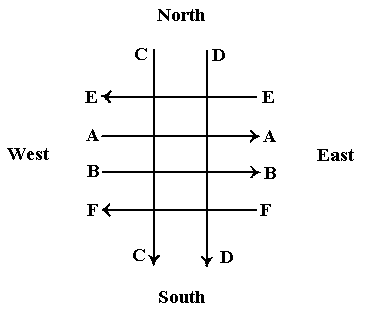
At first, the priest, standing before the censer, faces the east
and places two pieces (AA and BB in the above figure) of sandalwood
over the fire at a short distance from each other. Then
he turns to the south and places two more pieoes (CC and DD)
over the first two. Then he turns towards the west and places
two more pieces EE and FF over the four.21 He then washes with pure water22
the stone-slab on which the censer of the
[235]
Sacred Fire stands.23 This ceremony of washing the pedestal or
the stone-slab (Khân) on which the Sacred Fire stands, is alluded
to in the 9th chapter of the Yasna.24 The priest then places on
the fire a little sandalwood and frankincense three times, speaking the words
Humata, Hukhta, Hvarshta, i.e., good thoughts, good words, and good deeds.
Then he goes round the censer with a metallic ladle in his hand, and, standing in
eight25 different positions (viz., the four sides and the
four corners), and then going back to his original position on the
west of the censer and facing the east, recites, in these nine positions,
different words of a short formula of prayer. This ceremonial of going round
the censer is spoken of as 'chak farvun,' i.e., going round the circle
(Pers. chak, i.e., "one side of four; an eighth part of a thing").
22. For these purification ceremonies, the water itself is, as it were, purified. Two water-pots, full to the brim with well water, are taken into the chamber. The water from the one is poured into the other, which itself is full to the brim until the water overflows, and while thus overflowing cleans and purifies also the sides of the vessel. This is done three times with the recital of the words Khshnaothra Ahurahê Mazdao and of the Ashem-Vohu prayer. The water of the other pot is similarly purified. Then the water-pots with the water in them are said to be made pav, i.e., pure or clean with water (pa-âv = Persian, ba-âb).
23. The stone-slab is ordinarily spoken of by the priests as Khuân or Khân. Prof. Darmesteter, by some mistake (Le Zend Avesta I. Introduction LXX) calls the metallic tray, standing on a metallic stool on the left side of the censer, the Khân, but in the ordinary parlance of the priesthood, that tray is called Khânchê while the stone-slab is called Khân.
24. Yasna, Ha 9:1.
25. In the performance of the Afrinagan ceremony also, the Âtravakhshi, i.e., the person sitting before the fire, at the recital of the Ahunwar or Yatha Ahu Vairyo and Ashem Vohu, points with his ladle in the tray, the eight different directions. From an anthropological point of view, the custom has some similarity, with the sides and corners pointed by the Hindu Svastika and the pre-Christian Cross.
A chart of the different positions.
The following chart points out the different positions in which the priest stands whilst reciting the various parts of the prayer-formula. The numbers [236] point out the consecutive order in which he stands at the different positions before the censer on the altar:
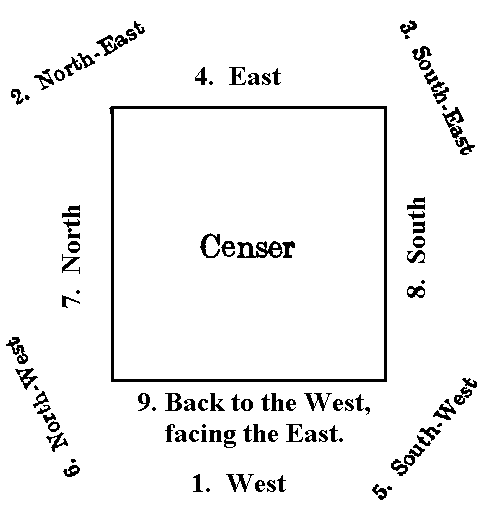
I give here an illustration of the performance of the Bui-ritual in the
sanctum sanctorum of the Fire-temple.26
The following table gives the different words of the text, recited in the different positions before the censer, the references to the Avesta text for the words, and their meanings
Table of the formula recited.
| Directions. | Words of the Avesta Text recited. | Reference to the Texts. | Translation of the words. |
|---|---|---|---|
| 1. West... | Âthwâ âthro gârayêmi.. | The first two words from Y51:9. | I praise (Thee, O God) through thy fire. |
| 2. North-East... | Vanghéush mananghô zaôthrâbyô yazamaîdê. | Y68:3. | We praise through the offerings of good thoughts. |
| 3. South-East... | Âthwâ âthro gârayêmi.. | Same as No. 1. | Same as No. 1. |
| 4. East... | Vanghéush ukhdhahâ zaôthrâbyô yazamaîdê.. | Y68:3. | We praise through the offerings of good words. |
| 5. South-West... | Âthwâ âthro gârayêmi.. | Same as No. 1. | Same as No. 1. |
| 6. North-West... | Vanghéush shyaôthnahê zaôthrâbyô yazamaîdê. | Y68:3. | We praise through the offerings of good actions. |
| 7. North... | Sukâî manangha .. | Y68:4. | For the enlightenment of (our) thoughts. |
| 8. South... | Sukâî vachangha.. | Ibid .. | For the enlightenment of (our) words. |
| 9. Coming back to the original place on the West of the censer and facing East... | Sukâî shyaôthna .. | Ibid. .. | For the enlightenment of (our) deeds. |
The meaning of the above formula on the whole is as follows:—
"O God! We praise Thee, through Thy fire. We praise Thee, by the offerings of
good thoughts. We praise Thee through Thy fire. We praise Thee by the offerings
of good words. We praise Thee through Thy fire. We praise Thee by the offerings
of good deeds. (We do all this) for the enlightenment of our thoughts, for the
enlightenment of our words, and for the enlightenment of our deeds." That is to
say, the worshipper standing before the sacred fire, taking it as the symbol of God's
refulgence and purity, and placing over the fire sandalwood and frankincense as
visible offerings, offers the real, though invisible offerings of good thoughts,
good words, and good deeds, and thereby hopes and prays for the further
enlightenment of his thoughts, words, and deeds.
Having recited the above short but pithy formula of prayer the priest places again
over the fire a little sandalwood and frankincense, and then recites, as said above,
the Atash Niyayesh27 several times, according to the Gah or
period of the day. While reciting the first Niyayesh for the first time, the priest goes
on placing bits of sandalwood and frankincense (aêsma bûi) at the intervals of a few words.
The ringing of the bell.
During the recital of the first Niyayesh, and during the recital of the first Pazand
portion of it, whilst uttering the words "dushmata," "duzhukhta," "duzvarshta,"
i.e., evil thoughts, evil words, and evil deeds, he rings a bell thrice;
some ring the bell thrice, whilst uttering each word, i.e., in all give nine strokes of the bell.
This is, as it were, to emphasise that portion of the prayer, wherein the worshipper expresses a
desire to shun bad thoughts, bad words, and bad deeds. At the end of the first recital of the
principal portion of the Atash Niyayesh, the priest draws by means of two ladles two circles
in the ash in the censer at its ridge, and at the similar end of the second recital
[239]
he obliterates the circles again. While reciting the Niyayesh
during the first and the fifth Gah or period of the day (the
Hawan and the Ushahin), the priest stands on the West of
the censer with his face towards the East, and during the
other periods vice versa.
(B) Consecration of the Sacred Fire of the second grade, the Atash Adaran.
The later Persian books say, that in a town or village where
ten Zoroastrian families reside, the presence of a Fire-temple
of the second grade, the Atash Adaran, is necessary. The
process of collecting, purifying and consecrating the fires for this
sacred Fire of the second grade is not very long. Four principal
kinds of fire are required to constitute this fire. They are:
Fire from the houses of (a) the Athornans, i.e., the priestly
class, (b) the Rathaêshtârân, i.e.,
the military class, (c) the Vâstryosân, i.e.,
the agricultural class, (d) the Hutokhshân, i.e.,
the artizans, tradesmen, and manufacturers. We will speak of the
consecration of the Sacred Fire of the second degree under
the following heads: 1. Collection of the fires. 2. Purifying the fires.
3. Consecrating the fires. 4. The final consecration of the united fire.
5. The final enthronement.
1. Collection of the fires from the houses of different classes.
(a) The first requisite fire is that from the houses of the
Athornans, i.e., of the men of the priestly
class. For this purpose, fires from the houses
of the following persons are generally
collected and united:— (1) The Dastur, or the head-priest of
the town. (2) An ordinary priest. (3) The leading or the head
layman of the town. (4) The donor. In case the Fire-temple
is founded by a private individual with a charitable or religious
motive, the fire of his house is generally taken, if convenient.
If he lives in a town different from that where he founds the
Fire-temple, the fire of his house need not necessarily be had.
The fires from the houses of these different persons are collected together.
[240]
(b) For the preparation of the fire of the Rathaeshtars, i.e., the military or the governing class, fires from the houses of the following grades of persons are collected:— 1. Fire of the house of the Governor, or the ruling authority of the place. For example, if a Fire-temple is sought to be founded in Bombay, the fire from the cook-room of the Governor's house may be had. If it is to be founded in a mofussil town, that from the house of the Collector or the Assistant Collector or the Deputy Collector, or any other officer who is the head ruling authority of the place may be had. 2. Fire of the house of a military officer or person residing in the town or in the neighbourhood may be had. If there are no houses of military officers or soldiers near at hand, the fire from the house of a Police Officer may be had. 3. Fire from the house of the leading judicial authority. For example, if it is in Bombay that a Fire-temple is being founded, the fire from the house of the Chief Justice or of any one of the Judges of the High Court may be had. In the mofussil, it may be had from the house of any judge or magistrate or other judicial officer. All these fires, are then mingled together to form a fire of the military or the ruling class.
(c) The fire of the house of an agriculturist may be had from
the house of any tiller of the soil in the locality. If there is a
Parsee cultivator at hand, the fire from his house may be had,
and then from that of a Hindu cultivator. A fire from the
house of an ordinary gardener may be had. Then all these fires
are mingled together to form one fire of the agricultural class.
The fire of the artizan class is prepared out of the fires of
different tradesmen and workmen. They are generally fetched
from the places of business of artizans and others, such as
the goldsmiths, silversmiths, ironsmiths, tinsmiths, copper
smiths, dyers, distillers, bakers, potters, tillers, brick-makers,
chunam-makers, shepherds, caravanbashis, sentinels, etc The
fires from their houses or places of business are all united to
form one fire of the artizan class.
[241]
2. Purification of the fires.
The process of purification is well nigh the same as that described
above in the case of the different
fires that were united to form the Sacred Fire
of the first Grade. A ladle with holes
containing powdered fuel, etc., is held over the fire at some distance
from the flame. The process differs in only one respect, viz., that in
this case the process is repeated thrice only, while in the case of the
Sacred Fire of the first Degree the number of repetitions varied from
33 to 91 times.
3. Consecration of the four fires.
Each of the above-said four united fires, after being purified
as above, is consecrated separately.
Each of the four fires is placed in a separate
vase and two priests take charge of each
fire, i.e., in all, eight priests are required to consecrate them.
A lesser number can do, but in that case it would take a larger
number of days. On the first day, each of the four pairs of priests
performs over the fires, in the morning, the Yasna ceremony and, after
midnight, the Vendidad with the Khshnuman of Srosh. On the second day,
the same ceremonies are performed again, but with the Khshnuman of Ahura Mazda.
During these recitals the four fires are placed before the officiating priests.
4. The final consecration of the Sacred Fire.
Then, on the third day, the four fires are all united into one.
The vase or censer containing the first, i.e.,
the fire of the Athornan or priestly class,
receives in itself the fire of the next three
classes. All the priests who officiate at the consecration unite
themselves by a paiwand and then, reciting the Yatha Ahu Vairyo
[Ahunwar] formula, combine the fires together in the first censer.
Having done so, they recite the nemashkâr [Namaskar]28
of Atash or homage to the Sacred Fire three times, finishing it with the
Ahmai-raeshcha prayer, etc. It runs as follows: "Homage to thee,
O Fire of wise Ahura Mazda, the benefit-giving great Yazata."
Having thus combined the fires and having thus paid an
homage to the united Fire, two priests — generally the two
priests who had at first consecrated separately the fires of the
priestly class — perform over it the Yasna ceremony in the
morning and the Vendidad at midnight with the Khshnuman of Srosh.
Then, on the morning of the fourth day, a Yasna with the Khshnuman
of Dadar Ahura Mazda is recited over the united Fire. This finishes
the preparation and the consecration of the Sacred Fire of Atash Adaran.
5. The enthronement of the Sacred Fire.
The Sacred Fire being thus prepared and consecrated, there
now remains the final ceremony of enthroning
it. It is well-nigh the same as that for
the Sacred Fire of the First Grade. The
assembled priests and others form a procession and formally
carry the Sacred Fire to the chamber which itself has been
cleaned, purified, and consecrated, as in the case of the
Atash-Bahram. There, it is enthroned on a large metallic censer
which stands upon a raised stone-platform or slab. A priest then
feeds this Sacred Fire reciting the Atash Niyayesh. All others also
recite this Niyayesh. Then, they assemble in the outer hall of the
Temple and perform the Jashan ceremony. In this, either the three
Afrinagans referred to in the case of the Jashan of the Atash-Bahram
or the following Afrinagans are recited:— 1. Ardwahisht Ameshaspand.
2. Ahura Mazda. 3. Spandarmad. 4. Arda Fravash. 5. Dahman, 6. Srosh.
Similarly, the Baj ceremony is performed at the same time.
(C) Consecration of the Sacred Fire of the Third Grade: The Atash Dadgah.
The ritual of the consecration of this fire is very simple. It
is the ordinary fire of the household that is consecrated. So
there is no special process of collection for it. Again, there
is no special purification. The principal function is the
consecration of the Temple where it is to be deposited. The fire, that is
[243]
used in the consecration of the Temple itself while performing
the Yasna and the Vendidad ceremony, forms the Sacred Fire of the
Atash Dadgah. The following is the process of consecrating the
Temple building:— The building intended or built for the
temple is cleaned and washed. Some later writings say, that all
Temple buildings may, at first, be washed and purified thrice
with gomez or cow's urine, but the practice is not generally
resorted to now. It may then be purified by being washed thrice
with water. After this purification and cleaning, commences the
consecration ceremony. It lasts for four days. During the first
three days, in the morning, a Yasna ceremony with the Khshnuman of Srosh,
and after midnight, a Vendidad with the same Khshnuman are recited. On the
morning of the fourth day, a Yasna with the Khshnuman of Arda Frawash
is recited. Then finally, the Jashan ceremony is performed. In this
Jashan ceremony, five Afrinagans are recited with the Khshnuman of:—
1. Ardwahisht. 2. Ahura Mazda. 3. Spandarmad (Spanta Armaiti\
4. Ardafrawash. 5. Dahman. 6. Srosh. Similarly, six Bajs are recited.29
[244]
CHAPTER X.
II.— CONSECRATION OF THE TOWERS OF SILENCE.
There are three ceremonies in connection with the consecration
of a Tower. They are the following:— I. Kodâri mârvi
(lit., to strike the first spade),1 i.e., the ceremony for
digging the ground to lay the foundation. II. The Tânâ ceremony, or the ceremony
of laying the foundation. III. The Consecration ceremony proper.
1. The preliminary ceremony of digging the ground.
The first ceremony is that of digging the ground. It is
performed a few days before the formal
laying of the foundation. In the centre of
the spot chosen for a Tower, a Barashnomwala
priest encloses a certain place with a "pavi"2 and
thereon performs, at first, the Khub ceremony with the five
springs of the Barsom (pânch tâi ni khûb). Then he recites the
"Baj" in honour (1) of Sraosha, the guardian angel guiding
the souls of the deceased, (2) of Ahura Mazda, (3) of Spenta Armaiti,
the Archangel presiding over ground, a portion of which is now being
enclosed for the construction of the Tower, (4) of "Ardafrawash,"
i.e., all the departed souls, and (5) of "Haft Ameshaspands,"
i.e., the seven Archangels. Having recited these prayers, the priest
holds a spade in his hand and recites the Srosh Baj upto Ashahe.
He then digs with his own hand a part of the ground required for the Tower.
While digging, he recites the Yatha Ahu Vairyo [Ahunwar] prayer 21 times.
II. The Tânâ or the ceremony for laying the foundation.
A few days after, when the whole of the required plot of
ground is excavated by the labourers, two
priests perform in the morning the "Tânâ"
ceremony for laying the foundation of the
Tower. The ceremony is so-called from the fact of "tânâ" or
a very fine thread being used to mark out the circumference of
the Tower and its different parts for the laying of the foundation.
One hundred and one3 fine threads are woven into one
strong thread or string. The thread so prepared should be as long
as would suffice to go round the circumference and the inner parts
three times.4 Some time before its use, this thread is made
"pâv," i.e., washed, purified, and dried. To hold this
thread, the priests have to fix in the ground 301 nails of different sizes
and weights. The following are the various numbers and weights:—
(a) One central nail (shown in the plan by the letter A) of one maund
without any holes. (b) Four side nails5 (i.e., for
South-East, South-West, North-West, and North-East sides) (B, E, D and C,),
each of half a maund. Each of these four nails is to have three holes, one
being straight and the other two crosswise, (c) Thirty-six nails
(16 in the outer circle, each shown in the plan by the letter F, and twenty
in the inner circle, each shown in the plan by the letter G,) weighing
altogether about one maund. (d) Two hundred and fifty-six nails,
altogether weighing one maund, 32 on each of the eight rows marked HH in
the plan, (e) Four nails of the same size as the above 256 to be fixed
at the places marked J J. These five sets of nails give the total of 301.
4. The number three is a sacred number, being symbolic of Humata, Hukhta, and Hvarshta, i.e., good thoughts, good words, and good deeds, the three precepts on which the moral structure of the Zoroastrian religion rests.
5. These nails correspond to the pegs in the Egyptian ritual. For the four nails, cf. "the four supports of heaven" (vide below, pp. 249-50).
On the day of the Tânâ ceremony, in the morning, two Barashnumwala priests get down into the excavation that has been dug for the foundation. Having performed the padyab, they perform the Khub ceremony with the five-twigs of the Barsom. They then put on their full sacerdotal dress (Jâmâ pichhori) and hold the paiwand between them. They then recite the Srosh Baj upto the word Ashahê, and begin to fix the nails in the ground. They recite one Ahunwar or Yathâ-ahû-vaîryô, while striking each nail. The central large nail A is struck first. The greater part of it is left above the ground. Then the nails on the South-East, South-West, North-West and North-East are struck. Then the above 36 nails are struck in the order marked in the plan beginning at G on the S.-E. which is marked as G 1. The order is G 1, F 2, G 3, F 4, G 5, F 6, and so on in the first quarter. Then G 10, F 11, and so on in the next quarter. Thus, the last or the 36th nail is at G 36 in the fourth quarter. Then the 256 nails are struck in eight different lines shown in the plan. The first 32 must be struck in the line between H and G 1. The next 32 on the similar row on the opposite side H-G 36. The third 32 on the third similar row H-G 10 and then the fourth 32 on the opposite row, and so on, till all the 256 are struck in the 8 rows at 32 per row. Then the last four are struck at the 4 points marked J. During the whole of the process of nailing, the priests recite Yathâ-ahû-vaîryôs.
After finishing the nailing, the priests commence passing the tânâ or the thread through the nails. They begin with the nail on the South-East quarter, B, one of the four large nails with three holes. The thread is passed through the lowest hole, and the end is fastened with it with a double knot which is put over. it with the recital of two Ahunwars. The long thread is then carried from nail to nail in a metallic tray. One of the two priests carries the tray and the other passes the thread from nail to nail, always moving to the right, i.e., from Southeast to the South, then to the Southwest, then to the West, and so on. Beginning with the nail at B, he takes the thread to G 1, then to F 2, then to G 3, then to F 4; and so on.
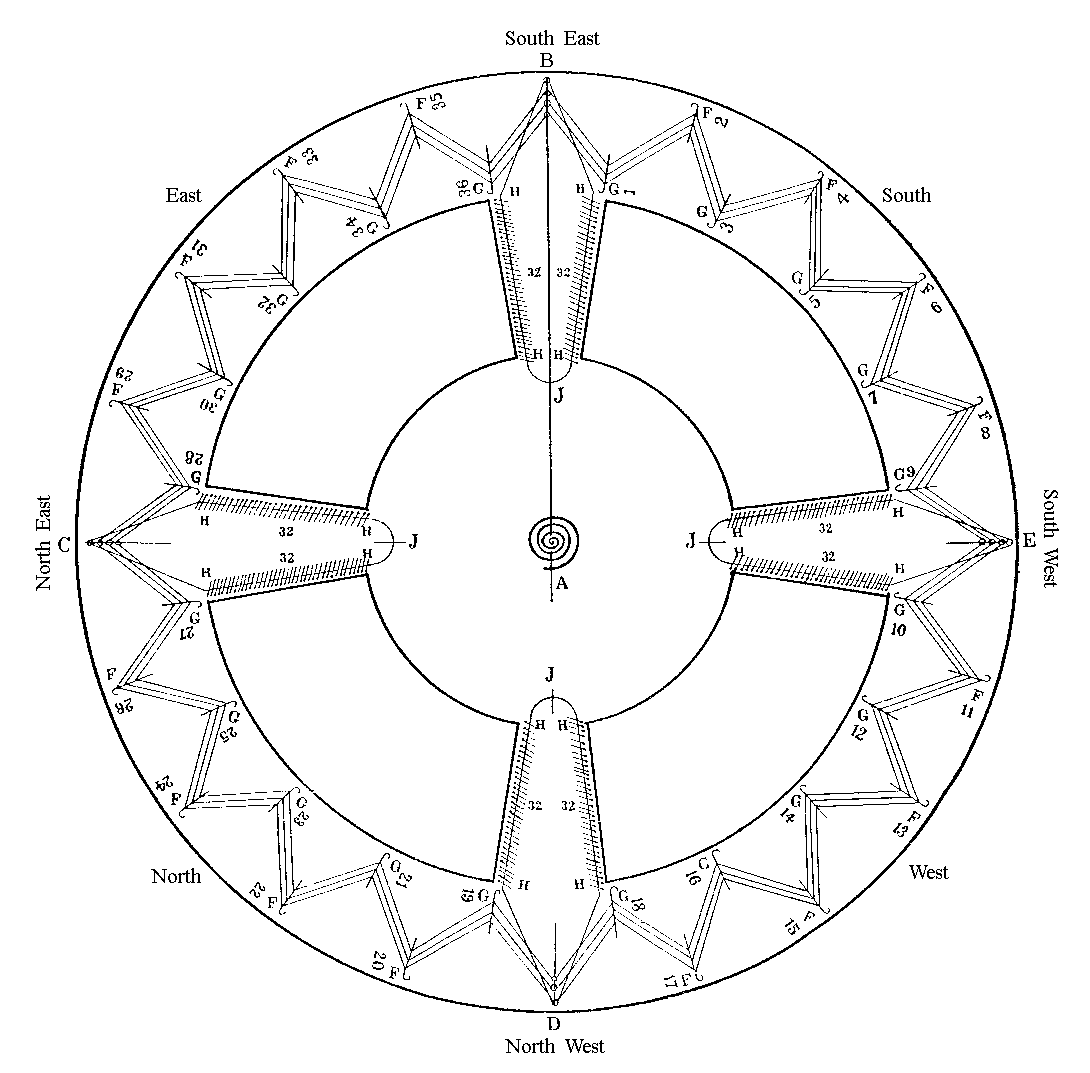
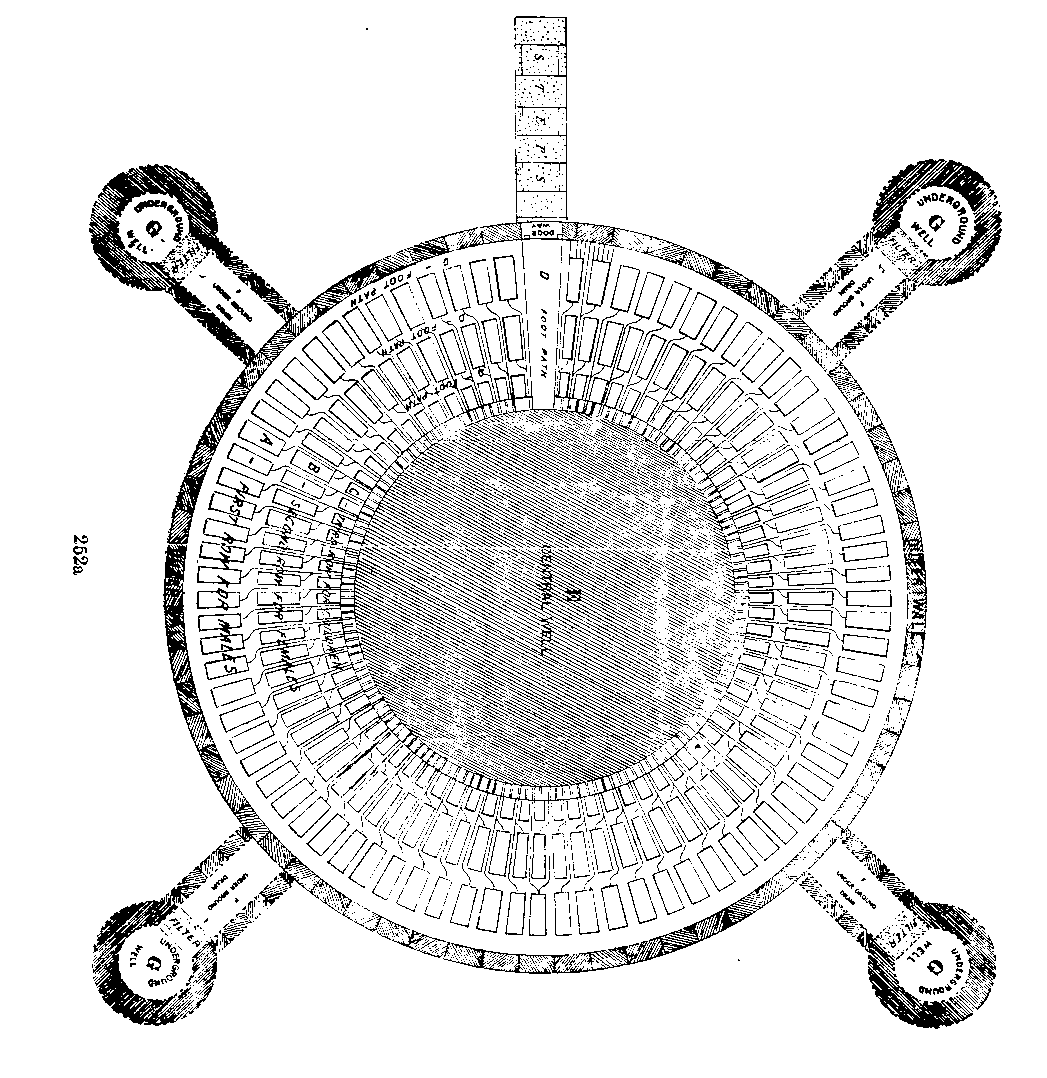
 whose art
Democritus boasts of having acquired."8 Another inscription says: "The hammer in my hand was of gold, as I struck the peg with it ...... Thy hand held the spade during the fixing of its (the temple's) four corners with accuracy by the four supports of heaven" In one picture, the king and the goddess are represented with clubs in their hands, to hammer the pegs.
whose art
Democritus boasts of having acquired."8 Another inscription says: "The hammer in my hand was of gold, as I struck the peg with it ...... Thy hand held the spade during the fixing of its (the temple's) four corners with accuracy by the four supports of heaven" In one picture, the king and the goddess are represented with clubs in their hands, to hammer the pegs.