CHAPTER V.
The Barashnom and the Riman.
Barashnom, the third form of purification.
The subject of the Barashnom is very large and intricate. Its description varies a little in the different parts of the Vendidad.
I will treat the subject of the Barashnom under the following heads:—
1. What is the Barashnom? Its meaning. Its original and present object.
2. A Description of the Barashnom, as given in the Vendidad.
3. Barashnomgah, or the place of the Barashnom. The ancient Barashnomgah
and the modern Barashnomgah. 4. The Process of giving the Barashnom.
We will treat this third part under two heads:—
(a) The preliminary preparation, and (b) The process proper.
5. The Retreat of nine full days after the Barashnom purification.
1. The Barashnom. Its meaning and object.
What is Barashnom. Meaning of the word.
Firstly we will speak of: What is Barashnom? How it differs from the first two forms of purification? What is its meaning? What was the originai object? What is its modern tendency?
Barashnom is the highest form of purification. It differs from the first two forms in several respects:— (a) While the Padyab is a work of one or two minutes, and the Nahn, of about half an hour, the Barashnom, which originally had the object both of purification and segregation, lasted nine days. So, it is, at times, referred to in Parsi books as the Barashnom-i-Noh Shab, i.e., the Barashnom of nine nights, (b) While the Padyab requires no help of a priest, and while the Nahn requires the help of one priest, the Barashnom requires the services of [103] two priests, (c) While the first two can be performed in any ordinary house or in a temple, the Barashnom purification must be gone through in a particular open-air place. Such a place is called Barashnomgah, i.e., the place of the Barashnom. We will describe this place later on.
This form of purification has taken its name from the word
bareshnu which means, 'top, head,' from Av. barez,
Sans. 'to be pre-eminent.' In the description of the process of the
particular form of sacred bath gone through in this ceremony,
as given in the Vendidad (Chap. VIII, 40), it is enjoined,
that the purification of the different parts of the body must
begin from the head or the top (Barashnom). The water is
first required to be poured over the head from which the
impurity passes down step by step. Hence the name. We will
speak of these different parts of the body later on.
The original and the modern objects of the Barashnom purification.
The original object of the Barashnom, as referred to in the
Vendidad, seems to be to purify those who
had come into contact with a worse form
of impurity — impurity which, from the
sanitary point of view, may be deemed
dangerous or infectious. For example, a man, who became
unclean by coming into close contact with the dead or,
through, what Dr. West calls "any other serious defilement,"1
was, in ancient Iran, required to go through this purification.
Some deaths occurred from infectious diseases, and so, the
"contacts," i.e., the persons who had come into long close
contact with such dead, were likely to spread contagion. They
were, therefore, required not only to go through purification,
but through segregation for nine days. Thus, it was a
joint form of purification and segregation. The original object
seems to have been latterly widened, perhaps from a point of
view of greater caution. At times, it is difficult for medical
men to determine, whether the disease of which a man dies
[104]
is infectious or not. If it is difficult for an expert medical
man to determine that, it must be more so for the ordinary
class of people. So, for the sake of caution or safety, it seems
to have been enjoined that the living, a short time after death,
must keep themselves at a distance from all the dead, whether
they died of infectious or of non-infectious diseases. Those,
who had, for some purpose or another, to remain in a very long
contact with the dead, had to go through the long form of
Barashnom purification and segregation.
Darmesteter's view.
While considering the subject of the Barashnom or the
great purification, in order to have a clear
grasp of the purification as originally
intended, we must bear in mind what Prof. Darmesteter says
on the subject of the ceremonies about the disposal of the dead
among the Parsis:2 "The principle which governs the
ceremonies of the first order is the fear of contagion, or, as
the Avesta says, of the Druj Nasu, the Druj of Carrion. Death,
that has once come, rests. The visible proof of it is given by
the corruption which at once goes on in the body and spreads
infection round about. It is represented in the form of a horrible
fly, the fly which hovers over the corpses. All the ceremonies of
this order can be summed up in two words, which are the same as
sum up to-day all the prophylactic measures in the case of an
epidemic:— (1) to cut off the communications
of the living with the centre of infection, real or supposed;
(2) to destroy the centre itself."
"Lawful impurity has always physiological causes. Above
all, the corpse is an impure object . . . But he who speaks of
impurity speaks of contagion: because the corpse engenders
putridity and pestilence..... The purification has for its
object the expulsion of this contagion which passes from the
dead to the living, and from one living person to another; and
the theory of impurity and of purification reduces itself in fact
to a theory of hygiene."3
Further on, Prof. Darmesteter says: "During the purification,
the impure remains isolated from the faithful (i.e., from
other Zoroastrians), whom he would (otherwise) defile, in a
sort of lazaret. . . . One sees, that they (i.e., the funeral
ceremonies) are summed up in two words—two words of
hygiene: (viz.,) to isolate the centre of infection, (and) to
destroy that centre. What distinguishes the Zoroastrian conception
from the European conception is this, that we busy
ourselves in isolating and destroying the dead element only
in case of diseases said to be infectious; (but) in Zoroastrianism
death is always infectious and contagious."4
The present object.
Latterly, the original object of the Barashnom purification was still further widened. At times, it was enjoined for the physical purification [106] originally intended, and, at times, it was intended to serve as a symbol for mental purification. It served as a kind of purification, both physical and mental, which qualified one for some higher religious ceremonies. Now-a-days, the persons who go through this Barashnom ceremony are the professional corpse-bearers, who go through it, both before joining the profession and on leaving it. They come into contact daily with dead bodies of men, some of whom may have died of infectious diseases. Of course, after the removal of every corpse to the Towers, they are required to bathe, but, when they leave for good, or at least for a long time, their daily line of business, it is thought to be good and safe that they may go through this higher form of purification, before they mix freely with others. So, one can understand the object of a corpse-bearer gang through the purification and segregation on retiring from his professional work. Looking to the original object of the purification as referred to in the Vendidad, it is not easy to understand why he has to go through this purification before he joins his profession. But, it order that he may be prepared for his business which requires extreme caution so as not to spread infection, or that he may be given an idea of the form of purification necessary in case of those who come into direct contact with the dead. It may be with a 'protective' view. In the matter of the purificatory ceremonies of various nations anthropologists occasionally speak of "the purificatory ceremony" as the protective theory. This may be an instance of the latter.
As to the priests, the Barashnom is necessary, both for a
person who wishes to be initiated for the priestly profession,
and for a full-fledged priest, when he wants to officiate in,
what may be called, the inner circle of higher ceremonies. In these
cases, there is not the origin idea of purification from
impurities caught by having come into contact with dead
bodies, but the idea of a sentimental and symbolic point of
[107]
view or a protective point of view. Another reason, which
may have, at first, led to the custom, may be this: It was
one of the functions of a priest to purify those who had come
into contact with the impurities of a corpse. He was, therefore,
also known as an Yaozdâthragar, i.e., purifier. That being the
case, it was held advisable that he himself should have at first
gone through this purification. Thus, latterly, the original
object of the Barashnom as enjoined by the Vendidad, viz.,
purification from the highest form of impurities like those arising
from coming into long and close contact with the dead, especially
the dead who died of infectious diseases, assumed also a symbolic
signification. Thus, purification became a priestly function and
was thought to be necessary for those priests who wanted to officiate
within the inner circle of the Fire-temple and at some of the higher
forms of ritual. The original object, latterly, in process of time, took another form.
For example, a priest takes a Barashnom, and while doing
so, declares that he does so for the "tan pâk" (purification
of the body) of A, B, or C, who may be living or dead, i.e., he
goes through the ceremony, so that the physical or the spiritual
body of that person, who is named in the ritual, may have the
efficacy of the purification.5 All this seems to be a later
diversion from, or degeneration of, the original sanitary object
of the Vendidad.
2. Description of the Barashnom as given in the Vendidad.
Three references to it.
We find references to the Barashnom in three chapters of the
Vendidad:— (a) The first and principal
reference is in the 9th Chapter (§§ 1-57),6
where it is treated at some length. To
have a clearer grasp, this chapter must be read with its
Pahlavi rendering and commentary.7 (b) The second reference
[108]
is in the 8th Chapter (§§ 35-72).8 (c) The third
reference is in the 19th Chapter (§§ 20-25).9
7. S. B. E. XVIII, pp. 431-454.
8. S. B. E. IV, pp. 103-110.
9. S. B. E. IV, pp. 209-11.
These three references seem to refer to three different forms of pollution, i.e., to three different forms of greater or lesser contact — direct or indirect — with corpses, which, when going through decomposition, are centres of disease and infection. Of course, all persons have to come into some contact with the corpses of their dead relatives or friends for some time after death. But then, they must observe some rules or laws of health, so as not to endanger their own lives, and through themselves, the lives of others. If they do not observe these, there is a likelihood that they may, by some close contact with the dead bodies, catch some germs of disease or infection and transfer them to others. In case they fail to observe those rules by accident or for some unavoidable purpose, in order to avoid any danger, they must go through some purification which may lessen the chance of their infecting others and spreading the disease.
The first reference (Vend. IX) seems to be an account of the
purification of an extreme case of contact with a corpse — so
extreme, that it requires to be carefully purified and isolated
for ten10 days, so that the least chance for the spread of
infection may be avoided.
The first reference (9:1-57) in the Vendidad.
The following is an outline of the account:— When a person has become polluted or defiled by coming into contact with a dead body, he must seek a purifier who must be (a) righteous, (b) speaker of truth, (c) versed in the manthras or holy scriptures, [109] and (d) who has learnt from experienced persons how to purify others. The righteous man with these qualifications must find out a sanitary piece of ground. He must cut off the trees, if there be any, on that ground. The ground chosen must be dry, clean, without vegetation and the least frequented by cattle and men.
On the ground thus selected, nine magas or pits may be dug.
Then these nine pits must be marked out by 13 karshas or
furrows which have to be drawn by a sharp metallic instrument.
Of these 13 karshas, the first must be drawn equidistant from
the line of the pits. Then three karshas must be drawn round
the first three pits. Then other three karshas round these first
three and second three pits, i.e., round the first six pits.
Then, other three, round the nine pits together; lastly, the remaining
three karshas round the central three pits. Then,
the ground thus selected and marked out, or symbolically
enclosed, must be covered over with sand or some such kind
of drying or disinfecting earth.
Now follows an account of the purification. The purifier is to stand out of the karshas drawn as above, and is to ask the infected person or the candidate for purification to advance to the pits. When the candidate has advanced to the first pit, the purifying priest is to say the words
"Nemaschâ yâ ârmaitish izâchâ"11and is to ask the candidate to repeat them. Each repetition of these words is said to weaken the influence of the infection. The purifying priest has to hold a naogar or a nine-knotted stick in his hand and to fasten an iron or leaden receptacle or spoon at its end. He is then to get, at first, the two hands of the candidate washed thrice by means of gomez or the consecrated urine poured on his hands by means of the above spoon. If that is not done carefully, the purification that may follow will not be effective or complete. The hands with which the candidate is to clean his whole body must be at first [110] thoroughly cleaned and purified. Then the whole body may be cleaned and purified in a particular way, beginning with the head and gradually coming down to the feet. By this purification from head to foot, the evil power of pollution or infection, is said to run away from one part of the body to another, lower down, and, at last, it leaves the body through the lowest parts of the body, viz., the toes of the feet, in the form of a stinking fly. Then, when this is done, the purifying priest is to recite the Ahunwar and then the Kem na Mazda prayers up to the words "Astvaitish ashahê." The recital of these formulae of prayers is said to be very efficacious and is said to have its good effect on the health of the body.
The above process of purification and the recital of prayers are to be repeated at each of the first six pits, to each of which the candidate is to advance step by step, and at each of which the evil power of pollution decreases step by step and the candidate gets purer. Having gone through this process of purification at each of the first six pits, the candidate is to advance towards the seventh pit, and is to sit at a distance of about 3 1/5 in. from it. The purification here is with sand or some sand-like substance. He is to rub his body with it 15 times. He is to wait there till the moisture — if any — of the application of the consecrated urine dries off. The sand is supposed to be a purifying substance and it serves to dry the moisture as well. Then he is to go to the seventh pit where he has to purify his body once with water. Then he is to advance to the eighth pit and purify his body twice with water. Then he is to advance to the ninth pit and there purify his body thrice with water. Then his body is to be fumigated with the smoke of the fuel of the wood Urvasna, Vohu-gaona, Vohu-kereti, and Hadhanaepata which were species of fragrant wood whose smoke was believed to have the quality of killing germs.
This finishes the purification proper. The candidate is now to put on his clothes and to retire to a house where he is not to come into physical contact with other persons He is to remain [111] aloof and away from fire, water, cultivated land, trees, cattle, men and women, He is to pass three days and nights in such isolation. On the fourth day, he is to wash his body at first with urine and then with water Then, he is to continue in the retreat, as said above, for three nights more. On the seventh day he goes through a bath again as on the fourth day. He then again remains aloof for three nights more, and then, on the tenth day, has again a bath. Thus, for nine days and nine nights after the first Barashnom purification, he is to remain in a kind of isolation and retreat. After the final bath on the tenth day, he is deemed to be perfectly purified and can then mix with all men and women.
The person who purifies must be properly paid by the person who goes through the purification. His fee depends upon the position of the candidate. The purifying person on his part is required to be proficient in his work. If he is not, he is guilty of doing harm to others and is liable to great punishment.
The second reference in the Vendidad VIII, 35-72.
The second reference to Barashnom in the 8th Chapter of the
Vendidad applies to cases, not so serious as
in the first reference. While in the 9th
Chapter, the case is that of a person who
is already supposed to have been defiled by a long contact
with the dead (hâm nasûm paiti-iristem), here, in the 8th
Chapter, the case refers only to one who has accidentally come
into slight contact with (yâ, nasâum ava-bereta) a dead body.
So, in this second case, the purification is not so irksome as in
the first case, both, in point of length of time and in the number
of baths or purifications. The process enjoined in this case is
as follows:— If the flesh of the dead body has been devoured
off by a flesh-eating bird or animal before the person touches it,
i.e., if the body is a mere carcase of bones without the flesh on
it, then, the most harmful parts of the body being done away with, there
is less risk of catching any germs of disease from the corpse. So, in
this case, he is simply to wash his body with gomez and water. A simple
bath of this kind is sufficient to
[112]
purify him. But, if the flesh of the corpse is not eaten off and
the body is there with all its decomposing parts on it, then, the
chances of risk being somewhat greater, the process of purification
is as follows:— Three magas, i.e., pits must be dug, and the
person is to purify his body with gomez on each of them. Then
a dog is to be taken near him. This process is to be repeated at
a second set of three pits. He is then to wait for some time till
the moisture of the urine, applied to his body and head, especially
that on the head, dries up. Then, the person is to advance to a third
set of three pits. He is to purify his body there, with water. The
water must be poured over the different parts of his body from head to foot
in a particular way which is the same as that described in the case of the
great Barashnom purification. Then, finally, he is to recite one
Ahunwar and the Kemna Mazda prayer upto the words
"Astvaitish ashahê."
The person then puts on his clothes and the Kusti or the sacred thread,
reciting its allotted prayer. This finishes the purification.
The third reference (Vend. XIX, 19-25).
There is a third reference to a higher form of purification, but
it cannot strictly be called Barashnom,
because, therein, it is not enjoined that the
bath should begin from the 'bareshnu'
(head) which word has given the purification its name. It says
that if a person has come into contact with a dead body,12
or if a person has come into contact with a 'contact'13 he is
to go through a process of purification. No pits are mentioned
in this purification. He is to wash his body four times with
gomez and twice with consecrated water. He is to recite 200
Ashem Vohus and 200 Ahunwars. He is to pray for nine nights.
13. In the language of plague operations, a person who came into contact with a 'contact' was known as an 'evict,' and he also was asked to leave his house and to go to camp.
The difference in the ritual. Its cause.
We find that there is a difference in the ritual, described in
the three parts of the Vendidad. The tendency
is to reduce the rigour and intricacy
and to make the ritual simple. The
difference may be due to various causes. It may be due (a) to
the different views of different priestly writers (b) or to the
changed times, when it was found permissible to reduce the
rigour, (c) or to the change in places, the priests of one part
of the country thinking it advisable to reduce the rigour.
When we find that in a limited Parsi population of India,
there are differences in ritual in places so close as Bombay,
Udvara and Naosari, Surat and Broach, we must be prepared
to find them in a large population like that of Iran. As a
matter of fact, the Pahlavi Epistles of Manushchiher do point
to such differences in later times, in the matter of the Barashnom.
Zadspram, the high priest of Sukan in the South of
Kirman, was found fault with by his brother Manuschihr,
the high-priest of the western country, for having made some
changes in the ritual of the Barashnom.14
I have spoken above of a karsha15 or a furrow, of a padan,
and of a naogar or nine-knotted stick, and shall have to speak of
them frequently later on. So, I will describe them here.
A karsha or kasha.
A karsha (Sanskrit karsha) from the root, 'karesh' (Per. kashidan, to draw) means 'a trench or a furrow.' The word has a technical meaning in Zoroastrian rituals. At times, sacred or consecrated things or materials are to be kept, for the time being, within a limited space or enclosure, so that persons other than the officiating priests may not come into contact with them. The person in charge of the things, placing the things on the ground, draws [114] round it a temporary circle, trench, or furrow. Suppose, it is the consecrated urine or water that he carries, and, in travelling, he has to place these things aside for a time. Then, he places them on the ground and immediately draws, with a nail, a circle or furrow or trench round it. It need not be very deep. This process, viz., placing the things within the circle so formed, indicates, that it is free from the contact of other undesirable persons or things. If somebody else steps within the circle — or touches it even from without the circle, in which case also the line of isolation is broken — the thing is said to have lost its efficacy of consecration. This karsha (or kasha as it is ordinarily spoken now) or circle of limit, has a double efficacy. Just as, when you shut a door of a room, you stop a person within from getting out and a person without from getting in, so when you draw a 'karsha' or the sacred circle, you not only stop — anyhow symbolically — the pollution from without affecting the purity of the consecrated substance within, but, in case the substance itself is undergoing decomposition and is impure, you stop the impurity from going out of the circle and spreading round about. For example, in the Barashnomgah, karshas having these two different significations are drawn, (a) The officiating priests take into the Barashnomgah 'nirang,' i.e., the consecrated urine, 'âv,' i.e., the consecrated water, and 'bhasam,' i.e., the consecrated ash of the Fire-temple. The priest who takes these there, first makes a circle on the ground with a nail or even at times with his forefinger, and then places the consecrated things within the ground thus enclosed. Now, in this case, the circle is believed to protect the consecrated things from the pollution outside or to preserve the efficacy of the consecrated things from being lost. (b) Then take the case of the karshas round the pits or holes, where the person to be purified is to go through the different washings and the final bath.
In this case, the karshas are meant to limit the circle of
pollution. Here, a person who is considered to have been
polluted or, to speak correctly, supposed to have been infected
with an infectious disease, goes through his washings and baths,
[115]
and the circles were originally intended to keep the infection
confined within the limit, so that it may not spread. The
furrows are supposed to be trenches which would prevent the
polluted water from his infected body to run beyond that
certain limit. The karsha that a corpse-bearer draws round
about the corpse in the house before removing the body to
the Towers16 is of a similar kind.
Pavi
Most of these karshas are of a temporary kind, but in the Fire-temples, they are of a permanent kind. In the Yazashna-gah, where the Yasna, Vendidad, and Baj ceremonies are performed, such karshas are necessary. So, there, they are of a permanent kind. There, the stone slabs, which form the pavement, have furrows, about two inches deep and two inches wide, cut in the stones. In the chamber of the Sacred Fire also, there are such permanent furrows cut in the stones of the pavement. These furrows are of the first kind, i.e., they are intended to preserve the efficacy of the consecrated fire or articles and of the sacred ceremonies within them.
A karsha of this kind is generally known as a "pâvi."
Pav17 means sacred. So a Pavi means a furrow
which preserves the sacredness of the consecrated things
or of the sacred ceremonies. When the efficacy of the
consecrated things is encroached upon by somebody else going
within the circle or within the limit pointed out by the pavi,
then the thing is said to be avâ, (apâv) i.e.,
desecrated. In the phraseology of the ritual, the words "pâvi karvi"
are at times used to signify the preparation of temporary furrows
or the performance of religious ceremonies.
Paiti-dâna or Padan.
The word padân is Avesta paiti-dâna, lit., that
which is kept over (the mouth). It is padân Pahlavi,
panãm or penûm in Pazend, padân in Persian.
It is a piece of white cloth of cotton with two strings at the top
to be fastened over the nose. It is a kind of mouth-veil put on at
different times with different purposes. The priests put it on, when
saying prayers before fire and the myazd or sacred things, so that
their breath or saliva may not defile the sacred things before them.
In this case, it resembles the covering which the ancient Flamines,
the Roman fire-priests, were required to put on. At other times, it is
put on, as it were, for a contrary purpose, i.e., to prevent
the outside defilement from coming to the person who puts it on.18
For example, the priest put it on, in the Barashnomgah, to prevent the
defilement of the infected person, whom he purified, coming towards him.
Some put it on even over the face of a corpse. Here also the object seems
to be to prevent the defilement from the nose and mouth of the corpse
spreading out. The Pahlavi Vendidad (XVIII, 1) says that it may be
prepared of any material (kolâ mandavami). It may be two
fingers (angusht) broad and should be of two layers of cloth.
Naôgar, the nine-knotted stick.
Naogar, or to speak more correctly, Naô-gireh is the technical
name of a nine-knotted stick (graom nava-pikhem, Vendidad IX, 14). The use of
such a stick in the purifying ceremony as a symbol, seems to have been suggested by
a passage of the Vendidad (XIX, 4). Zoroaster advances against Ahriman holding
an instrument in
[117]
his hand (asâno19 zasta drajimnô). In the
portraits of Zoroaster, drawn from some sculptures on the rocks in Persia supposed
to be those of Zoroaster, he is represented as having a stick in his hand. This
is perhaps in reference to the above passage of the Vendidad. Some translators of
the above passage of the Vendidad speak of this instrument as a nine-knotted stick.
Another instrument, with which Zoroaster is said to have advanced against Ahriman, is Ahunwar, i.e., the short prayer of Yathâ Ahu Vairyô.
That prayer is the spiritual weapon with which the prophet fights against the
Evil Spirit, and the stick is the material symbol of it. In all religions,
priests or bishops are made to hold some weapons, mostly the sword. These
weapons are symbols of religious authority. Now Zoroaster's fight against the
Evil Spirit is a kind of spiritual or mental purification. He fights to free or
purify the world from his evil influences. So, the weapon also came to be used
as a symbol in the Barashnom ceremony of purification, wherein also the
purifier fights against the pollution brought upon by the Evil Spirit.
Now, as to the number nine, it was a sacred number among
the ancients. It was supposed to be a symbol of a kind of
perfection, because when multiplied by any number, the addition
of the digits of the product always gives nine as the product. So,
it was held sacred even amongst the ancient Zoroastrians. In the
Barashnomgah, the pits are, as we said, nine. The karshas or
the furrows round the nine pits are nine. The isolation or the retreat
after the Barashnom lasts for nine nights, So, the number nine also
plays its part in the stick used in the purifying ceremony. The priest
gives the consecrated articles to the candidate for purification by
means of a spoon attached to such a nine-knotted stick. Perhaps, it
was thought, that, in case the
[118]
infection escaped from the infected person who is a candidate
for purification, it might not reach the purifying priest and
might be stopped at every knot of the stick. It might pass
through the fibres of the stick but might be stopped at each
of the knots. All this is symbolic, however we may try to
understand it.
3. Barashnom-gâh or the place for the Barashnom.
The locality for the Barashnomgah as enjoined in the Vendidad and the sanitary condition of the ground.
Having spoken at some length on what is Barashnom and
on its description in the Vendidad, I will
now speak of the Bareshnom-gâh. The
Barashnom being a form of purification for
a person who came into close contact with
a dead body — perhaps the dead body of a
person who died of an infectious disease — it is natural that
the place for this purification should be enjoined to be away
from thickly populated parts of a town. It ought to be in a
sequestered or the less frequented part of the town. The
Vendidad (IX, 1-11) enjoins, that it ought to be at a place,
less frequented by cattle, beasts of burden and men. Again, it
must be at the distance of at least 30 steps (gâya) from fire,
30 steps from the barsom20 and 3 steps from the holy man. What is
meant is, that it must be in a less frequented place and in a
place away from religious places which are frequented by people.
Let us determine the distance mentioned here. It is required
to be at the distance of at least 30 gâya from a religious place
where liturgical services are performed. Now, according to the
ancient Parsi books, each gâya, i.e., step, is made up of 3
pâdha, (Sans. pâdha Lat. ped-s or pés,
Fr. pied, Germ. fuss, Pers. pâi, foot)
i.e., feet. Now each pâdha or foot is equal to 14
êrêzu, i.e., fingers. Each êrêzu
or finger is about 4/5 of an inch.21 So each
[119]
pâdha (foot) comes to about ll 1/5 in., and each gâya
(step) comes to about 2 ft. 9 3/5 in. Thus, when it is said that the
Barashnomgah must be at least 30 gâya from a place where
religious services are performed, it means, in modern measures,
that it must be at least (30 by 2 ft. 9 3/5 in.=) 84 feet. In other
words, there must be no place of worship near the Barashnomgah for
about 84 feet. Holy men are required to keep themselves away from it
by three steps, i.e., by 8 ft. 4 4/5 in.
The above figures from the Vendidad speak about the distance
of the nearest frequented place. The Rivayats follow the spirit
of the Vendidad, but increase the distance, and say, that it
must be about 300 gâyas (steps), (Bareshnûmgâh dûr
az sheher si-sad gâm shâyad)22 i.e., at the
distance of about 280 yards from the city.
Again it is further enjoined, that, after having chosen a distant
or less frequented locality, one must select there a piece of
ground "where there is least water and where there are fewest
trees, the part which is the cleanest and driest" (Vendidad IX, 3).23
In short, the driest and the cleanest place is enjoined
for the purification, so that the impurities or germs of infection
from the infected person may not increase and develop, and thus
be a source of danger. In case, a place free of trees is not near
at hand, the trees on the ground must be cut off to meet the
requirement. The ground round about the Barashnomgah must
also be cleared of its trees, for a distance of about nine vibâzu. As
each vibâzu is spoken of as containing 8 vitashtis and
as each vitashti is about 10 in.,24 the ground so cleared
off must be about 9 x 8 x 10=720 in., i.e., about 60 feet from all sides.
24. Vide my Kadîm Iranians, p. 94.
Laying out of the Barashnomgah.
Having chosen the locality at a safe distance from the city, and at the distance of at least about 84 feet from the nearest inhabited or frequented place, and having made the place dry and devoid of trees [120] the next business is to lay out or arrange the Barashnomgah. It should be laid out in the centre of the above-mentioned area of 60 feet. The arrangement consists of 3 kinds of work:—
- Digging magas or pits at fixed distances from one another.
- Drawing out the karshas or the furrows round the pits.
- Covering the Barashnomgah with sand or earth.
(a) At first nine magas, i.e., pits or holes are to be dug in
the centre of the ground beginning from the West and ending in the East. Each of
these pits was to be two fingers (êrêzu), i.e., about
1 3/5 in. deep, if the time of the purification was
summer, but 4 fingers, i.e., about 3 1/5 inches deep, if it was winter.
At first, six such pits are to be dug at the distance of one step,
i.e., about 2 ft. 9 3/5 in. from one another. Then, at the other
end of this set of 6 pits, a space of 3 steps, i.e., about 8 ft. 4 4/5 in. is
to be left undug. Then follows another set of 3 pits of the same
depth and at the same distance from each other as those of the
first set of six. The breadth of each of the nine pits is
not given in the Vendidad; but the depth being, as said above,
1 3/5 in. in summer and 3 1/5 in. in winter, let us suppose that the
width also is the same, viz., in summer 1 3/5 in., and in winter
3 1/5 in. The reason, why different sizes were enjoined in the
different seasons, seems to be, that in summer, the heat being
great, the ground, moistened by the water in the purification
process, dries up earlier than in winter.
(b) The next important work in the preparation of the Barashnomgah is that of drawing the karshas or furrows round the pits, to mark out the ground, beyond which the pollution or infection may not pass. The infected person is to have his baths in such a way that the water running from his infected body may not run further from the place and not pollute further ground. So, the ground must be marked out and proper channels or furrows for the water must be made. These [121] channels may serve as limits for confining the pollution or infection in a particular place.
At first, one large karsha is to be drawn round the whole
limit of the Barashnomgah with a sharp metallic instrument.
(Vendidad IX, 10). It must be at the distance of 3 steps
(gaya), i.e., about 8 ft. 4 4/5 in. from the long row of pits.
Then, 12 karshas must be drawn round the pits themselves in the following
order: Firstly, 3 karshas round the first three pits; secondly,
3 karshas round the first six pits; thirdly, 3 karshas round
all the nine pits. Then, lastly, 3 karshas round the inner,
i.e., central three pits.
(c) Having prepared the pits, on each of which the candidate
has to purify his body, and having enclosed the ground, the Barashnomgah
must be covered with some earth or sand. The candidate for purification
has to go through the purifying process on each of the pits. Going
through that, he has to cross that pit and go to the other or the purer
side of the pit, leaving behind, in the pit just crossed, any pollution
that had passed away from his body. So, he must have purer and cleaner
ground to stand upon, after crossing the pit. This was secured by having
the ground covered with sand or such other moisture-absorbing clay or
earth.25
Taking the distances as given in the Vendidad and as described above, the figures for the length and breadth of the Barashnomgah and for the space occupied by the pits, the intervening spaces, and the furrows come to these:—
The breadth of each pit is 3 1/5 in. in winter and 1 3/5 in. in
summer. We take the largest breadth of winter months in our
calculations. As there are altogether 9 pits, they occupy altogether
(9 X 3 1/5 in.=) 28 4/5 in. = 2 ft. 4 4/5 in. Then, the distance
between each pit being 2 ft. 9 3/5 in., as there are 7 intervals or
distances between these 9 pits, they occupy in all (7 X 2 ft. 9 3/5 in.=)
235 1/5 in.= 19 ft. 7 1/5 in. Then, the distance between the first set of
[122]
6 pits and the second set of 3 pits being 8 ft. 4 4/5 in., the length
of the ground occupied by the whole set of pits comes to (2 ft.
4 4/5 in. + 19 ft. 7 1/5 in. + 8 ft. 4/5 in.=) 30 ft. 4 4/5 in. Then, the
first and the most distant karsha or furrow being 8 ft. 4 4/5 in.
from all sides of the pits, allowing the space of 8 ft. 4 4/5 in. from
the space (30 ft. 4 4/5 in.) between the first and the ninth or the
last pit, i.e., on the East and on the West, the whole length of
the ground from East to West comes to (30 ft. 4 4/5 in. + 8 ft.
4 4/5 in. + 8 ft. 4 4/5 in.=) 47 ft. 2 2/5 in. Coming to the breadth,
(north and south), as the first and most distant karsha or
furrow is to be 8 ft. 4 4/5 in. on both sides from any one of the pits,
taking the pit to be a square and therefore its length to be the same
as its breadth, i.e., 3f in., we have the breadth of
(8 ft. 4 4/5 in. + 8 ft. 4 4/5 in.+ 3 1/5 in.=) 17 ft. 4/5 in.
A modern Barashnomgah.
Fromi all these calculations, we learn that the Barashnomgah,
as enjoined by the Vendidad, must have the surrounding
ground of the distance of about 60 ft. from all its sides, cleared
off of its trees, and that the space in it to be occupied for the
purpose of the purification ceremony itself should be 33 ft. 2 2/5 in.
in length from East to West, and 17 ft. 4/5 in. in breadth from
North to South. The accompanying plan presents a plan of the
Barashnomgah, enjoined as above by the Vendidad.
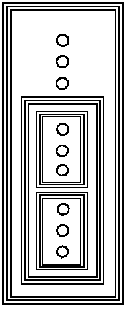
Plan of the Barashnomgah as enjoined in the Vendidad.
A modern Barashnomgah.
Now, as the modern Barashnom purification has changed
somewhat from the original one of the
Vendidad times, in its object and in the
matter of the persons who should take the
Barashnom, so has the modern Barashnomgah changed from the
original Barashnomgah of the Vendidad times. Again, even at
present, some of the rigid injunctions are more honoured in
their breach than in their observance. We will here examine
the changes, which are especially in the following points:
(a) Its locality. (b) Its area. (c) The form
of its magas or pits. (d) The distance between the pits.
(a) Firstly, as to locality, the present Barashnomgahs are not always away from the city. It is only at Naosari, the old [123] head-quarters of the Parsi priesthood, that tho old injunction of the Vendidad is followed and the Barashnomgah is situated at some distance from the closely inhabited part of the town. Even at Naosari, the ground round about, of the distance of about 60 ft., is not cleared off of its trees. Now-a-days, the Barashnomgahs are attached to many Fire-temples, because the original purpose of the Barashnom, viz., that of purifying only the infected, has lost much of its importance, and the Barashnom is looked at, as a form of purification necessary for the performance of liturgical services and ceremonies in the Fire-temple. It is mostly the priests that now-a-days take the Barashnom. So, the original requirement of the infected person being kept apart from frequented quartets of the town no longer exists. Thus, the Barashnom being a more frequent form of purification, and being the requirement for a priest, the Barashnomgahs are now attached to the Fire-temples.
(b) The area of the modern Barashnomgah also is much smaller than that described in the Vendidad. It varies in different towns. According to the Vendidad, the row of pits was in the centre of the area. In the modern one, it is nearer to the northern boundary.
(c) As to the form of the magas, we have no pits at all. They are replaced by sets of small stones. Each set consists of 5 stones. The space between each set of pits as enjoined by the Vendidad was 9| in. That space is now replaced by sets of 3 stones each.
(d) The magas or the pits having been done away, the
distances, mentioned in the Vendidad, between each of the pits,
viz., 9 3/5 in., and between the first set of six pits and the second
set of three pits, viz., 8 ft. 4 4/5 in., are not observed. The omission
of the small distances between each of the pits or their
modern substitutes, viz., the sets of stones, is not noticeable;
but the omission to observe the greater distance between
the first six; and the second three pits is easily marked. In
[124]
the modern Barashnomgah, all these sets of stones — both
those representing the original pits, viz., sets of 5 stones, and
those representing the original empty spaces between the pits,
viz., sets of 3 stones — are only about 6 in. apart.
Sets of small stones in the modern Barashnomgah
Taking the replacement of the Vendidad magas by sets of stones at present, there must be nine sets of stones, each of 5 stones, to represent the 9 pits of the older Barashnomgah, and nine sets of stones, each of 3 stones, to represent the intervening spaces between the pits — in all, 18 sets of stones. But instead of these 18, we have 21 sets in the modern Barashnomgah. The extra three are made up of two sets, each of 3 stones, and one of 5. The first extra set of 3 stones is in the front of the long row of stones, i.e., in the west end of the row, and it is on this set, that the purifying priest places his nine-knotted stick, and commences the process of preparing the Barashnomgah or drawing the karshas. The second extra set of 5 stones is at the other end of the long row on the east, and it is on this set that the candidate takes his final bath. These 5 stones are generally replaced by a broad large stone, so that the person can conveniently stand or sit on it and have his bath. The third or the final set of three stones forms the furthest end of the row on the east. It is provided for the bather to stand upon, after his final bath on the large stone, to dry his feet before putting on his shoes.
It seems, that, according to the Vendidad, in ancient times,
at each time that there was a case of a person who had become
infected by coming into contact with a dead person in a prohibited
way or in a way other than the proper or prescribed way, a Barashnomgah
was laid out. A piece of ground was selected, pits were dug, and
the karshas or furrows were drawn. It appears, that the
cases were rare, and so, the necessity of preparing the Barashnomgah
arose rarely. But latterly, when the original object of the purification
was changed, and its use and object were extended, a permanent thing was
wanted. Now-a-days, the Barashnom purification is a rare and uncommon thing
[125]
for the laymen, but common with the priests, who want to
qualify themselves for performing religious ceremonies in the
inner circle of the temples. So, in the modern Barashnomgah,
much of the arrangement enjoined in the Vendidad is given
a permanent form. As said above, they have done away with
the digging of the nine magas or pits and replaced them by
9 sets of stones; and the intervening spaces between the pits
are permanently replaced by sets of stones. It is only the
karshas or the furrows that are newly made on each occasion
of the Barashnom, and that part of the process only is now-a-days
technically known as "preparing the Barashnomgah."
Again, in the modern ritual, there is no fumigation.
Plan of the Barashnomgah.
Plans of the Barashnomgah are given by Anquetil du Perron,26 Harlez,27 Spiegel,28 Darmesteter,29 and West.30 But they all are faulty in one respect. They point the arrangement of the pits in the direction North to South, thus indicating, that the candidate for purification comes in from the North and advances to the South. But as a matter of fact, the direction is from West to East. The candidate enters from the West and advances to the East. Again, the plans of Prof. Darmesteter and Dr. West are further faulty, in this, that they point out the last 3 karshas to be round the last set of pits. But this is not so. These last three karshas are round the central set of the three pits.
The plans given by all these scholars do not give clear
separate ideas of (a) what a modern permanent Barashnomgah
is, and (b) what it appears to be when prepared at the time
of giving a Barashnom to a candidate. I give a plan which
gives a view of both, and I will illustrate the process of
giving the Barashnom by references to it.
27. Avesta, Introduction, p. CLXXVI.
28. Avesta, Erster Band, Vendidad, p. 295.
29. Le Zend Avesta: Deuxième volume, p. 162.
30. S. B. E., Vol. XVIII, p. 435.
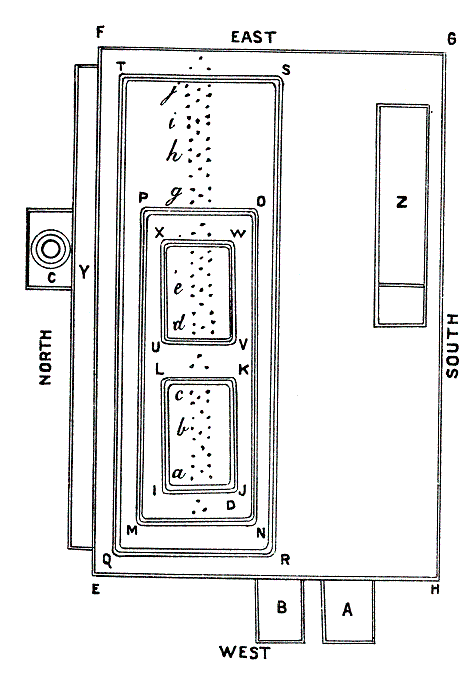
4. The process of giving the Barashnom.
Now we come to the subject of the process of giving the Barashnom. I will at first speak (A) of some requisite preliminary preparations and then (B) of the process itself.
(A.) Preliminary Preparations.
The preliminary preparations consist of the following:— (a) Preparing or consecrating the requisites for the purification. (b) Preparation on the part of the particular priest who gives the purification. (c) Preparation of the Barashnomgah. (d) Preparation of the candidate.
(a) Preparing necessary requisites for the Barashnom.
At first, two Barashnomwalla31 priests who have previously
performed the great Khub32 ceremony, carry
to the Barashnomgah, the following consecrated
articles required for the Barashnom:—
(a) The Nirangdin, i.e., the consecrated urine of the cow.
(b) The Âv, i.e., the consecrated water,
(c) The Bhasam,33 i.e.,
the consecrated ash of the Sacred Fire of the Atash Beharam [Bahram].
Besides these consecrated things, the following utensils and
articles are required in the Barashnomgah:— (a) Two pots-ful
of water. (e) Two metallic cups. (f) The leaf of a
pomegranate tree, (g) Two Naogars, i.e., sticks having nine
knots. One of these two sticks has a metallic spoon at one
end tied with a kusti or sacred thread. Another stick has a
metallic nail similarly tied at one end. The first three
consecrated things are placed within a pavi.34 This pâvi is
on the south side of the Barashnomgah (place marked Z in the plan).
32. The khub ceremony requires the recital of the Yasna and the observance of certain ceremonies.
33. [Sanskrit] is said to be a special purification ceremony among the Hindus. [Skt.] is one of the several names of Shiva, because he sprinkled ashes over his body. [Skt.] is their sacred ash (Calcutta Review of Jany. 1905).
34. Vide above, p. 115.
The purification of the utensils and of the water.
Having placed the above consecrated articles and other
necessary things into the Barashnomgah,
the two priests perform the kusti-padyab, of the water.
and put on the padan. Then one of them
first makes pâv,35 i.e., cleans ceremonially the two small metallic
cups. In one of the cups, he pours the consecrated urine and
throws into it a pinch of the Bhasam or the consecrated ash.
Then he makes the two water-pots pâv and pours into them a
few drops of consecrated water. A few drops of consecrated
water consecrate all the water in the pots.
(b) Preparation on the part of the particular priest who gives the purification-bath.
After preparing the requisite things as said above, the priest
himself takes a bath in the Barashnomgah.
He purifies himself with consecrated water
before purifying the candidate. One of the
above two pots of water is for his use and
the other for the subsequent use of the candidate. He goes to
an adjoining place enclosed by a pâvi (marked C on the plan),
recites the formula of Khsnaothra Ahurahê Mazdâo Ashem Vohû,
and then unclothes himself. He places his clothes at a
little distance from himself on a set of three stones. In doing
so, he removes his turban with the padân hanging over it.
Then, sitting on a big stone, he bathes with the consecrated
water contained in one of the two pots placed before him by
the other priest on a set of three stones. The other priest
sprinkles a few drops of the âv or the consecrated water on the
clothes of the priest. Thus, he symbolically purifies with the
consecrated water his clothes also. On finishing his bath, he
puts on his clothes and in so doing, he puts on his turban with
the padân hanging over it. Then throwing his kusti on his
shoulders, he recites the Kemna Mazda prayer and then puts
on the kusti, reciting the Nirang-i-Kusti.
(c) The preparation of the Barashnomgah.
Having bathed with the consecrated water, the priest now
proceeds to "prepare the Barashnomgah."
As said above, in the modern Barashnomgah,
the place is all ready with the
[128]
9 pits, now-a-days replaced by 9 sets of 5 stones each and with
the intervening sets of 3 stones each. What is left undone is the
drawing of the karshas or the furrows which is technically
known as "preparing the Barashnomgah." He proceeds to
draw the karshas as follows: He takes the two Naogars or
the nine-knotted sticks, in his hands, the one with the metallic nail
at the end in his right hand, and the other with the spoon in his
left hand. Then, going to the place where the sets of
stones commence, he places the nailed end of the first stick on the
first set of 3 stones — the first extra set marked D in
the plan — and stands facing the East. He then recites what is
technically called the Dasturi, i.e., he declares, that he performs
the ceremony as enjoined by the Dasturs. In this recital,
he first recites Khshnaôthra Ahurahê Mazdâo, one
Ashem Vohu and five Ahunwars, and then recites in Baj, i.e., in a
suppressed tone, the Dasturi formula.36 Then he recites loudly
three Ashem vohus, and takes the Baj of Sraosh upto the words
"Vidhvao mraotu." Then saying the word Ashem, once loudly,
and for the second time in a suppressed tone, he goes to the north-west corner
of the limit of the Barashnomgah (marked E in the plan) and draws one karsha
with the nailed end of the nine-knotted stick round the whole boundary, beginning
with the northern side. Some draw this karsha within the permanent
pâvi which shows the inner boundary of the Barashnomgah and
others draw it out of the pâvi on the inside of the boundary.
He slowly proceeds from West to East (E to F in the plan), reciting four Ahunwars
during the process. Then he continues on the eastern side (F to G),
then on the southern side (G to H), and lastly, on the western side (H to E),
reciting three Ahunwars each time. Thus, completing the quadrangle, he draws
the first large karsha referred to, as said above, in the Vendidad.
Then, he goes back to the row of stones and draws 12 karshas round
about them. At first, he draws three karshas round the first set of the three pits
[129]
(I J K L), each represented in the modern Barashnomgah by
three sets of 5 stones and shown in the plan by 5 dots. Then, he
draws 3 karshas round the first six pits, as marked M N O P in
the plan; then, thirdly, round all the nine pits as marked
Q R S T in the plan. Lastly, he draws three other karshas round
the middle set, as marked U V W X. When these 13 karshas are drawn,
the Barashnomgah is technically said to have become taiyâr
i.e., ready for the purification ceremony of the
candidate. The priest, who thus prepares it, finishes the
Baj of Sraosh, the first portion of which he had recited at the
commencement of the work of preparing the Barashnomgah.
(d) Preparation of the candidate.
The candidate for purification first takes his ordinary bath in
the morning with the necessary ritual, either
at his house or at the Fire-temple. At Naosari,
he takes this preliminary bath at his
own house, and then goes to the Barashnomgah. As it is a small
town, and there are quarters which are strictly Parsi quarters,
and the distances to the Barashnomgah and the Fire-temples are
not great, one can easily walk from his house to the Barashnomgah,
and from there to the Temple, where he has to pass nine days
in a kind of retreat. But Bombay being a large city, it is not
quite possible to go from one's house to the Barashnomgah in a
Temple without running the chance of coming into contact with
non-Zoroastrians, from whom he is to keep aloof. So, in Bombay and
in other large centres of population, the candidate — and when
one speaks of a candidate, he is almost always a priest who goes
through the ceremony to qualify himself for the performance of
certain religious ceremonies — takes the preliminary bath at the
Temple. He puts on a newly washed set of clothes. Then, he goes to the
Barashoumgah. If a long interval has passed since his preliminary bath,
he performs the Kusti-Padyab; if not, he need not perform that.
Then he takes his seat on a piece of clean cloth on the ground
within an enclosed pâvi (A in the plan) outside the Barashnomgah
proper. Then, he is made to say the Baj, or prayer of grace,
[130]
and is given a pomegranate leaf to chew, and a little consecrated
urine to drink in one of the two small metallic cups referred to above.
He then finishes the Baj and recites the Patet. The process is the same
as that in the Nan ceremony or in the second form of purification. So,
I need not describe it in detail here.37 He goes through this
preliminary preparation before the technical "preparation of the Barashnomgah."
(B) The process proper of the Barashnom.
Now, we come to the subject proper of the process of the
Barashnom ceremony. Two priests are
required for the purpose.38 As said above,
one of the priests, the purifier, has himself
gone through a purification with consecrated water. He has
'prepared' the Barashnomgah for the purification. The candidate
himself is now ready. The second priest now goes in a
pâvi (Y) outside the Barashnomgah proper, and holds a dog by
a chain in his hand. The candidate is now about to enter into the
Barashnomgah; but before he does so, the priest who is to purify him retires
into the pâvi (Z) wherein the consecrated
articles are kept. An infected person is supposed to step into the
Barashnomgah; so, not only should the consecrated things, but also
the priests who are to purify him and to give him a bath of purification
are supposed to keep themselves out of the chances of infection and pollution.
The pâvi, which is prepared by drawing a karsha or a
furrow round about, protects them.
The candidate now rises from his seat on the ground, leaves the pâvi
wherein he ate and drank the consecrated things, and steps into another pâvi (B).
Coming in there, he takes the Baj. He recites Khshnaothra Ahurahe Mazdao, Ashem Vohu.39
Then he recites in baj, i.e., in a suppressed or
[131]
muttering tone, "Humata, hukhta, hvarshta, hu-manashnê hu-gavashnê,
hu-kunashnê ........40 ........tan pâk," i.e., "(I go
through this ceremony) with good thoughts, with good words and good deeds,41
and I do this with the intention that the good of this may result to the body of
(such and such a person)."
40. Here, he names the person, for whose naiyat or intention he takes the Barashnom. If it is for himself, he says so. Vide above p. 107, n. 5.
41. The words are here repeated in their Pazand form.
This is a later change, development, or rather, degeneration. The original object of the purification, viz., purification from a kind of pollution or infection, was lost, and the ceremony became a kind of qualification for the performance of some ceremonies. The priests go through this, and are paid for that and for the subsequent ceremonies, Yasna, &c. At first, they recited the name of the person who had asked them to perform the ceremonies in certain formula recited in the prayers. But, latterly, they began to recite his or her name in the purification ceremony itself.
The candidate then unclothes himself. He is not to speak anything now. If he has to say anything, he must speak in Baj, i.e., in a suppressed tone. Having unclothed himself, he seats himself on the first set of 5 stones (a in the plan) which represent the first maga or pit of the original Barashnomgah of the Vendidad. While proceeding to the seat, he covers his head with his right hand, because a Zoroastrian is enjoined not to walk bear-headed. With another hand, he tries for decency to cover his private part.
The candidate for purification having taken his seat in the
pâvi or enclosure formed by the karshas or furrows,
the cause of infection is, as it were, confined within that space. As the
infection is not expected to spread, the purifying priest now comes out of
the pâvi, where he had taken his refuge for the sake of
safety. He goes to the candidate to purify him, but always takes care
to stand out of the pâvi formed by the
[132]
furrows in which the candidate is seated. He holds the nine-knotted
stick with the spoon in his right hand, and the
second stick with the metallic nail in his left hand. Then, the
candidate places his right hand on his head. The reason
why he now puts his right hand on his head is that a Zoroastrian
is asked not to speak with an uncovered head.42 When
he has to say anything with an uncovered head, for example,
during the bath, he places his right hand over his head, and
then says what he has to say. Now, as the candidate has
to speak something, as we will see later on, he has to cover
his head temporarily with his hand.
While saying prayers or performing religious ceremonies, a decent head-dress was unavoidably necessary. Herodotus says: "When any one wishes to offer sacrifice ...... he invokes the god, usually having his tiara decked with myrtle." (Bk. I, 132, Ibid, p. 60.)
The priest who has advanced to purify him now places the
spoon-end of the nine-knotted stick on his hand which covers
the head. The candidate then places his left hand over the
spoon. Care must be taken that the hands of the candidate
only touch the spoon, i.e., the metallic part of the stick, and
not the wooden part, which, being porous, is likely to catch
[133]
germs of infection from him. The priest then recites three
Ashem Vohus and the Baj of Sraosh up to "Vidhvao Mraotu,"
and with the word Ashem, (i.e., Purity), removes
from the head the spooned stick. Then going to the
pâvi where the âlât or the consecrated things are placed, and
taking, in one of the small metallic cups above referred to,
a little of the Nirang, goes to the candidate again, pours a
little of it in the spoon,43 and drops it in the hand of the candidate
who applies it to his whole body. He repeats this three times.
The Vendidad (IX, 15-26) enjoins that the application must not be haphazard, but in a particular way beginning from the top of the head to the tip of the toe. It says, that, at first, both the hands must be cleaned or purified with the Nirang, so that, with those clean hands, he may clean all the other parts of the body. It says (IX, 15): "At first, both his hands must be washed. If both his hands are not washed at first, he makes his whole body unclean." The Nirang after its application to the hand, must be applied to the other parts of the body in the following order: The head, the front part of the face between the brows, the back part of the head, the cheeks, the right ear, the left ear, the right shoulder, the left shoulder, the right arm-pit, the left arm-pit, the chest, the back, the right nipple, the left nipple, the right rib, the left rib, the right hip, the left hip, the sexual parts, (if the candidate for purification is a male, the application must first be on the hind part and then on the front part; but if a female, it must begin on the front and then on the hind part), the right thigh, the left thigh, the right knee, the left knee, the right shin of the leg, the left shin of the leg, the right ankle, the left ankle, the right instep, the left instep, the right sole of the foot, the left sole of the foot, the right toe, the left toe.
The Vendidad adds, that, with such an application, the Druj-i-Nasu, i.e., the Evil of infection or — to speak in modern [134] scientific language — the microbe of infection leaves the particular part of the body thus cleaned and runs down to the next named part, and, at last, leaves the infected person at the foot, making good his escape in the northern direction.
Now-a-days, the application is not so systematic and not in the same successive order as enjoined in the Vendidad. It differs in several points:—
(a) Firstly, it is a hasty application or rubbing of the Nirang
from head to foot, (b) Secondly, the Vendidad enjoins the priest
who purifies the candidate to throw or sprinkle the Nirang gradually
upon the different parts of the body, one after another.
That process would require a very large quantity. But in
practice now, the priest gives at once a little quantity, about
a tea-spoonful the most, in the hollow of the hand of the
candidate who applies that quantity over all the parts of
the body, (c) Thirdly, in modern practice, the priest drops
the Nirang in the hands of the candidate three times at each
pit. This triple process of dropping it is, perhaps, to replace,
and to make up for, the abandonment of the very long and
intricate process of the application as enjoined in the Vendidad.
(d) Fourthly, it is enjoined, that the words "nemaschâ, yâ
Ârmaitish izhâchâ" (i.e., praise and commendation to Armaiti,
i.e., to the Purity of thought) are to be recited by the priest
and repeated by the candidate before the first application or
washing, but, in practice, they are recited after the first triple
application.
Then, to proceed in our description of the process of the Barashnom,
the priest, after dropping the nirang into his hands, retires
again into his pâvi or enclosure where the âlât or the consecrated
articles are placed. The candidate is isolated within the karshas
or the furrows. The isolation is shortly to be broken or
dissolved by the other priest who is to present a dog before the
candidate.44 If that is done, the purifier himself, coming within
[135]
the circle of pollution or infection, is likely to catch infection.
So, he retires within his enclosure (Z) of isolation for safety.
The other priest then advances with a dog held by a metallic
chain, and keeping himself at a distance beyond the pâvi, —
in this case the first and distant karsha or furrow, — presents the
dog before the candidate who then touches with his left hand
the left ear of the dog.
 44. The isolation of the pâvis is said to be broken or dissolved when a
contact is made between a person or persons or a thing or things
within the pâvi and between a person or persons, or a thing or things
outside the pâvi. For example, suppose the adjoining A
figure represents a space enclosed in a pâvi. The
lines AB, BC, CD, DA represent the four furrows of
the pâvi on the four sides. Now suppose a stick or
a handkerchief falls on one of the pâvis in the way
shown at E. Then, the pâvi is said to be connected D
and so the isolation is said to be dissolved or broken.
44. The isolation of the pâvis is said to be broken or dissolved when a
contact is made between a person or persons or a thing or things
within the pâvi and between a person or persons, or a thing or things
outside the pâvi. For example, suppose the adjoining A
figure represents a space enclosed in a pâvi. The
lines AB, BC, CD, DA represent the four furrows of
the pâvi on the four sides. Now suppose a stick or
a handkerchief falls on one of the pâvis in the way
shown at E. Then, the pâvi is said to be connected D
and so the isolation is said to be dissolved or broken.
The Dog in the Barashnom ceremony.
I will say a few words here on the use of the dog in this
purification ceremony. In the 9th chapter
of the Vendidad, where a lengthy description
of the Barashnom purification is given,
we find no reference to the dog. But it is in its Pahlavi
commentary that we find it. There, on the authority of
the later commentators, it is said, that "when they (the
candidates for purification) pass from one pit to another,
the dog may be held before them once."45 The 8th chapter of
the Vendidad (§, 37-38) also enjoins the presentation of a dog
before the candidate. The description of the 8th chapter,
though it refers to the Barashnom purification, refers specially
to the case of an inferior kind of pollution or infection. It is the
case of a person who has merely "touched the corpse of a dog
or of a man." But the case in the 9th chapter is rather a more
serious case — the case of a person who has not simply touched
the body but is actually "defiled by the dead." In this latter
case, he is supposed to have come into greater contact with the
corpse and to have disregarded the observances and restrictions
[136]
enjoined by the then sanitary authorities in the matter of isolation.
So, when in the first case (Vendidad, VIII), viz., that of
merely touching the body either accidentally or for some purpose
under proper observances, he is to go through mere purifications
and baths, in the latter case (Vendidad IX) of an actual defilement,
he is not only to go through the purification, but also through an
isolation for 9 days and nights. He was to remain aloof, as we will
see later on, for a period of full 9 days and 9 nights, i.e.,
about 10 days.
Now, the question is: why was it enjoined that a dog should
be presented before the candidate for purification? One cannot
speak with authority or certainty, but can advance a probable
reason by analogy or inference. The reason seems to be the
following:— Of the several means or ways to be adopted to
do away with the spread of disease or infection, one was the
speedy consumption of the body that was the centre of disease
or infection. Consumption by the flesh-devouring animals was
one of such ancient prevalent ways. In the Vendidad, we find
a reference to the old primitive way when corpses were exposed
on tops of mountains, so that flesh-eating birds and animals,
like vultures and dogs, who served as scavengers of Nature may
devour the flesh. The dog was a domestic animal useful to the
ancient Iranian in many ways. He served as a policeman to guard
his house, to guard his fields, to guard his flock. Not only that,
but it served him, as said above, as a scavenger of Nature in
eating away the flesh of the corpse of a deceased person which
otherwise would have gone on decomposing, and then endangering
the health of his town. So the dog was, in the eyes of an ancient
Iranian, a very dear and useful animal. What is very dear and useful
whether that be a man, an animal, or a thing is, as it were, in one
sense, sacred. The dog therefore became a useful and sacred animal
in the eyes of an Iranian. His great and important services were
those of stopping decomposition and of stopping the spread of
disease and infection. Such being the case, one of the several
objects, why on the death of a person, the dog was brought before the
[137]
corpse for sagdid, was, that the dog may see, that a person was
dead and that a prey was ready for him. He may, by instinct,
know, what was waiting for him. The second object, which
arose from the first object and from all the above considerations,
was rather more symbolic. The dog, being the scavenger
of Nature, and as such, as said above, one of the means for the
prevention of the spread of disease and infection, one of the
means for keeping pure the earth, air, and ground of God, was the
symbol and type of purification. Other thoughts and ideas seem
latterly to have been associated with the dog, on
account of his other characteristics as a faithful domestic
animal. So, from all these considerations, he was brought
before a corpse and made to see the corpse. His very eyesight was,
as it were, a means of purification. So much for his presence
before the corpse.
From the view of his presence before a corpse which was a
great centre of putrefaction, infection and disease, the view
of his presence before a person who was polluted and infected
and who was therefore another, though lesser, centre of infection
and disease, was only one step. The dog was a means, a channel, an
instrument for purification, for keeping the air, earth and water
of God pure. Here, in the Barashnomgah, there is a candidate, who
coming into contact with a corpse, seeks purification, so that,
being purified, he may not continue to be a source of danger to
those round about him. So, the dog's presence there was thought
necessary to emphasize the original object of purification. The
dog was one of the instruments of Nature in keeping its products
pure. Here is a person, who to avoid any chance of infection, lest
his infected condition may be a source of danger, goes through a
form of purification. Thus, the presence of the dog before the
person, who very likely was as infectious as a corpse, was symbolic
and significant.46
Now there does not seem to be any particular significance in the candidate touching the left ear of the dog with his left hand. As we said above, the candidate had now and then to keep his head covered with his right hand. Again, the dog had to be presented to him from beyond the furrows on his left. So it is only his left hand that was conveniently available. It is perhaps to preserve harmony or uniformity, that he touches the left ear of the dog. Perhaps, it is convenient also on account of the position of the dog. As we said above, the west is the side from which they enter the Barashnomgah, and the candidate proceeds to the east. The priest who fetches the dog also comes in from the west. So, the dog, when it is made to stand on the left side of the candidate, with its face towards him, has his left ear conveniently near. There seems to be no other particular signification for this. As to the reason, why the candidate touches the ear, it seems to be only to draw its attention to himself. In the East, they generally twist the ear of a person to make him look a little sharp if he is careless or indolent. The ear of a child is twisted by a parent or teacher to make it look a little sharp.
The candidate is not to let his left hand touch his body. His hands were
cleaned in the above process of the first purification by the nirang.
Having come into contact with something else,
[139]
which, in its turn has not been washed, a part of the purity of the
hand is said to have been lost by a touch to the dog. So, he must not
apply it to his body before purifying it. This he does at the early
stage of the next or second stage of purification at the second set
of 5 stones which represent the next maga or pit.
Repetition of the application of nirang, &c.
On the dog being removed from near the candidate, the isolation
of the candidate within the furrows is
secured and the priest gets out of his pâvi or
enclosure with the spooned nine-knotted stick
in his hand, and recites the Kem na Mazda prayer upto the word Ashahê.
Then while reciting the next word 'nemaschâ yâ Ârmaitish izâchâ'
points with his above stick to the second set of 5 stones (marked b, in the plan)
which represent the second maga or pit referred to in the Vendidad.
That means an intimation that he should now advance further. The candidate
thereupon repeats the words 'nemaschâ yâ Ârmaitish izâchâ,'
and advances, towards that set. On his taking his seat there, the priest
repeats thrice the above described process of handing some nirang
for fresh application. The candidate applies it to the whole of his body
as described above. The priest again retires to his pâvi (Z).
The second priest again advances towards the candidate with the dog.
The candidate again touches the left ear of the dog. The priest with
the dog retires and the first priest again gets out of his pâvi,
advances towards the candidate, recites the abovesaid Kem nâ Mazdâ
prayer as described above, asks the candidate to advance to
the third set of 5 stones and gives him the nirang for application.
Then the priest with the dog again advances. Thus the same process, with the
above details and particulars, is gone through altogether for six times
on the first six sets of pits which are represented in the modern Barashnomgah
by the first six sets of 5 stones (a, b, c, d, e, f in the plan).
Application of sand.
On coming to the seventh maga or pit (g) or the seventh
set of 5 stones, the application to the body
is not that of the nirang, but that of mere
[140]
sand (khâk).47 The details of the process are the same
as those described above in the case of handing the nirang.
This is done 18 times, i.e., the sand is given 18 times for application.
The modern Barashnomgah is covered over with sand
which is renewed occasionally. So, it is some of this sand
that the priest gives to the candidate. Having given this
18 times, the priest again retires to his pâvi (Z) and the other
priest with his dog advances and the same process of touching
the dog is gone through.
Application of consecrated water.
Then the first priest again gets out of his pâvi for the 8th time. At this time, before reciting the Kem nâ Mazdâ prayer as described above, he utters "Ahunem varirîm tanûm pâiti," (i.e., "the prayer of Ahunwar or Yathâ Ahû Vairyô protects the body") and then recites the Ahunwar formula once. He then asks the candidate, as before, to advance to the 8th pit or set of 5 stones (h). On the candidate taking his seat there, the application to the body is neither that of nirang nor of sand but of âv, i.e., consecrated water. This he does three times. The candidate applies the consecrated water to his body as he had previously applied the nirang and the sand. The first priest retires into his pâvi (Z) and the second priest with the dog advances, and the same process is gone through as before. Then, the first priest getting out of his pâvi recites "Ahunem Vairîm tanûm pâiti, Yathâ Ahû Vairyô, and Kem nâ Mazdâ" as at the eighth stage of the process and asks the candidate to advance to the ninth pit or the 9th set of 5 stones (i). Here again he gives him thrice the consecrated water for application as at the 8th set of stones. The whole of the process is the same. But there is this difference, that at this 9th pit or set of stones, the whole process is repeated or gone through twice. [141]
Then again the first priest gets out of his pâvi, recites
"Ahunem Vairîm tanûm pâiti, Yathâ Ahû Vairyô,
and Kem nâ Mazdâ" prayers, as he did three times
before (once at the 8th stage and twice at the 9th stage), and asks
the candidate to advance to the final stage, i.e., the final
or the tenth set (j) of 5 stones, which, in the modern Barashnomgah,
is generally replaced by a large broad stone on which one can conveniently
sit and bathe. Here again, the priest gives thrice the consecrated water
for application and the same process is gone through. But, the process
of the recital of the prayers by the first priest and the application
of the consecrated water by the candidate is repeated or gone through
thrice. The process of the presentation of the dog before the candidate
by the second priest is gone through twice.
The bath at the last stage.
The first priest, after giving the consecrated water for application for the last time on the last stage, places the small metallic cup on the ground out of his pâvi, and makes a small pâvi round the cup. He then brings out of his pâvi the second pot of water which is consecrated by the addition of a few drops of âv or consecrated water and pours a little water out of it into the above-named small metallic cup. Then, taking the pot before the candidate, he pours gradually the water out of the pot upon his body. He must take care, that, in doing so, he himself is not besprinkled with water. He must stand beyond the karsha or the furrow. This is the final bath. He then once more retires to his pâvi and the other priest presents the dog again before the candidate for the last time. He touches it, keeping his hand thus touched, apart. The dog being removed and the contact broken, the first priest gets out of his pâvi and recites once more "Ahunem Vairîm tanûm pâiti" and "Yathâ Ahû Vairyô" and the "Kem nâ Mazdâ" prayer upto Nemaschâ yâ Ârmaitish izâcha. The candidate repeats these last words after the priest. [142]
The following table gives a list of the above details of the applications, &c, in the process of the Barashnom purification, according to the modern practice:—
A table showing the number of applications.
| No. of the Maga (pit), or the stage, or set of 5 stones. |
Kind of the con- secrated substance applied. |
No. of applica- tions |
Prayer recited. | The pre- sentation of the dog. |
|---|---|---|---|---|
|
1st stage .. 2nd ,, .. 3rd ,, .. 4th ,, .. 5th ,, .. 6th ,, .. Intervening space represented in the modern Barashnomgah by 3 stones. 7th stage .. 8th ,, .. 9th stage. Pro- cess repeated. 10th or the final stage. |
Nirang Do. Do. Do. Do. Do. sand .. âv (wa- ter) 3 âv 3 âv 3 âv 3 âv 3 âv 3 | 3 3 3 3 3 3 18 3 6 9 |
Kem nâ Mazdâ 1 Do. 1 Do. 1 Do. 1 Do. 1 Do. 1 Ahunem Vairim tanûm pâiti, Ya- thâ Ahû Vairyô and Kem nâ Mazdâ. 1. .. Do. 1 Do. 2 repeated twice. Do. 3 repeated thrice. |
Once. ,, ,, ,, ,, ,, ,, ,, Twice. Thrice. |
This table shows that there were altogether 18 applications
of nirang or consecrated urine of the ox, 18 khâk or sand and
[143]
18 of âv or consecrated water. The first priest recited the
Kem nâ Mazdâ prayer only six times and recited that prayer with
Ahunem Vairîm Tanûm pâiti and Yathâ Ahû Vairyô
seven times. The dog was presented before the candidate 13 times.
Consecrating the clothes.
After the recital of the final Kem nâ Mazdâ, as said above,
the priest fetches the candidate's new set
of clothes before him. It was placed
aside in the Barashnomgah beforehand.
He pours over that suit a few drops of consecrated water
from the small metallic cup which he had filled up just a
little while ago. Thus, he consecrates the candidate's clothes
before he puts them on. He pours the rest of the water out of
that cup upon the left hand of the candidate, which had remained
uncleaned since he had touched the dog for the last time with
that hand. The priest then retires to his pâvi again. The
candidate now puts on his suit of clothes and places his Kusti
or sacred thread over his shoulders. He then puts on his Jâmâ
or a loose linen overcoat which forms the upper garment of
a Parsee's full dress. This garment has always long sleeves.
While putting it on in the Barashnomgah after his bath of purification,
he is not to pull up these long sleeves, but is to keep them hanging.
Then the priest comes out of his pâvi with his two
nine-knotted sticks in his hands. The candidate then throws the loose
low skirt of the right-hand side of his loose hanging gown (Jâmâ)
on his left shoulder, placing his left hand under it over the shoulder. The priest
places the spooned end of one of his knotted sticks over the abovesaid
skirt of the gown. The candidate places his right hand covered with its
hanging sleeves over the above spooned end of the priest's knotted stick.
In all this, care must be taken that the candidate's sleeves and clothing
touch only the metallic spoon but not the wooden part of the stick. Then
the candidate finishes the Baj which he had taken when he had just
entered the Barashnomgah for purification and just before removing
his clothes.48
When the candidate has individually finished the Baj, he and the priest jointly again finish the Baj. Having done so, the priest makes the candidate recite the following formula:—
"Zadeh nasash, sar o tan pâk ashahê ravân (he repeats the words three times), sag asho harbad pâk." (These words also are repeated thrice). The words mean, "The Nasu, i.e., the Evil Spirit of pollution is put down. The head and the body, (i.e., the whole body) have become purified. The soul has been purified. The dog is holy, the priest is holy."
When these words are repeated, the priest lifts up his knotted stick
from the shoulder of the candidate who now puts on the sacred thread [kusti]
that was hanging over his shoulders, reciting the Nirang-i-Kusti.
This finishes the ceremony of the Barashnom purification.
5. Retreat after the Barashnom.
Retreat of 9 days.
Though the purification proper is finished, the candidate has still to wait for full nine days and nights before he goes to his usual avocation.49 After the purification, he retires from the Barashnomgah to the Dar-i-Meher or Fire-temple. Some temples, for example the temples at Naosari, have a separate place for the purpose, which is called nâhnkhâneh (i.e., the place for nâhn). It is so called because the Barashnom also is ordinarily known as nân, the name by which the second purification is known. There, he has still to remain aloof from others. He is not to come into contact with anything. His food and water are to be served to him in his plates and cups by other persons. He has to take his meals during the day-hours. He is to eat with a spoon in a gloved hand and not to use his fingers. He has a separate suit of clothes for the purpose of his meals. He has to say his prayers for the most part of his time, especially at the commencement of the 5 gâhs or periods of the day. The [145] first three nights must be, as it were, nights of 'vigils,' i.e., when he sleeps, he must sleep in a watchful or wakeful mood, so as not to let his sleep be disturbed by worldly thoughts. If he is disturbed by a nocturnal pollution during the first three nights, he has to repeat the whole of the Barashnom purification referred to above.
If the Bareshnum is gone through for being qualified to perform the Nirangdin ceremony which is the ceremony for the consecration of the gaomez or cow's urine, a nocturnal pollution during any of the nine days and nights of the Retreat vitiates the whole Barashnom, which, in that case, is to be repeated. The priests in this ceremony are expected to pass their time in pure mental thoughts, in devotion, and prayer. A wet dream is a proof that they have not done so. So, they are disqualified to perform a religious ceremony in which gâomez (urine) and âv (water) are consecrated for the purification — both physical and mental — of others. If those who consecrate a thing are not mentally pure, the things consecrated by them are not expected to have the influence of purifying the body and elevating the mind of others. He only, who is himself pure — both physically and mentally — can make others pure, both physically and mentally. In the case of the initiates or candidates for priesthood (nâvar), a similar state of mental purity is expected for a much longer time.
Again, the candidates are not to sit, rest, or sleep on wooden chairs
or benches or beds, when in the Retreat. They spread their beds
on the floor. Wooden things are all avoided. They are not to use
water for any purpose except for drinking. They are to perform their
pâdyâb also with the application of a little
gaomez. They observe the dry system and use a kind of clay
instead of sanitary paper.
The navshu baths.
On the fourth day, after their great Barashnom purification, they are to go through a bath which is known as the first navshu, i.e., the first bath (or, [146] wash 'shu') out of the nine nights of the Isolation or Retreat. The process is as follows:—
In the Bareshnomgah or in any other clean place covered over with dry sand, a pâvi or enclosure is made by drawing three karshas. A set of three stones is placed therein for the candidate to sit on to bathe. Then a priest with the Barashnom, who has performed the Khub, makes pâv, a water-pot and a small metallic cup. The water-pot is then filled with ordinary pure water. A few drops of the consecrated water are put into it. This consecrates all the water. In the metallic cup is poured a little of the consecrated gaomez. The candidate then goes to the place and undressing himself, puts his clothes in an adjoining pâvi. He then takes his seat on the above-mentioned set of three stones, facing the east. Then the priest who is to give him the supplementary sacred bath, brings the metallic cup containing gaomez before him, and places it out of the pâvi of the candidate drawing a pâvi or karsha round about the cup. The candidate then places his right hand over his head and takes the Baj of Srosh, beginning with 3 Ashem Vohus. Reciting the Kem nâ Mazdâ, upto the word Ashahâ, he takes the metallic cup before him and applies the gaomez thrice over his whole body. Having done so, he removes the cup out of his own pâvi. The priest then brings the pot of the consecrated water and places it before him, drawing a pâvi round it. He pours a few drops of the consecrated water out of the pot upon the newly washed set of clothes which the candidate is to put on after his bath. He thus consecrates the clothes also. The candidate then bathes himself. Then, putting on his clothes and placing his sacred thread over his shoulders, he finishes the Baj, facing the sun. He then puts on his sacred thread. This finishes the first navshu bath. If the candidate has gone through the first great Barashnom purification in the Hawan gah, i.e., in the morning he must have his first navshu in the morning of the fourth day. If he has gone through it in the Uzeran gah, i.e., in the afternoon, his navshu bath must be had in the afternoon. [147]
After the navshu bath, the candidate again returns to his place
in the Fire-temple and observes the regulations in the same way as during
the first three days. He then has a second navshu bath on the seventh day.
The process is all the same, but with this difference, that at this second
navshu he is given two pots of water. The second pot need not be
as large as the first. A small one is generally given. Then again, three
more days of retirement are observed. The above process is gone through on
the tenth day, but with this difference, that in this third navshu,
three pots of water are given him to wash his body with. After this
final bath, he is free to come into contact with all.
The Khûb after the Barashnom.
We said above, that it is generally the priests now-a-days
who go through the Barashnom purification
ceremony, and that, that ceremony is held to
qualify them for the performance of several
liturgical ceremonies. So, to qualify themselves for these, they
perform, in the morning of the 11th day,50 what is called the
Khub ceremony. It consists in the recital of the whole of the Yasna,
accompanied by its ritual. A priest who has himself performed the Khub
previously, makes him get through this Khub ceremony. This finishes the
whole of the Barashnom.
The time of the Barashnom ceremony.
The Barashnom purification, as well as the Nân purification,
can be gone through the day-time only,
and not at night.51 Again the Barashnom
purification, in modern practice, is gone
through, only during the dry season52 and not during the rains.
The Naosari priests stop it from roz Behram [Warharan], month Aban
(the 20th day of the 8th month), up to roz Behram [Warharan], month Frawardin
(the 20th day of the 1st month), of the next year. Among the priests
of other towns, the days vary somewhat.
[148]
The reason seems to be this. As said above, it is enjoined
that the place of the Barashnomgah must be dry and free from
moisture. But the rains prevent the ground from assuming this
state of dryness. Even in the ordinary dry season, if it rains
out of season, the purification ceremony cannot be gone through.
Not only that, but even if it rains continually for a day or two,
during the nine days and nights of the Retreat, one is to abandon
his course of Retreat and to repeat the whole Barashnom from the
very commencement when the weather gets dry and the Barashnomgah
gets free of moisture. The reason for vitiation is, that, owing
to the continuous rain, he is not likely to avoid rain water
falling upon him while going out for purposes of nature to the
proper places which are generally detached from the Temples, and
while going to the Barashnomgah for his first, second or third navshu.
52. Ibid. amat dayan mag-i pavan gomiz vârân vâdunyen la shâyad.
A Barashnomwala priest. Causes that vitiate the Barashnom.
A priest, who has gone through the complete Barashnom purification including the final Khub ceremony, is said to be a Barashnomwala priest, i.e., a priest with the Barashnom qualification. He is said "to hold" that qualification as long as he observes certain rules and observances enjoined by custom to be held. A priest may hold that qualification for years together, or his qualification may be vitiated or made defective in a short time. When holding the Barashnom, he is qualified to perform the religious ceremonies of Baj, Yasna, Visparad, and Vendidad, which are generally performed in a Fire-temple. If he does not hold the Barashnom, he cannot perform these, but can perform ordinary ceremonies, such as the Naojote, Marriage, and Afrinagan.
The non-observance of the following regulations and observances vitiate the Barashnom: 1. Eating of food cooked by non-Zoroastrians. 2. Non-observance of the Baj. 3. Long travels and voyages. 4. Swearing or taking oaths. 5. Falling off of the turban from over the head. [149]
1. Food cooked by non-Zoroastrians.
Barashnomwala priests are required to abstain from food cooked,
and water fetched, by non-Zoroastrians.
Custom in India has gone even further and
has enjoined that they must be cooked
and fetched by a member — male or female — of the priestly class.
Even the holy bread (Dron) which they consecrate in the Baj, Yasna,
and Vendidad ceremonies must be prepared by members of the priestly class.
Upto a few years ago, even the laymen abstained from food cooked by non-Parsees.53
2. Observance of the Baj.
They must commence and finish several daily functions of
necessity, with the recital of the Baj. Some
of these functions are the meals, baths and calls of nature,
which all have their proper bajs or recitals to be made at the
beginning and end. These recitals do not take a long time, but
they generally begin and end with the Padyab-Kusti. The non-observance
of these regulations vitiates the Barashnom.
3. Long travels and voyages.
Long travels vitiate a Barashnom. It is generally so, in the case of long railway travelling. The reason seems to be that while so travelling, it is not possible for the Barashnomwala priest to observe the above rules and regulations about saying the Bajs on the necessary occasions or functions. For example, he must perform the Padyab-Kusti before his meals. To do that, he must have pure clean water fetched by himself or by a Zoroastrian. He must tie and untie his sacred thread. While doing so he must avoid contact with a non-Zoroastrian. All these cannot be done in a long journey by railway train. [150]
Long voyages also vitiate a Barashnom; not only that, but they are
held to disqualify a priest on his return to his town from performing
the Yasna, Vendidad, Baj and such other higher liturgical ceremonies.
The version of Tacitus on the subject of long voyages.
This is an old Iranian custom referred to by Tacitus, in his
account of the Parthian King Valkhash
(Vologeses) and his brother Tiradata (Tiridates),
the King of Armenia, who lived in
the time of Emperor Nero and who belonged to an orthodox
priestly family. They were both kings as well as priests.
When called to Rome by Nero, to receive his crown as King
of Armenia from his own hands, Tiridates refused on account of
his religious scruples to go by sea. Tacitus says on this point:
"Neither would his (Vologeses') brother Tiridates refuse coming
to Rome to receive the Armenian diadem, but that the obligation
of his priesthood withheld him: he would, however, go to
the standards and images of Caesar, and there, in presence of the
legions, solemnly receive the Kingdom."54 Subsequently when
Tiridates did go to Rome, he went by land instead of by sea.
It is said that even Valkhash (Vologeses) refused to go to Rome
by sea, when called by Nero.
Reason for this prohibition suggested by the Vendidad and supported by the writings of Heroditus and Strabo.
The reason seems to be this: The Zoroastrian books, and
among them, the Vendidad especially, enjoin
that no impurities may be thrown into water.
If a Zoroastrian finds some rotten thing
thrown in water, it is his duty to get into
the water and remove it (Vendidad, VI,
26-27), lest it may infect the water and endanger the health
of the living. Herodotus refers to this old Iranian view
when he says: "They (the Persians) neither make water, nor
spit, nor wash their hands in a river, nor defile the stream
with urine, nor do they allow anyone else to do so."55 Strabo
[151]
also refers to this custom and says: "The Persians never
pollute a river with urine, nor wash, nor bathe in it; they never
throw a dead body nor anything unclean into it."56 In long
voyages by sea, a Zoroastrian priest has to commit nuisance
therein and throw impurities in the sea. So, he is prohibited
to go on long voyages. If he does, not only is his Barashnom
vitiated, but he is prohibited from going through it again.
This prohibition seems to stick to the letter and not to the
spirit of the original commandment. The prohibition to throw
impurities in water was originally in the case of the fresh water
of streams and rivers. Herodotus and Strabo refer to the fresh water
of rivers. So far, it was good and sanitary. But as it generally
happens in the matter of many commandments, the field of operation
for the above wholesome regulation was widened and made unduly
strict in later times, even as early as in the times of the Parthian dynasty.
56. The Geography of Strabo (translated by Hamilton and Falconer, 1857). Vol. III, p. 137; Bk. XV, chap. IV, 16.
4. Prohibition to take oaths.
If a priest holding the Barashnom has to go to a court of
justice, and there to swear or take an oath,
his Barashnom is vitiated, and he has to go
through it again if he wishes to continue his
profession. This custom also seems to be a very old Iranian
custom. We find references to it in old Parsee books. Adarbad Marespand57
asks his readers not to swear. The prohibition
seems to rest on the oft-spoken characteristic of an ancient
Iranian, viz., to speak the truth and nothing but the truth —
a characteristic referred to by Herodotus,58 Xenophon,59
Strabo,60 Plato,61 and Nicholas Demoscenes.62
To speak the truth was considered, as it were, the birth-characteristic of an
ancient Iranian. His word must be taken as true by the opposite party. If it
was not, and if he had, in order to support it, to swear or to take an oath,
that was, as it were, a slur upon his
[152]
character. If he yielded and swore, he, as it were, showed his
want of self-respect. That being the view, an ancient Zoroastrian
was prohibited from taking an oath. The modern custom seems to be a
relic of the old idea. So, if a priest has to go to court and
unavoidably to take an oath, he is supposed to have gone against
an old commandment, and therefore, his Barashnom is vitiated. Hence,
Parsee priests generally avoid going to courts, especially during the
monsoon months, when, owing to the rains, they cannot go through the
Barashnom ceremony again to qualify themselves for the performance of
the inner ceremonies of the Temple. They are very careful to avoid any
action that may vitiate their Barashnom during the rainy months, because
the Frawardigan holidays, during which their services are in greater
demand and better paid, occur at the end of the season.
58. Bk. I, 136, 137.
59. Cyropædia, I. 20.
60. XV, ch. III, 18.
61. Alcibiades, I, 121.
62. Fragment, 67.
5. Falling off of the turban. The turban and the padân, the insignia of priesthood.
The Parsee priests generally wear white turbans. If the
turban falls off from their head, even
accidentally, that vitiates the Barashnom
of the priest. The reason seems to be this:
Firstly, all Zoroastrians are required to
have their heads covered. It is improper to remain with head
uncovered. So the falling off of the hat interrupts the observance
of the custom. But the most important thing is this,
that the turban and the padân are, as it were, the insignia of
the office of priesthood. When that insignia falls off from the
head, he is, as it were, deposed from his sacred office. So, his
Barashnom, which qualifies him for that office, is considered to
be vitiated, and he has to repeat it, if he wishes to continue
to perform that sacred office. This custom seems to be an old
custom common among some other ancient nations. "In the
old religions, one so often finds that the celebrant and assistants
officiated with shrouded heads. . . . . . The Flemins
of Jupiter were forbidden to present themselves in public or
even to go out into the open air without their skull-caps,
and that, too, by a law so stringent that Sulpicius, when the
[153]
tuft of his fell off accidentally, was deposed from his sacred office."63
The padân or the piece of cloth, which a Parsee priest puts on
over the face while performing religious ceremonies, is also held as an
insignia of the qualification of the Barashnom. Though it is put on by the
priests in other ceremonies also wherein the Barashnom qualification is not
necessary, still, in the phraseology common among the priests, "padân bândhvu,"
i.e., to put on the padân, means to be qualified to officiate
with the Barashnom. When the head-priest permits the subordinate priests to go
and officiate in the Yazashnagâh of the Temple, he says, "Put on the Padân."
When he wants to prohibit somebody from officiating there, he says, "Do not put on the Padân."
So when one pulls off the padân from over the face of a priest,
or when he takes off or throws off the turban from over his head, he deprives
him of his qualification and is responsible for the action. The Barashnom of
the priest, so deprived, is vitiated.
IV. Riman, The Fourth Form of Purification.
Riman purification. Its process.
As said above, the Barashnom purification, though originally a purification for those who had come into contact with the dead, especially the dead who died of infectious diseases, has, now, with its accompanying retreat and Khub ceremony, come to be a form of purification for the priests who wish to perform the religious ceremonies of the inner circle of the Temple. So, now-a-days, those who have come into contact with dead bodies, in ways that have been prohibited, have to go through a comparatively simpler form of purification. It is known as Riman purification. We will describe it here shortly:—
The word Riman  P.
P.  comes from 'rim,'
(Pahl.
comes from 'rim,'
(Pahl.  P.
P.  or
or  from Av. root ri
  Sans.
Sans.  to ooze, to be foul, to
[154]
desecrate) i.e., pus, filth. This word seems to be the same as
English 'rheum' meaning "serous fluid secreted by mucous
glands." So 'riman' is one that has become polluted by coming
into contact with filth from dead bodies. In this form of purification,
the services of two persons are required, one of them must be a priest,
the other may be a layman. In order to be qualified to purify a riman
(i.e., the person supposed to be polluted or infected) by this
process of purification, the priest must perform the Khub ceremony. The
efficacy of his Khub ends with the purification. If he has to perform
other ceremonies which require tho Khub, he must repeat the Khub ceremony.
In the riman purification, the alat, i.e., the consecrated things
and the other requisites required, are the same as those in the Barashnom.
to ooze, to be foul, to
[154]
desecrate) i.e., pus, filth. This word seems to be the same as
English 'rheum' meaning "serous fluid secreted by mucous
glands." So 'riman' is one that has become polluted by coming
into contact with filth from dead bodies. In this form of purification,
the services of two persons are required, one of them must be a priest,
the other may be a layman. In order to be qualified to purify a riman
(i.e., the person supposed to be polluted or infected) by this
process of purification, the priest must perform the Khub ceremony. The
efficacy of his Khub ends with the purification. If he has to perform
other ceremonies which require tho Khub, he must repeat the Khub ceremony.
In the riman purification, the alat, i.e., the consecrated things
and the other requisites required, are the same as those in the Barashnom.
The place for this purification.
The place of the purification must be one which is the least frequented by people. On such a place, the priest has to prepare altogether nine pâvis or enclosures. While preparing these, he is to bear in mind the position of the sun and the direction of the wind. The pâvis must be so drawn as not to let the shadow of the riman's body fall over the purifier, and thus deprive him of the heat and light of the luminary. Again, they must be so arranged that the direction of the wind may not be from the riman to the purifier, lest it may carry any germs of disease from the infected person to the priest. The pâvis may be prepared either by digging in the ground, or by spreading sand on the ground in a way which may form a furrow. Generally it is done in the second way. Seven of the pavis must be in one line and two others in a line by the side of this row adjoining the central part of the row. A tenth circular pâvi must be drawn at a distance with six [155] circular furrows. A set of three stones are to be arranged outride this circular pâvi.
Description of the plan.
The above plan gives an idea of the place. In the pâvi A,
the priest first places all the alat or the consecrated
requisites. He then performs the
padyab and then fetches water from a well
in two pots previously made pâv or purified by three washings.
One of these two pots is large and the other small. Then he puts
on tight trousers known as ijâr and also the padân. Then, as
in the case of the Barashnom, he makes two small metallic cups
pâv, and, after having dried them, pours in one a little of the
nirangdin, i.e., the consecrated urine and the bhasam, i.e.,
the sacred ash, and into another a little of the urine for external
application. He then makes the two water-pots pâv and throws
a little of the âv or consecrated water into them. The priest
then retires to his pâvi wherein the alat are placed. Then the
riman, i.e., the person who seeks purification, undresses himself
at a distance and buries his clothing in the ground. He then
comes and takes his stand in the pâvi G allotted to him. The
second person who has accompanied the priest and whose
standing place is somewhere about L gives to the person who is
[156]
riman all the necessary instructions as to where to seat himself
etc. He gives these instructions by a show of hands and signs.
He is not to speak anything.64 He must not go so near the riman
as to let his shadow fall upon himself or to let the wind blow from
his direction towards himself. The priest then pours the consecrated
urine from the small metallic cup into an empty shell
of an egg. This is done to avoid even a drinking cup coming
into contact with the lips of the person supposed to be infected.
He places the shell so filled and a leaf of the pomegranate in the
pâvi (marked I). The second person lifts these up and
places them in the pâvi F. He, by signs, instructs the riman
to chew the pomegranate leaf and then to drink the consecrated
urine three times from the shell of the egg. The riman must
avoid touching his lips with the shell but try to pour the consecrated
urine into his mouth, so that even the shell of the egg may not catch
any germs. Having drunk from it, he breaks the shell and buries it in
the ground near his place. Then
the priest advances from his pâvi A to the third pâvi C with
the navgireh [naogar] in his right hand and the small metallic cup containing
the consecrated urine for application in his left hand.
From there, by means of the long navgireh [naogar] or the nine-knotted
stick, he pours the gomez in the hands of the riman. He must avoid
touching the hands of the riman. He must throw it quickly so that the falling
liquid may not even form a current which can transfer the infection. The riman
then applies the gaomez to his body 15 times. Having given the gomez,
the priest comes back to his first pâvi A, takes a little sand
from there and goes to the third pâvi C again, and
gives as above the sand to the riman 15 times. The riman rubs
the sand over his whole body. The priest then coming back to his pâvi,
takes the small pot of consecrated water with
[157]
him and similarly pours that water to the riman 15 times for
application as above. He then coming back to his pâvi
takes the large pot of water and places it in the pâvi I.
The second person takes it from there and instructs the riman by
signs to leave his pavi G, and advance to the place of his final bath K.
The riman does so. Then the second person, standing at some
distance from him, pours from the pot gradually the water on his body.
He is to take care that he is not besprinkled with any water from the
body of the riman. He is to pour the water three times over his body.
Thus washing his body, the riman puts on a new suit of clothes
fetched near him by the other attendant. He then puts on the sacred thread [kusti]
reciting its usual nirang. This finishes the process and the person is now purified.
Old Iranian Purification and Modern Plague Operations.
All the Iranian injunctions about purification as enjoined
in the Vendidad, and to a certain extent, as observed now, appear
to have at first the object of securing safety from disease. They seem
to have been framed in the times of a great epidemic. The plague operations
of modern times in. India, especially in the first two or three years of
the plague, have shown, that these injunctions had their use in those
early times, and have their use even now, if observed in the spirit and
not in the letter. We would compare here some of the above injunctions
with modern regulations, enjoined in the times of plague in its early
stages in Bombay in 1897 and 1898. Some of these were enforced so strictly
that they even led to public riots.
1. Purification or disinfection of infected houses.
The houses where plague cases occurred were disinfected.
In case of tents, they were removed and
sterilized. A number of houses were fumigated
with sulphur and other substances.
There is a corresponding injunction in the Vendidad to
fumigate the house or to remove the house if removable, i.e.
[158]
if it is a hut or a tent. The dwellers were to leave the houses for a time.
2. The Hamrit of the Parsee books and the "Contacts" of modern times.
Those who oame in contact with plague cases, for example
members of the family in which a plague
case occurred, were called "contacts" by
Plague officers. There were separate isolated
"contact camps" for them. The regulations
for these people were at times so hard that they
caused great heart-burning. In a Parsee camp at Dadar,
it was enjoined by a Plague Medical Officer in charge of
the district, that the inmates of the camp must not be allowed
to move out of the camp and to go to the bazar to fetch their daily
things, but that a person — an outsider — may be appointed to
take orders from these people and fetch things for them. As
the Secretary of the Institution that erected these camps, I
had to protest to the Plague Committee against too hard an
enforcement of this rule, and relief was granted. But, I think
that the European Medical Officer was a better follower of the
Vendidad in this matter than myself.
3. The Patrits of the Parsee books and the "Evicts" of the modern times.
Those, who did not come into contact with plague cases, but came into indirect contact with the "contacts," were called "evicts," and they also were asked to go out to camps. Both these classes of people had to remain in camp for at least a period of 10 days known as the "incubation period." The "contacts" were asked to hold little intercourse with others outside the camp. The "evicts" were allowed to go out, but were carefully watched. These "contacts" of the modern plague phraseology were the "hamrits," and the "evicts" were the "patrits" of the old Parsee books. According to the Vendidad also, the immediate "contacts" had to go through a purification-isolation for 10 days. [159]
4. The baths and fumigations of the Vendidad and of modern times.
In the first years of the plague, people leaving infected towns
and districts were made to go through a
bath with disinfecting substances. On railway
stations like that of Ânand, passengers
had to get down and go through such baths
before proceeding further. In some places,
they had to go through fumigation. For example, the Baroda
State had ordered at one time, that people going to Naosari,
one of the towns under its jurisdiction, and the headquarters
of the Parsee priesthood, were, before they went to the town,
to go through fumigation in a house adjoining the station. It
is said, that even the Head Parsee Priest of the town, on returning
to Naosari from a visit to an adjoining town, was made to submit to
this fumigation; and he took some offence at this compulsion, not
remembering, perhaps at the time, that what he was then enjoined to
do, was a form of the injunction of his own Vendidad, where a person,
after passing through the Barashnum purification, was enjoined to go
through a fumigation (Vendidad, IX, 32). The Yaôzdâtar,
i.e., the priest or the officer who made the person pass
through the purification, was required to be a person well versed
in his work of ensuring perfect purification. If he did not know his
work well or if he failed in his duty, he was condemned as a man who
brought disaster upon his city (Vendidad IX, 51).
5. Conversation with the infected.
It is said65 that in the 14th century, at the time of the plague
in A.D. 1340 at Florence, it was believed
that even conversation with an infected
person transferred disease from one to
another. In the riman purification, it is a custom that the
purifier and the person going through the purification must
not speak, and the former must take his stand in a position
which would avoid even the current of wind from the latter.
6. Destruction of things suspected of contact.
As in the Vendidad, so now-a-days, things, that are supposed
to have come into contact with the dead
body of an infected person, are enjoined to
be rejected, or if used, to be used only
after certain disinfection (Vendidad, VI, 42-43; VIII, 12-15;
28-35; 73-75).
7. Burial prohibited.
Scientific opinion believes that plague germs remain buried
in the ground together with the dead body
and thrive again after a number of years on
getting an opportunity. "Even after the lapse of several
hundred years microzymes, or disease-producing organisms,
were found to be alive and as active as ever and became the
cause of death to hundreds of workmen engaged in digging up
ground which had been a burial place of some who had died of
the plague of Modena, 300 years before. In fact, the plague was
started anew and so killed thousands more."66 It is with this
idea that burial seems to have been prohibited in the books of the
Parsees. Herodotus refers to this ancient prohibition (I, 140). Strabo
also refers to it (Strabo's Geography, Bk. XV, chap. III, 20).
According to the Vendidad, the place where a corpse is buried is
not considered to be pure and safe to live upon, for a period of
at least 50 years from the time of the burial (VII, 48).
As said by Prof. Darmesteter, with the Iranians, the question of a
man's death was not the question of his death alone. "In the death of a man,
there is more involved than the death of one man: the power of death, called
forth from hell, threatens from the corpse, as from a stronghold, the whole
world of the living, ready to seize whatever may fall within his reach, and
'from the dead defiles the living, from the living rushes upon the living.'
When a man dies in a house, there is danger for three days lest somebody else
should die in that house.67
"The notion or feeling, out of which these ceremonies grew,
was far from unknown to the other Indo-European peoples:
what was peculiar to Mazdaism was that it carried to an extreme,
and preserved a clearer sense of it, while elsewhere it grew dimmer
and dimmer, and faded away. In fact, when the Greek, going out of a
house where a dead man lay, sprinkled himself with water from the
ardauiou at the door,
it was death that he drove away from himself. The Vedic
Indian, too, although his rites were intended chiefly for the
benefit of the dead, considered himself in danger and, while
burning the corpse, cried aloud: 'Away, go away, O Death!
injure not our sons and our men!' " (Rig-veda X, 18,1).68
I will close this subject with a short account of purification
among the ancient Hebrews and Romans, with a view, that the reader
may see, at one glance, some points of similarity, between the Iranian
purification and the Hebrew and Roman purification.
The Iranian purification and the Hebrew purification.
With reference to the similarity between the purificatory
regulations of the Iranians and those of the
ancient Hebrews, we read in the Old Testament,
of the unclean being removed out of
the camp. And the Lord spake unto Moses, saying, "Command
the children of Israel, that they put out of the camp every
leper, and everyone that hath an issue, and whosoever is defiled
by the dead: Both male and female shall ye put out, without
the camp shall ye put them; that they defile not their camps,
in the midst whereof I dwell."69 We find some points of
resemblance as follows:—
1. In place of the consecrated gomez, the Hebrews had
what they called the "water of separation." It was produced
as follows: An unyoked spotless red heifer was slayed in the
presence of the priest who sprinkled her blood before the
[162]
tabernacle seven times, and burnt her with all her skin, flesh,
blood, and dung. Cedar wood, hyssop, and scarlet which, as it
were, here took the place of the urvâsna, vohû-gaona, and vohû-kereti
of the Vendidad, were burnt with the heifer.70 A man
that was clean was to gather up the ashes of the heifer so
burnt, and was to "lay them up without the camp in a clean
place . . . for a water of separation" which was "a purification
for sin."71
71. Ibid., 9.
2. The Iranian Barashnom, the purification of one who had
come into contact with the dead, lasted for full nine days. The
Hebrew purification lasted seven days. "He that toucheth the
dead body of any man shall be unclean seven days." As in the
Iranian Barashnom, so in the Hebrew purification, there was one
purification on the third day (the first navshu of the Barashnom)
and the second on the seventh day. As the unclean man
in the Iranian Barashnom is asked to keep himself away from
a place of worship, so among the Hebrews, he was to keep
himself away from the holy tabernacle. Among the Hebrews,
even one, who "toucheth a bone of a man, or a grave, shall be
unclean seven days."72
3. Ashes played an important part in, the purification ceremonies
in both. In place of the ashes of the burnt heifer,
the Iranians had the bhasam or the ashes of the sacred fire
of Atash Bahram.
4. Among both, if a man died in a tent, the tent became
unclean. Among the Hebrews the uncleanliness extended to
"all the vessels, and upon the persons that were there."73
5. Among the Iranians, the yaozdâiar [yozdathregar] or the purifier is
required to take all possible care to secure himself from any contact with
the unclean. Among the Hebrews also, the
[163]
purifier, the person "that sprinkleth the water of separation"
is required to wash his clothes. He was taken as "unclean until evening."
6. Among both, any person, whom the unclean touched, himself became unclean.
The Iranian purification and the Roman purification.
The ceremony of the Barashnom purification of the ancient
Persians and the modern Parsis reminds us
of two kinds of purification known to the
ancient Romans.
(1) One was that of the taurobolium or blood-bath in the
worship of the Mother, the goddess Cybele which worship the
Romans are said to have admitted into Rome from Prygia,
with all possible pomp and dignity, in order to have its
protection and help against Hannibal who was overrunning
Italy. The novena or the fast of nine days in this ceremony reminds
us of the nine days (noh-shab) Retreat of the Barashnom
ceremony. In the ceremony of Cybele, "the votary was placed
in a pit covered with a grating of planks pierced with holes, on
which a bull and a ram were slaughtered, so that the blood
dropped through on to the recipient below."74 Thus, we see, that
pits or holes and bulls had their use in the Roman taurobolium,
just as they had in the Iranian Barashnom. The worship and
ceremony of this goddess are connected by some with the worship
of Mithras which had spread in the West. This Mithras of the West
was the Mithra of the ancient Iranians, and it must be remembered,
that, even now, the temple, where the Barashnom purification ceremony
is gone through, is spoken of as the Dar-i-Meher [Dar-e Mihr], i.e., the
Port or the Gate of Mithra, Meher being the later Persian form of
Mithra. The ancient Iranian worship of Mithra, the Yazata or Angel of Light,
while passing to the West had much degenerated. Here, we have an evidence of
this. When the Iranians used and continued to use the
[164]
Gaomez, the urine (mez) of the cow or the bull (gao) after
consecration, the borrowers of the mysteries or the rituals
in the West resorted to blood sacrifices in which they
slaughtered bulls. It is possible, that the degeneration in the
West may have reactad to some extent here and there on Iran, but, on the
whole, the original object of purification, the physical, mental, and
moral purification, was not lost sight of but was always in view.
Of the Roman celebration of the goddess Cybele, it is said,
that (a) "it was thought to have a magical effect on the
votary, who often records on votive tablets and altars that he or
she has been by it 'reborn unto eternity.' (b) It also seems to
have been performed, like the Catholic Mass, for the benefit of
others, since we hear of its being celebrated for the health of
the emperor, the success of the Roman arms, and other like purposes."75
75. Ibid., p. 704.
We may say that upto about 69 or 70 years ago, as in the
case of the Cybele celebration among the Romans, so among
the Parsees, very young girls, of the age of about ten or
under, went through the Barashnom purification. Even now,
some priests go through the purification for, what Mr. Legge
speaks of, as "the benefits of others."
(2) The second Roman purification of which we are reminded
is that known as the "lustratio." A paper on "Lustratio"
by Mr. Fowler76 suggests many thoughts of similarity:
(a) As among the Parsees, so among the Romans, the original
idea of purification or lustratio arose from the idea of removing
impurities caught from "some mysterious miasmatic
contamination,"77 corresponding to the Druj-i Nasush
of the Iranians.
(b) Water, bull's blood, fire, sulphur, laurel, wool, and pine
twigs formed some purificatory materials among the Romans.
Water, bull's urine, fire or rather its product, ashes, and
[165]
some fragrant plants for fumigation were the materials among
the Iranians. The Romans also used "strips of the skin
of a victim." The Iranians had nothing of the kind of
victims or animal sacrifices. They had the consecrated
urine of the bull. The Romans had a cake also as a
holy ingredient. Among the Parsees, the candidate had to
chew a pomegranate-leaf, but the purifying priest wanted
daruns [drons] or sacred breads for performing the khub
which qualified him to do his work of purifying the candidate.
(c) The Romans associated their lustratio with processions,
or "slow-ordered movements in procession, so characteristic
of the old Roman character." In the case of the Barashnom
among the Parsees, in an old Parsee centre of priesthood like
Naosari, we find that, at times, some parents invite their near
relatives and friends at the Barashnomgah to witness the
purification of their son when he goes through the Barashnom,
which precedes his initiation into priesthood. Those assembled
then follow after purification, the candidate on foot, forming
a small procession to the temple where the candidate goes
through his nine days' retreat.
(d) In the case of the Roman lustratio Mr. Fowler draws
a line "between a magical period and a religious period."78
In the case of the Iranian Bareshnum I would distinguish
the periods as physical and spiritual (tani va ravâni). At first
the Barashnom was meant as a purification from the contact
with the dead or from physical impurities, and then a spiritual
signification began to be added. Among the Romans the idea
of purification was extended from men to animals and even
to armies and cities. With this extension of ideas, the periods
of lustration, which came to be known as lustrums, came to
be utilized in the case of armies, for reviews of troops, and in
the case of cities, for taking the census. The ancient Hebrews
also had, in their purificatory ceremonies, some connection
[166]
with their system of census. The very name 'Numbers' for
one of their Old Testament books signifies that.
(e) Among the Romans, February was the month of purification.
The month was so called from februare (to purify).
Among the Parsees, the last ten days of the year are generally
the days for the second kind of purification, viz., the nahn.
(f) The Romans had, what are known as, their "boundary-lines"
in their wholesale purifications of cities. These boundary-lines
correspond, to a certain extent, to the Iranian Kashas.79
The ancient Egyptians also had some purificatory ceremonies
for their priests. According to Maspero,80 the officiating priest
must carefully wash — nabu — his face, mouth, hands and body;
and so necessary was this purification, that from it, the professional priest
derived his name nibu, i.e., the washed, the cleaned. Similarly, at times,
Parsee priests were spoken of as nâhniâs from nâhn.
Water, in which natron &c. had been dissolved, was used as a
purifying agent, both for application and drinking. Such water was
perfumed with specially prepared incense.81
81. A short History of the Egyptian People by Dr. Budge (1910), p. 200.
CHAPTER VI.
PURIFACTORY PROCESSES AND CUSTOMS IN DAILY LIFE.
We will now speak about the purification of things infected,
or supposed or suspected to be infected, and of the
purificatory processes or customs observed in daily life.
Purification of a house.
Not only is purification necessary for a man who has come
into contact with a dead body, but it is
necessary in the case of the house where
such a death has taken place and in the case of things that
have come into contact with such a dead body. In the case
of the house, it is enjoined that, after the removal of the dead
body, the house may be purified, or, to speak in modern
terms, may be disinfected or fumigated, by burning in it the
wood of trees like urvâsana, vôhugaona, vôhu-kereti, and hadhânaepata.1
The smoke of the burning wood of these trees was
believed to have possessed a disinfecting result. In the case
of removable houses, such as tents and huts, it was enjoined
that they may be removed from the place where death took
place and then disinfected as above.2
2. Vd. 8:3. Cf. the Old Testament, Num. 19:14-18, "When a man dieth in a tent: all that come into the tent, and all that is in the tent, shall be unclean seven days .... And a clean person shall take hyssop, and dip it in the water (i.e. 'the water of separation' made of the ashes of a red heifer) and sprinkle it upon the tent."
Purification of things that have been defiled.
Besides the house, there are other inanimate things, which
also get defiled, and they, in their turn, are
likely to be the medium of infection. So,
just as men require purification, these things
also require purification, though that purification is of a simple
[168]
nature. The following are the injunctions of the Vendidad for
the purification of these things:— In the case of the bedding of
the deceased, if it is spoilt by any excretions of the deceased,
it must be rejected altogether. If it is not so spoilt, it may
be disinfected with cow's urine and used again.3 If the bedding
consists of things made of leather, there must be three washings
with cow's urine, three rubbings with some disinfectant clay and
finally three washings with water. It must then be exposed in
the air for three months before being used again. If the bedding
consists of linen things, all the above cleanings and washings
must be made six times and the exposure in the air must last
for six months.4 If wooden things, fodder, and grain have
come into contact with dead bodies, a certain portion of these,
that may have come into direct contact with the impurities,
shall be rejected, and the rest must be purified and exposed
in the air before being used.5 In the case of metallic utensils,
the purification depended upon their specific gravity. Gold
being the least porous, and so the least likely to hold infection,
golden utensils required only one purification; silver ones,
two; iron three, and so on.6
4. Ibid., 15.
5. Ibid., 28-35.
6. Ibid., 73-75. Cf.. Old Testament, Numbers 19:15, where open vessels in the tent where a man died, were taken to be unclean.
Some purificatory processes in daily life.
In the consideration of the principle of purification, one
fact must be borne in mind, and that is
that, according to the old Iranian idea,
which to a great extent may be considered
the modern hygienic idea, not only does death spread uncleanliness,
but whatever goes out of the body also spreads uncleanliness.
So, the following things are unclean and require a kind of
purification:— (a) Breath or saliva from the mouth; (b) Nails
of the fingers or toes, when separated from the body; (c) hair
when cut from the body; (d) issues both from males and females.
[169]
(a) Uncleanliness of breath or saliva. Pollution of drinking from the same cup.
If a person drank from a cup or vessel, touching his lips
with the cup or vessel, no Zoroastrian must
drink from that cup until it is washed with
water. This is enjoined to avoid the risk
of catching the germs if any disease, which
the first drinker may be suffering from.
These germs may have passed with his saliva to the sides of
the cup.7
Glass or metallic cups from which one person has drunk,
touching his lips with it, must be washed and purified. It is
after this washing that another person can safely drink from
it. In the case of cups made of clay, the clay being porous and
so likely to imbibe germs of disease, it is believed, that they are
not likely to be sufficiently free from danger even after washing.
Porcelain though glazed, has some risk. So, custom has
enjoined that priests, observing the Barashnom, who are
expected to observe all forms of purity, must not eat or drink
from clay, wooden and porcelain vessels or cups.
The breath or the saliva being unclean, it is a Parsee custom,
that when a priest goes before the sacred fire or when he says
his prayers with the myazd, or the sacred offerings like fruit,
flowers, &c. before him, he is to put on a paiti-dâna or padân
over his face,8 so that the sacred fire or things may not be polluted.
[170]
Again for this reason, the Parsees are not to extinguish
the fire or a lamp by their breath, i.e., by blowing over it.9
"This principle appears not to have been peculiar to the Zoroastrian Aryans, for the Slavonian priest in Arkona was enjoined to go out of the temple, whenever he wanted to draw breath 'lest the presence of the god should be defiled by contact with mortal breath.' " (Darmesteter. S.B.E. IV, 1st ed., p. 168, n. 7).
9. The Rivayets; Strabo Bk. XV, chap. III, 14. The Taziks still observe this custom.
(b, c) The pollution of nail and hair.
When nails are pared or hair cut, they must not be thrown
at haphazard, but they must be buried
carefully in the ground. The Vendidad
(17) enjoins, that they must be buried
in a dry place at some distance from the house in a well-dug
hole. It further enjoins that they should be buried with the
recital of a certain formula of prayer. According to the modern
practice, it is the priests only — and of those also very few —
who bury the nails with the recital of the Baj. The hair are
rarely buried but they are carefully cast aside. When the head
is shaved or the hair cut, it is usually the practice, to bathe
after the process.10
(d) Pollution after issues.
Issue makes the person, whether male or female, unclean.
Not only the person, but those who come
into contact with him or her, before he or
she has purified himself or herself with a
bath, gets unclean. In the case of a male, wet dream or sexual
intercourse makes him unclean and he must bathe before he
mixes with others. This practice is still observed generally.
In the case of priests, wet dreams vitiate the efficacy of
certain religious ceremonies in which they may be engaged.
Sexual intercourse necessitates a bath for women also. The
monthly issue or discharge requires greater restrictions on the
part of women.
[171]
Menses, and uncleanliness. (Vd. 16) The Dastânistân or the place for the women in their monthly course.
As said above, according to the Iranian views of cleanliness
and uncleanliness, whatever emanates from
human body is dead, and so, likely to do
harm to the living. So, like nails of hands
and feet, and hair, women's menses fall
under the same category, and fall under
the heading of things that are under the
influence of Ahriman, or the Evil Spirit. They are harmful
to the health of the living, and harmful even to the
women if not properly guarded and taken care of. So,
the first care is to provide proper places for women under
this condition.
It appears that in ancient Iran, just as every village or a
street in a large town had a separate margzâd, i.e., mortuary,
where people took their dead from their houses, for the performance
of the necessary funeral rites and ceremonies before
their removal to the Towers of Silence, so every village or street
had also a Dastânistân,11 or, a house for the women in menses.
It was not convenient in every house to provide proper
accommodation for them, so a common house in the village or
street was provided. It was enjoined that such a place should
be about 15 kadams (about 13 yards) distant from household
fire, water, and places of worship, and 3 kadams (about 2.5 yards)
distant from places frequented by men. (Vd. 16:2).
Isolation. Its period.
They were not to touch anything. Anything that they touched became unclean. If they had their children with them, and if these children were to be taken out of their Dastânistân, their hands were first to be washed, and then their whole bodies to be washed with water. If a person touched a woman in her menses, he became unclean. If he did that by chance or unintentionally, he was to purify himself by a bath [172] with gomez, i.e., urine and water. If he did that intentionally, he was to be punished and that punishment increased in proportion as his fault was for the first or the second time and so on (Vd. 16:14-26). If a person had sexual intercourse with a woman in menses, that was a heinous offence deserving great punishment. The 18th chapter of the Vendidad enjoins the performance of several good acts of righteousness in expiation of this most heinous of crimes.
The ordinary period of menses was thought to be three days in the least and nine days at the most. She was, under no circumstances, to stop the issue when in the ordinary course of menses. If she stopped the issue by any artificial means, for example, by the use of medicinal drugs, it was a sinful act, as it was likely to affect her health. When she found that she was free from further issue, she must wait one day more before she purified herself. If, after nine days, the woman did not find herself free, she must consider, that that was not her usual monthly course, but was some other illness. Such an extraordinary issue was supposed to be the work of Ahriman or the Evil Spirit (Vd. 1:18-19).
Women in menses were to be given only a certain quantity
of food, lest any increase of it may cause greater flow or
stronger issue. The Vendidad speaks of two dânarês (i.e.,
about 1,400 grains) of corn and two dânarês of animal food.
The persons giving them food are to do so from a distance
and not to touch them. They were to take their meals in
utensils made of metal and not of clay or wood, because the
latter, being more porous than the former, are likely to secret
the impurities and thus likely to do harm to the health of those
who later on used these utensils again. Again, they are not
to use their naked hands for eating, but they are to put on
dastânehs (gloves) or kissehs (i.e., glove-like bags) over their
hands and then to eat by means of spoons.
[173]
Purification from menses.
On the day after that on which the issue stops, she
has to purify herself by a bath before
coming into contact with other persons
and things. The Vendidad enjoined, that
she was to bathe or wash herself with gomez and water
on three magas or pits like those mentioned in the purification
ceremonies of the Barashnom. Her bedding and
outer clothing also were to be washed and cleaned. Those
who came into contact with her had also to wash themselves.
It seems, that in the times of the Vendidad, some
expiatory ceremony was performed by the women in menses
after their purification, e.g., that of destroying a particular
number of little noxious creatures that were thought capable
of doing harm to mankind. It seems, that at first, this expiatory ceremony
was enjoined in the case of extraordinary
issues which were the result of the work of the Evil Spirit.
The woman's carelessness for her health or indifference for the
ordinary laws of health was, as it were, the work of the Evil Spirit.
So, some punishment or expiation was necessary for
such carelessness. Then, latterly, by some unknown process
or for some unknown reason, the expiation was extended even
to the cases of ordinary menses.
The Pahlavi books on menses.
Among the Pahlavi books, the Bundehesh (3:7) speaks of
menstruation as the work of Ahriman.
The Shayast-la Shayast (Chap. 2:17, 96)
considers the things used by a woman in
menses as unclean. Things with which she is in contact
just at the time when she knows that menstruation has begun,
do not become unclean. For example, if she is on a carpet,
and there feels or knows for the first time that she is in
menses, the carpet does not become unclean (Chap. 3:2).
Similarly, whatever objects that be on her body just at that
time, — her necklace, earrings, garments, &c., — are not unclean
if immediately removed; (Chap. 3:4) but if they are not
removed immediately, or if they are taken in, or put on afterwards,
they become unclean. Her look vitiates the purification
[174]
of the padyab and consecrated things. When the issue stops,
she must at least wait for one day before she bathes and
purifies herself. Things that pass through her hand may be
considered clean after being washed with gomez and water.
The Persian Sad-dar (Chaps. 41 and 48) also speaks
of the above and similar other injunctions. The injunction,
of the later writings are more strict. Dastur Darab Pahlan, in
his Persian Farziat-nameh, gives the following injunction,
based on what he calls Pahlavi Zend and Pazend writings. (1)
On finding the symptoms, the woman is to change at once
her ordinary clothings. (2) She is to seek a sequestered
place and keep herself away from, or not see, water, fire, holy man,
the sun, moon, sky, mountains, stars, and trees. (3)
Whatever she sees, suffers harm or diminution (jurm) (4)
While eating, she must put on, on her hands, a piece of
old cloth (raku) and eat with a spoon; while drinking,
she must not let a single drop of water fall over her body.
(5) She must thus keep herself aloof for from three to nine
days, and then wash herself with gomez and water. (6) If
she has unwittingly failed to observe any of these regulations,
she is to say a patet or repentance prayer. Duwazdah homast (Dvazdah hamast)12
is the proper atonement for her faults in this matter. She
may recite that or ask a priest to recite that on her behalf.
On the subject of all these notions, Prof. Darmesteter says
"The origin of all these notions is in certain physical
instincts in physiological psychology, which is the reason
why they are found among peoples very far removed from one
another by race or religion. But they took in Persia a new
meaning as they were made a logical part of the whole religious
system."13
13. S.B.E. IV (1880), introduction, p. XCII.
The present practice.
At present also, most of the Parsee women generally observe
the above practices. There are no separate
Dastânistâns or houses for menses in Parsee
[175]
towns or streets, but generally a sequestered part of one's own
house is chosen for the purpose. The down-floor of the house
was thought to be the proper place, But nowadays, in a crowded
city like Bombay, the down-floor, instead of being a quiet and
healthy place, such as that contemplated by the early injunctions
of the Vendidad, is generally quite the contrary. So, most
women in menses pass the period of menstruation on their
upper floors, but in an isolated way. Every family has a separate
iron cot for the occasion and a separate bedding, &c. They
are supplied their meals from a distance by others and they
neither come into contact with others, nor do they touch other
things or do household work. The very rigorous isolation
enjoined by the later books is not observed, but anyhow, some
kind of isolation and separation is maintained by the generality
of women. In the matter of taking food, very few use spoons
now, though upto about 25 years ago, that was generally the
case. In the matter of purification, they observe the bath
enjoined by the early books, but the Vendidad injunction of
bathing over the three magas is not observed at all. A
separate place of bathing and for purposes of nature for women
in this condition is generally provided in Parsee houses. No
expiation ceremonies as those hinted in the Vendidad are
observed now, but, up to twenty-five or thirty years ago,
women after their purification by a bath got a Patet, or an
atonement prayer, recited by a priest, with a hope that if any
injunctions enjoined to be observed in the matter of isolation
may not have been observed, the fault may be pardoned.
Similar injunctions of the Leviticus.
Issues or discharges caused ceremonial impurity among
the ancient Hebrews and Christians also.
(Leviticus, XV). A difference was made
between short issues, the result of sexual
intercourse or wet dreams and "running issues." In the former
case, an ordinary bath brought about purification. In the latter
case, a strict isolation was enjoined, and persons or things, that
came into contact with the person, his bed, or his things, were
held unclean. Earthenware that came into such contact was to
[176]
be destroyed and wooden things to be "rinsed in water."
Even after the close of the running issue, the person was to
remain isolated for 7 days, and, on the eighth day, he had
to seek an atonement, "the atonement for her before the
Lord," at the hand of a priest and to make offerings. As
to the "contacts" or the persons who had come into contact
with the persons who had issues or discharges, they also
became unclean. Water was a purifier in their case, and in
addition, time itself was a purifier. If such unclean persons or
things were left to themselves "until the even", they got
purified, as if by the action of the moving purifying air.
The children, who remained with the mother during the state
of her above uncleanliness, had also to be purified. The
Deuteronomy (XXIII) also speaks of these issues and their
uncleanliness. It appears that the laws of the Hebrews were to
a certain extent more strict than those of the Persians. For
example, persons who had polluta nocturna were asked to pass
the succeeding day out of the Hebrew camp and to return
by evening.
Pliny on menstruation.
We find a reflex of the notion of the ancients on this point,
as given by Pliny in his Natural History
(Bk. VII, chap. XIII),14 in the later regulations
as summed up in the above-mentioned Farziat-nameh.
Pliny says: "It would indeed be a difficult matter to find anything which is productive of more
marvellous effects than the menstrual discharge. On the
approach of a woman in this state, must (i.e., wine pressed
from the grape) will become sour, seeds which are touched
by her will become sterile, grafts wither away, garden plants
are parched up, and the fruit will fall from the tree beneath
which she sits. Her very look, even, will dim the brightness
of mirrors, blunt the edge of steel, and take away
the polish from ivory. A swarm of bees, if looked upon
by her, will die immediately; brass and iron will instantly
[177]
become rusty and emit an offensive odour, while dogs
which may have tasted of the matter discharged are seized
with madness, and their bite is venomous and incurable. In
addition to this, the bitumen. . . . . . which is peculiarly
tenacious and adheres to everything it touches, can only be
divided into separate pieces by means of a thread which has been
dipped in this virulent matter. It is said that the ant, even
an insect so extremely minute, is sensible of its presence, and
rejects the grains which it has been carrying and will not return
to them again." Pliny says in another chapter (Bk. XXVIII, ch. 23),
"Young wives. . . . . are injured immediately by the
touch of a woman in this state; and both rue and ivy, plants
possessed of highly medicinal virtues, will die instantly upon
being touched by her. Much as I have already stated on the
virulent effects of this discharge, I have to state in addition
that bees, it is a well-known fact, will forsake their hives if
touched by a menstruate woman; that linen boiling in the
cauldron will turn black, that the edge of a razor will become
blunted, and that copper vessels will contract a fetid smell and
become covered with verdigris, on coming in contact with her.
A mare big with foal, if touched by a woman in this state, will
be sure to miscarry; nay even more than this, at the very sight
of a woman, though seen at a distance even, should she happen
to be menstruating for the first time after the loss of her virginity
or for the first time while in a state of virginity. . . . . Fire
itself even, an element which triumphs over every other substance,
is unable to conquer this.... Indeed, so pernicious are its
properties, that women themselves, the source from which it
is derived, are far from being proof against its effects; a pregnant
woman, for instance, if touched with it, or indeed if she so much
as steps over it, will be liable to miscarry."
The later Parsee writings attribute many of the above-said
noxious effects referred to by Pliny to the menses of women.
The injunctions of the Vendidad do not go to such
an extent. Much seems to have been borrowed latterly.